Categories
Terrorism

Bad Theatre

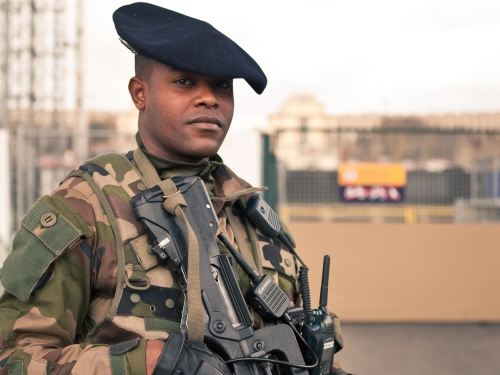
French soldier guarding the Eiffel Tower. Image: DerekKey/Flickr

This article was originally published by European Geostrategy on 26 February, 2015. Republished with permission.

Pairs of Belgian soldiers have been standing guard at the entrance of NATO headquarters and other sensitive locations in Brussels since the Belgian security services successfully raided a terrorist cell in the Belgian city of Verviers on 15 January, just days after the attack on the offices of Charlie Hebdo in Paris. One rather hopes that NATO especially was already somewhat protected before; two foot soldiers will hardly make much difference in any case.

Indeed, why deploy the army in the streets of Brussels at all? What one seems to forget is that no terrorist attack took place. Unlike in May of last year, when a returned French ‘foreign fighter’ murdered four people in the Jewish Museum in Brussels, this time an attack was prevented, thanks to excellent police and intelligence work – and yet now the army was deployed whereas last year it was not. That does not mean that there is no more remaining threat, quite the contrary, but it does more than nuance the causal link between troops in the street and security at home. Khaki in the streets is mostly bad theatre, a feeble attempt to signal resolve in the face of a threat that can never be entirely prevented (although in this particular instance it actually was).

Categories
Regional Stability

Is Old-Fashioned Nationalism Driving a Militarized Gold Rush in East Asian Seas?

Republic of Korea Army 1st Lt. Choi Min Kyu points across the border into North Korea. Image: Seaman Christopher Church/Wikimedia

This article was originally published by the IPI Global Observatory on 25 February 2015.

The security climate of East Asia is changing. Last month, the Japanese Cabinet under Prime Minster Shinzo Abe approved a record defense budget of 4.98 trillion yen (42 billion USD) for fiscal year 2015. This is two percent more than last year and the third consecutive increase after more than a decade of stagnation. As of 2013, the Stockholm International Peace Research Institute (SIPRI) ranked Japan’s military spending as the world’s eighth largest.

With the country still in the economic doldrums, experiencing ballooning public debt and facing sharpening controversy over the government’s attempts at altering the war-renouncing constitution, Abe has justified the increased spending with the need to counter Chinese maritime expansion in the East and South China Seas. His government is also adamant Japan needs a stronger and more active military to contribute to the furthering of international security through “proactive pacifism.”

Categories
Regional Stability

NATO Enlargement: Why a Fourth Round is Long Overdue

Albanian Prime Minister Edi Rama with John Kerry in Wales, September 2014. Image: US Department of State/Wikimedia

This article was originally published by Atlantic-Community.org on February 23, 2015.

Since the late 1990s, the NATO alliance has experienced three distinct phases of enlargement: in March 1999, March 2004 and April 2009. Some security experts have taken a rather cynical view of this process, arguing that NATO’s eastward expansion was a factor in causing the current instabilities in the Ukraine. In fact, this analysis has proven to be very weak as it does not consider the efforts the alliance made to build a real dialogue with Russia over the course of 20 years. These individuals would equally want to be reminded of the so-called ‘dual-track approach’ to NATO enlargement, launched in the 1990s. This meant that any possible enlargement of NATO would have to go hand-in-hand with the formulation of a strategic partnership with the Russian Federation. This was the basis for the 1997 NATO-Russia Founding Act and was a coherent part in the setting up of the NATO-Russia Council in 2002.

“The Response Ulrich Beck Would Have Liked to Hear”

Artistic depiction of New York City. Image: Werner Kunz/Flickr

This article was originally published by the Barcelona Centre for International Affairs (CIDOB) in the 297th Edition of Opinión on 20 January, 2015.

The death of Ulrich Beck leaves us bereft of that always lucid, special perspective found in each of his articles or in the new publication that arrived on just the day that, for the umpteenth time, we were doubting our own theories or missing someone to lend a hand and help us understand the world. For Beck, as a sociologist, what happened in the world was what happened between people and groups, making “globalised patchwork generations” of their hopes and dreams, their fears, disappointments and frustrations.

Categories
CSS Blog

Mediation Perspectives: the Need for a New Syrian Narrative

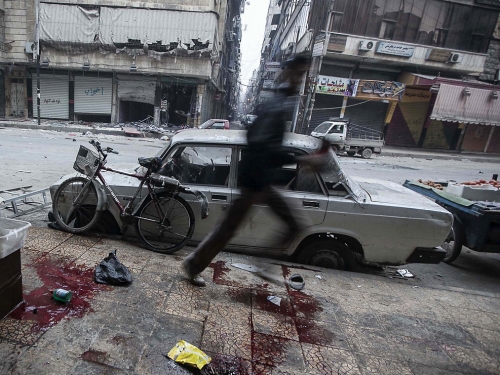
A Syrian man runs for cover during heavy fighting between Free Syrian Army fighters and government forces in Aleppo, on December 3, 2012. Image: Freedom House/Flickr

The conflict in Syria is entering its fifth year, and the Syrian suffering continues. In the last week it was reported that the so-called “Islamic State” (IS) had attacked the Khabur region in the northeast of the country, kidnapped more than two hundred Assyrian Christians, including women and children, destroyed churches and provoked a mass exodus from these communities.

According to the United Nations High Commissioner for Refugees, António Guterres,  the Syrian situation is “the most dramatic humanitarian crisis the world has faced in a very long time.” Syrians are now the largest refugee population under UNHCR’s mandate. Further, more than 6.5 million Syrians are internally displaced persons (IDPs). Together, refugees and IDPs account for 40 per cent of the country’s pre-conflict population, and at least half of that number is children.