
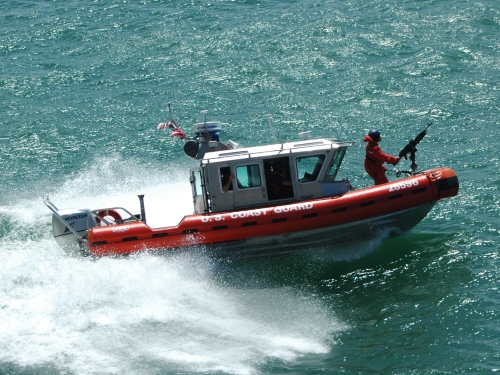
The US Coast Guard’s Western Hemisphere Strategy

US Coast Guard machine gun boat near Puerto Rico. Image: Shannon Okey/Flickr

This article was originally published by E-International Relations on 5 March, 2015.

On September 2014, the United States Coast Guard (USCG) published its Western Hemisphere Strategy (WHS), a document explaining the vision, objectives, priorities, and initiatives that the USCG plans to take in the immediate future, in order to protect the US and support regional partners in the Western Hemisphere, notably in the Greater Caribbean. The WHS is an important document that requires in-depth research, since the USCG is greatly involved in the day-to-day counter-narcotic operations taking place in the Greater Caribbean. In this analysis, we aim to discuss the Western Hemisphere Strategy, primarily focusing on the USCG’s current and future security-related operations. 

The Case for Better Aid to Pakistan: Climate, Health, Demographic Challenges Demand New Approach

Pakistani children play with a toy helicopter at Jabba Farm tent village in Shinkiari, Pakistan, Nov. 21, 2005. Image: US Navy/Wikimedia

This article was originally published on 2 March 2015 by New Security Beat, the blog of the Environmental Change and Security Program (ECSP) at the Wilson Center.

In 2009, the U.S. Congress passed a five-year, $7.5 billion aid package for a country it had all but abandoned just 10 years earlier. Indeed, if one word can summarize the U.S. relationship with Pakistan, “volatile” might be it. Since the September 11 attacks, the U.S. has appropriated nearly $61 billion in aid to Pakistan – more than twice what it received since independence in 1947.

Though some remaining funds may still be disbursed, the latest round of aid came to a close last September amid growing dissatisfaction on both sides. The Department of State billed the 2009 Enhanced Partnership with Pakistan Act (or Kerry-Lugar-Berman Act, also known as KLB) as an “innovative approach” to aid because of its attention to Pakistani priorities, its support of visible infrastructure projects, its focus on areas most susceptible to violent extremism, and its whole-of-government coordination.

As Crisis in Venezuela Deepens, Maduro’s Iron Fist Tightens

Venezuelan protester, symbolically wearing chains. Image: Carlos Díaz/Wikimedia

This article was originally published by The Conversation on 4 March, 2015.

Since the death of Hugo Chávez, Venezuela’s political leadership has moved from charisma to authoritarianism. Support for Chávez’s Bolivarian Revolution has fallen from 65% when the populist leader died to 22% today.

The revolution’s erstwhile steward is Nicolás Maduro, Venezuela’s current president and Chávez’s hand-picked successor. Maduro lacks his mentor’s extraordinary charm and intelligence – and to compensate, he is resorting to the iron fist.

Who is Nicolas Maduro?

As a teenager, Maduro aspired to have his own rock band, and was a fan of Led Zeppelin. In an interview with the Guardian, he referred to himself as a “a little bohemian”. Although he never finished high school, Maduro was able to build a successful political career. A robust man of 6’4″, he spent the 1980s working as a bus driver in the capital’s public transport system, where he founded and led an informal trade union.

The Time Is Right for US-China Nuclear Dialogue

U.S. Secretary of State John Kerry speaks with Chinese Foreign Minister Wang Yi in Beijing, China, on April 13, 2013. Image: U.S Department of State/Wikimedia

This PacNet Commentary was originally published by Pacific Forum CSIS on 4 March 2015.

As part of the so-called ‘new type of major-country relations,’ there has been a proliferation of official dialogues between the United States and China. But, in the area where mistakes or miscalculation could prove the most disastrous – nuclear weapons policy – Beijing has resisted elevating very constructive unofficial Track 2 and Track 1.5 dialogues (involving government and military officials in their private capacities, along with outside scholars and experts) to the official Track 1 level. A meaningful official dialogue on strategic nuclear issues is needed to prevent lingering suspicion and distrust about each other‘s capabilities and intentions from damaging overall US-China relations. This will not happen, however, until Washington accommodates what Beijing perceives to be its legitimate security concerns and clarifies its own objectives, and Beijing realizes that further delay could undermine its long-term interests.

Categories
Regional Stability

Time to Abandon the Greed-Grievance Debate

Police confront rioters during 2012 Rohingya riots in Burma. Image: Hmuu Zaw/Wikimedia

Over the past ten years, the question of whether violent conflicts are the result of genuine grievances or the product of an environment in which rebellion is an attractive and/or viable option has been  at the heart of a fierce theoretical controversy known as the greed versus grievance debate. The debate was sparked when Paul Collier and Anke Hoeffler claimed that rebellion cannot be explained by grievances resulting from ethnic animosities or economic and political inequalities, because situations in which people want to rebel are ubiquitous, whereas the circumstances in which people are able to rebel (weak states, rough terrain, the presence of lootable resources etc.) are sufficiently rare to constitute the explanation.

This claim and its morally charged phrasing in terms of “greed” and “grievance” posed a tough challenge to the dominant view of many political scientists and to conventional wisdom more generally. While many scholars subsequently shifted their attention to studying the opportunities for conflict, others put their efforts into finding better ways to measure people’s grievances. An award-winning book on Inequality, Grievances, and Civil War, published in 2013, testifies to the fact that the jury in this debate is still out.