Categories
CSS Blog

Mediation Perspectives: Reframing the Ukraine Crisis

Poroshenko, Merkel and Putin at the 70th annual D-Day commemoration. Image: www.kremlin.ru/Wikimedia

“They say the next big thing is here,
that the revolution’s near,
but to me it seems quite clear
that it’s all just a little bit of history repeating”

Shirley Bassey ~ “History Repeating”

The board game Risk: The Game of Global Domination is an extreme representation of geopolitical power dynamics. It pits players against each other on a simplified map of the world controlled by soldiers, cannons and cavalry. Although simplified and exaggerated, Risk is a crude model of thousands of years of international history: the rise and fall of empires, shifting balances of power, alliances, betrayals and perhaps the most disturbing factor – that the widespread death and destruction controlled by the ‘players’ is portrayed as a normal and inevitable part of geopolitics.

Categories
Terrorism

Cuba: Not a Terrorist Threat

Revolutionary propaganda of Camilo Cienfuegos. Image: 819043/Pixabay

This article was originally published by the World Policy Institute on 11 March 2015.

This blog is the first in several leading up to the World Policy Institute Board trip to Cuba in May. The trip seeks to re-open a once highly effective dialogue with Cuban leaders. WPI plans to examine the achievements of 55 years of revolutionary society and explore ways to highlight what the U.S. and Cuba can learn from each other.

As the Obama administration and Cuban negotiators examine the 54-year-old unilateral embargo (or “blockade” as the Cubans refer to it), one obstacle—particularly painful for Cubans and extremely important to American interests—must be addressed: Cuba’s continued presence on the U.S. State Department’s list of state sponsors of terrorism.

President Obama directed the State Department to review this designation in December 2014, since Cuba’s removal from that list is entirely justified and long overdue. As a result, when the State Department issues its annual Country Reports on Terrorism on April 30, it is likely to be the first time in 33 years that Cuba is not designated a sponsor.

Lying to Ourselves: The Demise of Military Integrity

Two US Army soldiers during an exercise at Fort McCoy, July 15, 2009. Image: Sgt. 1st Class Mark Bell/Flickr

This article was originally published by War on the Rocks on 10 March 2015.

Leaders lie “in the routine performance of their duties,” and “ethical and moral transgressions [occur] across all levels” of the organization. Leaders have also become “ethically numb,” using “justifications and rationalizations” to overcome any ethical doubts. This “tacit acceptance of dishonesty… [facilitates] hypocrisy” among leaders.

These quotations sound like they are ripped from the headlines about some major corporate scandal. But they’re not describing Enron before its collapse in 2001, or firms like Lehman Brothers and Countrywide before the 2008 financial crisis. Instead, they describe one of the country’s most respected institutions: the U.S. Army.

Foreign Aid and the 28 Percent Myth

The crew of USS Abraham Lincoln (CVN 72) loads boxes of food and water into helicopters during humanitarian aid missions to Aceh, Sumatra, Indonesia. Image: Tyler J. Clements/Wikimedia

This article was originally published by Harvard International Review on 11 March, 2015.

Public opinion on United States foreign aid varies widely depending on who is being asked. However, one domestic opinion on the matter is clear: we spend too much on foreign aid. In a 2013 poll conducted by the Pew Research Center, the majority of Americans wanted to either maintain or increase spending for almost all US government initiatives. Foreign aid was the only exception. Facing a national debt of more than sixteen trillions while news of humanitarian initiatives in foreign nations proliferate, it is not surprising that so many Americans believe the US should be cutting back on foreign aid. However, much of this sentiment is based on an ongoing misconception — the majority of Americans believes the US government spends 28 percent of its federal budget on foreign aid. In reality, foreign aid accounts for only 0.7 percent. Military aid, which is accounted for separately, makes up another 0.5 percent.

Categories
Regional Stability

The Future of the Two Koreas

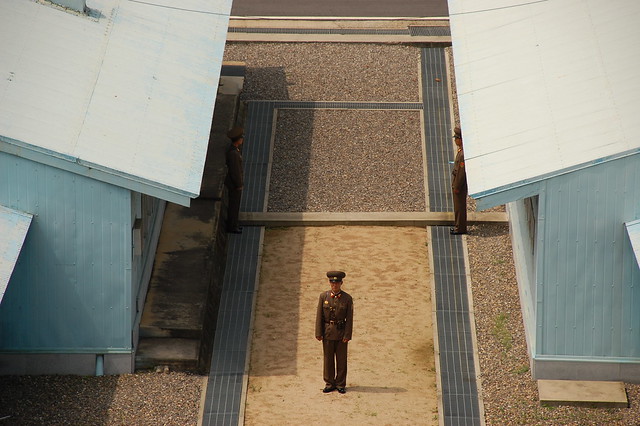
The Demilitarized Zone between North and South Korea. Image: flickr/stephan

What does the future hold for the divided Korean peninsula? How realistic is the prospect of reunification between the prosperous and democratic South and the persistently isolated North? Indeed, how might the end of this ‘frozen’ conflict impact regional and international security? To discuss these and related issues, the Center for Security Studies (CSS) recently hosted an Evening Talk with Dr. Eun-Jeung Lee, who is a Professor of Korean Studies at Freie Universität Berlin, and Nina Belz, who writes on international affairs for the Neue Zürcher Zeitung (NZZ). While Lee focused on the historical and geopolitical aspects of the conflict between the two Koreas, Belz looked at what their neighbors think about the possibility of Korean reunification.