
Categories
Terrorism

Book Review: The Hizbullah Phenomenon: Politics and Communication

The flag of the Lebanese Hizbullah party. Image: Wikimedia

This article was originally published by the LSE Review of Books, hosted by the London School of Economics and Political Science, on 23 March, 2015.

The Hizbullah Phenomenon: Politics and Communication. Lina Khatib, Dina Matar and Atef Alshaer. Oxford University Press. 2014.

In The Hizbullah Phenomenon: Politics and Communication, Lina Khatib, Dinar Matar and Atef Alshaer offer a comprehensive analysis of the group’s sophisticated political communication strategy since its inception in 1982. Although they offer no startling insights into the group’s socio-political aims and approaches within Lebanon or its relations with foreign powers, their contribution lies in their detailed analysis of how Hizbullah has continuously sought to legitimise and market itself to domestic and foreign audiences. This is a highly valuable contribution that sheds much needed light on a key causal dimension in the movement’s endurance.
Categories
Business and Finance

China’s Domino Tactics Boost Infrastructure Bank

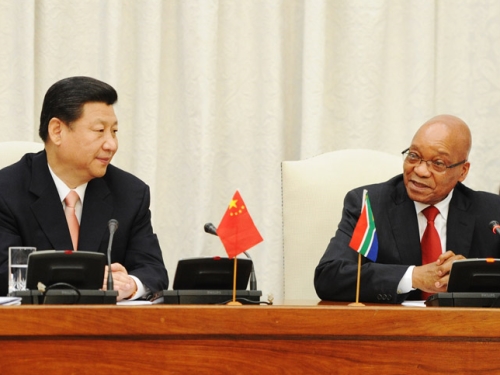
President Jacob Zuma receiving the President of the People’s Republic of China, Xi Jinping in Pretoria in March of 2013. Image: GovernmentZA/Flickr

This article was originally published by the CIPS Blog, hosted by the Centre for International Policy Studies on 22 March 2015.

China is looking ever the experienced super-power. In a week it has scooped up all the important European dominos, humiliating a U.S. government which has lobbied hard to block the launch of China’s new $50b Asian Infrastructure Investment Bank (AIIB).

The dominos have fallen quickly. Last week it was the UK’s turn to join, preferring its commercial interest and geo-political judgment over its friendship with the U.S. Now it is a coordinated set of EU announcements from France, Germany and Italy. The driver was their desire to be well-connected economic partners in Asia, but there was also an element of blowback on U.S. geo-political arrogance, be it spying on Angela Merkel or military jingoism towards Russia.

Sick Defense: How to Foster an Affordable, Innovative Defense Industrial Base

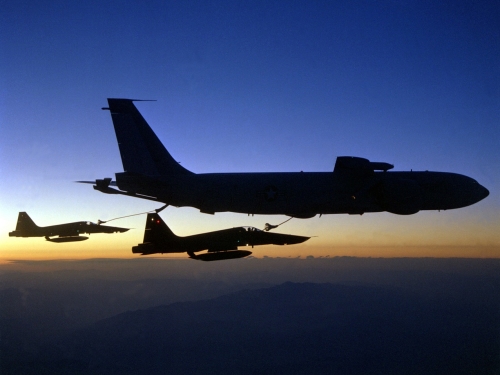
Two fighter jets refueling while in the air. Image: Defence-Imagery/Pixabay.

This article was originally published by War on the Rocks on 19 March, 2015.

The U.S. defense industrial base provides America and its allies with the capabilities to deter, engage, and defeat adversaries decisively. This “arsenal for democracy” must be a source of technological advantage at a price tag the taxpayers can afford. A healthy U.S. defense enterprise has proven a decisive lever in America’s success in past conflicts and a critical tool to maintaining the peace. Yet the relative strength and vitality of our industrial base is at risk. The Department of Defense (DoD) has reacted with alarm at flagging research and development (R&D) across industry. This has motivated U.S. defense officials to increasingly reach out to commercial technology providers for solutions. However, as their recent visit to Silicon Valley demonstrated, not everyone is chomping at the bit to work with the Pentagon.

What Are the Ethical Implications of Emerging Tech?

Hal 9000, the intelligent computer of Stanley Kubrick’s 2001: A Space Odyssey. Image: OpenClips/Pixabay

This article was originally published by Agenda, a blog operated by the World Economic Forum, on 4 March, 2015.

In the past four decades, technology has fundamentally altered our lives: from the way we work, to how we communicate, to how we fight wars. These technologies have not been without controversy, and many have sparked intense debates, often polarized or embroiled in scientific ambiguities or dishonest demagoguery.

The debate on stem cells and embryo research, for example, has become a hot-button political issue, involving scientists, policy-makers, politicians and religious groups. Similarly, the discussions on genetically modified organisms (GMOs) have mobilized civil society, scientists and policy-makers in a wide debate on ethics and safety. The developments in genome-editing technologies are just one example that bio research and its impact on market goods are strongly dependent on social acceptance and cannot escape public debates of regulation and ethics. Moreover, requests for transparency are increasingly central to these debates, as shown by movements like Right to Know, which has repeatedly demanded the labelling of GMOs on food products.

Everyday Life after Annexation: The Autonomous Republic of Crimea

Signing of the treaty on the adoption of the Republic of Crimea and Sevastopol to Russia. Left to right: S. Aksyonov, V. Konstantinov, V. Putin and A. Chalyi. Image: Kremlin.ru/Wikimedia

This article was originally published as part of the ‘Ukraine and Russia’ Collection by E-International Relations on 20 March, 2015.

Imagine for a moment that tanks roll into your state. Armed and masked men without military insignia occupy your city streets. The airport is closed. Then, after a hasty vote, a new leader, someone you understood was part of the criminal underworld, is promoted to the top executive position. Suddenly, you must turn your clocks back two full hours to correspond with the new capital, some 1,400 kilometres away. Your ATM card stops working, and then your bank closes. Familiar foods, foods you have been eating your entire life, are banned and disappear from grocery store shelves to be replaced with foreign ones. Your medication becomes six times more expensive than before. Then your cell phone stops working, and you must find a new carrier to regain service. The television station you relied on for nightly news closes. You are told you have three months to turn in your passport for a new one, or you may not be able to renew your driver’s license or return to your home after travel. This chaotic and liminal situation is not, of course, hypothetical. It is what happened to residents of Crimea following annexation by the Russian Federation.