On Friday, the 14th of October, the State Department announced that the US was sending 100 military advisers to Uganda. Their purpose: to help African troops pursue the Lord’s Resistance Army (LRA) and its leader, Joseph Kony, whom the ICC accuses of 21 counts of war crimes and 12 counts of crimes against humanity. The deployment follows the unanimous passage and signing into law last year of legislation which makes it American policy to kill or capture Joseph Kony and defeat his army.
It's week 42 of the ISN's 2011 editorial coverage, Photo: Eva the Weaver/flickr
We’ll highlight the following:
In ISN Insightson Monday, Dr Harsh Pant from the Department of Defense Studies at King’s College London comments on India’s faltering counterterrorism policy
We’re featuring another ‘keyword in focus’ on Tuesday
In Wednesday’s ISN Insight, Denis Burke of The Broker magazine analyzes the path to political succession in Tibet
We’ll feature an upcoming event being held by our partner, the Overseas Development Institute on Thursday
In Friday’s ISN podcast, Drs. Oya Dursun-Oksanca and Odysseus Cristou will discuss political perspectives on Cyprus
AR-15 lower receiver and ‘print file’. Images: Wikimedia Commons, Thingiverse
3-D printing, while unknown to most of the public, has been around for quite a while. Its industrial applications range from rapid prototyping and archaeological reconstructions to medical uses in implant technology and custom-fitted hearing aids. Now, the technology is becoming affordable for the average consumer: while an industrial-strength 3-D printer that can use materials like bronze-infused steel, or even titanium, still costs more than $10,000, desktop machines for printing hard plastics are being sold in kits available for little over $1000.
A statue of Thucydides in Vienna. Photo: ChrisJL/flickr
The first important contributor to ‘international’ thought is usually considered to be Thucydides. Though Herodotus is the “father of history” and it was Socrates that first brought philosophy ‘down from the heavens’ and into the agora, Thucydides was the first to deal with the relations among and between political communities in a theoretical manner.
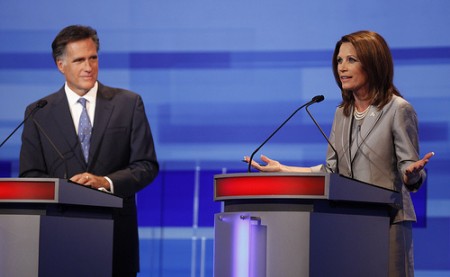
The next American presidential election is only 13 months away, and the campaign season is getting close to full-swing. Last night in Hanover, New Hampshire, the candidates for the Republican nomination met for what is already their seventh debate, and there are signs, in his energetic push for the Jobs Bill, that ‘campaign Obama’ may be about to emerge from his presidential shell. At this stage, all eyes are understandably focused on the economy, as it is widely believed that the election will be decided by what happens with unemployment. In September, the economy created 103,000 non-farm jobs, edging the official rate up to 9.1 percent. Looming ever more ominously on the horizon, however, is the much bigger problem of the national debt. At last count, total outstanding public debt is now at 99 pct of GDP, the highest level since the heyday of the Marshall Plan.
As James Traub, for Foreign Policy, has pointed out, this focus on economic matters has meant less direct attention to foreign affairs, particularly by the Republican candidates.