The CIA Battled the Kremlin With Books and Movies

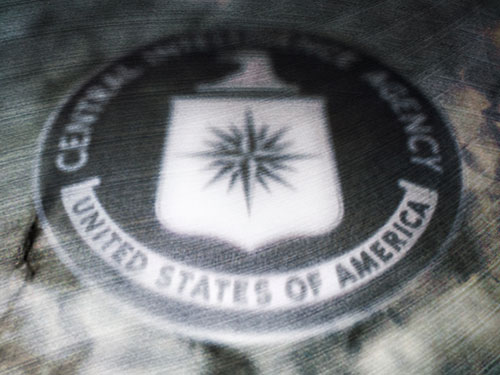
Seal of the Central Intelligence Agency. Image: Truthout.org/Flickr

This article was originally published by War is Boring on 2 May, 2015.

During the Cold War, Moscow’s Ministry of Culture was a master of censorship. The Kremlin’s cultural bulwark screened non-Russian films, suppressed literature and shaped the lives of Soviet artists.

The U.S. Central Intelligence Agency also dabbled in the dark arts of cultural influence. Except it preferred the carrot to the stick.

Words matter. A society’s books and movies impact the world. Books, in particular were often internationally influential during the Cold War. Both the ministry and the agency understood this.

The CIA funded the production and distribution of individual literary projects. It made sure Russian-language copies of Boris Pasternak’s Doctor Zhivago flooded into the Soviet Union. Further, the agency directed more comprehensive operations.

Kim Jong Un’s Popularity, Explained

Sketched portrait of Kim Jong Un,leader of North Korea. Image: Monico Chavez/Wikimedia

This article was originally published by NK News on 27 September, 2015. Republished with permission.

A survey of North Korean refugees attracted some attention several weeks ago. According to the survey, a full 63 percent of recently arrived refugees believed that Kim Jong Un enjoys support amongst a majority of the North Korean public.

Such findings are not all that surprising for people who interact with North Koreans frequently enough. Indeed, while the protruding belly, plump cheeks and rather bizarre haircut present a somewhat comical picture to Western audiences, a significant number of North Koreans feel much hope about the third incarnation of Kimhood, finding the young leader attractive and somewhat charismatic.

Where does Oman and Iran’s Pipeline leave Saudi Arabia?

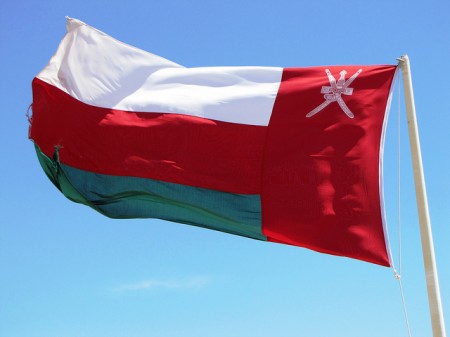
Flag of Oman. Source: Flickr Groundhopping Merseburg

This article was originally published by Gulf State Analytics on 24 September, 2015.

Recent reports suggest that officials in the Sultanate of Oman and the Islamic Republic of Iran have given the go-ahead for the rumored 173-mile underwater gas pipeline connecting the two nations. As of March 2013, only an “understanding” had been reached. The new reports raise clear implications for the wider Gulf region, particularly Saudi Arabia.

For decades, and especially since the “Arab Spring” uprisings several years ago, Saudi Arabia has attempted to bind its smaller Gulf neighbors in a tight bloc to counter perceived Iranian aggression. On numerous occasions, Riyadh has provided military and economic support for its fellow Gulf Cooperation Council (GCC) states. The Saudis have also pushed for the establishment of a Gulf union comprising the Council’s six member states. The kingdom’s objective has been to further bind the GCC together in a united political and economic front vis-à-vis Iran.

Striking the Right Balance: Truth at the Heart of Transitional Justice in Colombia

Flag of the “Fuerzas Armadas Revolucionarias de Colombia” (FARC). Image: MrPenguin20/Wikimedia

This article was originally published by Justice in Conflict on 25 September, 2015. Republished with permission.

It wasn’t long ago that the peace process between the FARC and the Colombian government seemed stuck. Little if any progress was being made and the biggest barrier to a final accord – agreeing on how to achieve justice and accountability for past atrocities – was proving impossible to overcome. However, in the last few weeks all of the parties agreed to a plan to achieve transitional justice. It was undoubtedly a remarkable development. But did Colombia and the FARC strike the right balance between peace and justice?

When I was interviewing the FARC on the peace negotiations in Havana earlier this year, the atmosphere was tense. The FARC, the rebel faction fighting the Colombian government since the early 1960s, responded to renewed military offensive by suspending their unilateral ceasefire. At that moment, reaching an agreement seemed like a distant prospect, despite the fact that the parties had already been negotiating for three years. Energy and stamina were at their lowest point and those closely involved in the negotiations confided that discussions had been at an impasse for over a year on the issue of justice. After having reached substantive agreements on the three previous agenda points (land reform, political participation, and the illegal drug trade), the talks had stalled on the age-old dilemma of peace versus justice.

Categories
Terrorism

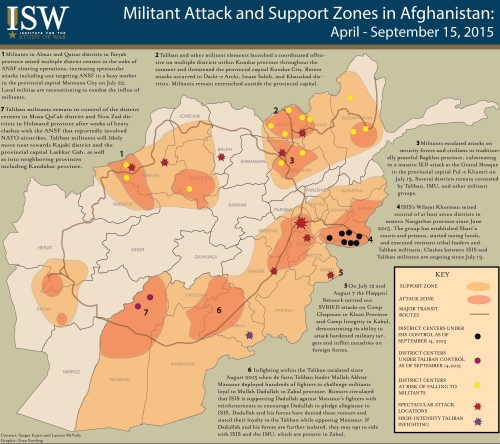
Militant Attack and Support Zones in Afghanistan: April – September 2015 (Institute for the Study of War)

Attack and support zones of ISIS, Taliban and other militants in Afghanistan (click for detailed view). Map: Evan Sterling/Institute for the Study of War

This report was originally published by the Institute for the Study of War on 7 August, 2015.

Taliban elements and other militant groups are conducting operations across Afghanistan, including spectacular attacks against major population centers and U.S. bases. The Haqqa­ni Network, a Taliban aligned-group, continues to pressure the ANSF and NATO forces with spectacular attacks in Kabul and Khost. Taliban elements are also conducting numerous ground assaults to seize district centers, especially in northern and southern Afghanistan. These campaigns comprised the 2015 warm weather from April 2015- September 2015. There have been several notable developments following the announcement of the death of Mullah Omar onJuly 29. First, Taliban militants have claimed control of two district cen­ters in Helmand on August II and August 26. Second, ISIS’s Wilayat Khorasan have claimed control of seven district centers in Nangarhar over the course of July and September. Third, Taliban infighting has escalated as different factions compete and express varying positions on who should lead the Taliban movement.