

Why is Russia Favored by Mongolia and North Korea?

Border between Russia and Mongolia. Photo: Geoff Sowrey/flickr

Russia is favored by Mongolia and North Korea just as the United States is welcomed by some of its Southeast Asian partners. At the same time, Mongolia and especially North Korea provide opportunities for Russia to raise its stakes in Northeast Asian matters.

Despite the collapse of the Soviet Union and relative inattention by the Kremlin in the 1990s, Ulaanbaatar and Pyongyang never abandoned their attempts to renew ties with Russia. High-ranking political and military officials constantly made calls to advance political, military, economic, and cultural ties with Moscow. Positive responses came after a decade, under Russian President Putin. Putin’s visit to the DPRK and Mongolia in 2000 demonstrated the Kremlin’s new emphasis on two its former allies, whose industrial facilities and enterprises were built with Soviet assistance and technology. Their treaties of mutual assistance with Russia were replaced by treaties of good neighborliness in 1993 (Mongolia) and 2001 (North Korea). And the $11 billion debts incurred during the Soviet era, were resolved favorably for Mongolians in 2003 and North Koreans in 2012. As a result, Russia seems to have secured its stake in key infrastructure development projects. In North Korea, Russia will invest in the trans-Korean railway, a gas pipeline, special economic zones, and education. Russia will invest in the trans-Mongolian railway, its extension, and the mining of uranium and aluminum in Mongolia. Economic cooperation with Mongolia and North Korea will play an important role in Putin’s agenda to develop Russia’s long-neglected Far East and Siberia and to secure Chinese and East Asian markets for its mineral exports.
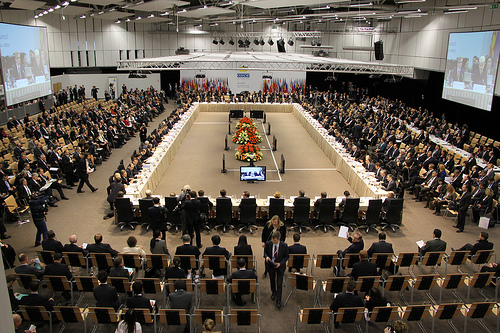

The OSCE and Conventional Arms Control in Europe: Towards a Double Relaunch

OSCE Ministerial Council meeting opening in Vilnius, 2011


Much has been written about the OSCE’s crisis. Much of it is true. Still, the future of this organization may be less grim than many predict. Current developments in Europe suggest that the role and relevance of the OSCE may actually grow in the years ahead.

For one thing, following the ambivalent outcome of military operations in Iraq and Afghanistan, there is a conspicuous intervention fatigue among European publics. The ‘crisis’ of military crisis management is bound to exacerbate as the European debt crisis translates into shrinking defense budgets. There will likely be a shift towards more subtle, civilian, long-term approaches to conflict resolution and peacebuilding – the type of measures the OSCE has focused on.

Looking at the EU and NATO, there is also growing enlargement fatigue. This points to obvious limits to how far stability in Europe can be accomplished by expanding the Euro-Atlantic security community. By implication, the pan-European OSCE, with twice as many member states as the EU and NATO, is bound to gain traction again.

The Obama Doctrine’s First Term

Obama
US President Obama. Photo: rob.rudloff/flickr.

ASPEN – Public-opinion polls in the United States indicate a close presidential election in November. While President Barack Obama outpolls the Republican challenger, Mitt Romney, on foreign policy, slow economic growth and high unemployment – issues that are far more salient in US elections – favor Romney. And, even on foreign policy, Obama’s critics complain that he has failed to implement the transformational initiatives that he promised four years ago. Are they right?

Obama came to power when both the US and the world economy were in the midst of the worst financial crisis since the Great Depression. Indeed, some of Obama’s economic advisers counseled him that unless urgent steps were taken to stimulate the economy, there was a one-in-three chance of entering a full-scale depression.

The NATO Global Hub

NATO headquarters
NATO headquarters. Photo: Utenriksdept/flickr.

WASHINGTON, DC – What should an alliance do when its leading member and dominant pillar decides to shift its focus to the other side of the world? NATO leaders have been grappling with this question since US President Barack Obama’s announcement of his administration’s “pivot” to Asia last year compelled them to examine the Alliance’s global role.

NATO leaders have examined their approach to managing relations with countries, such as China and Russia, that still view NATO as a potential threat rather than as a genuine partner. And they have had to consider whether to engage in more missions beyond the North Atlantic, like that in Afghanistan, where 22 countries – including El Salvador, Malaysia, Mongolia, Singapore, and Tonga – have deployed forces under the NATO-led International Security Assistance Force.

The Media Cold War

Internet cafe in Taipei
Internet cafe in Taipei. Photo: jared/flickr.

PRINCETON – An information war has erupted around the world. The battle lines are drawn between those governments that regard the free flow of information, and the ability to access it, as a matter of fundamental human rights, and those that regard official control of information as a fundamental sovereign prerogative. The contest is being waged institutionally in organizations like the International Telecommunications Union (ITU) and daily in countries like Syria.

The sociologist Philip N. Howard recently used the term “new cold war” to describe “battles between broadcast media outlets and social-media upstarts, which have very different approaches to news production, ownership, and censorship.” Because broadcasting requires significant funding, it is more centralized – and thus much more susceptible to state control. Social media, by contrast, transforms anyone with a mobile phone into a potential roving monitor of government deeds or misdeeds, and are hard to shut down without shutting down the entire Internet. Surveying struggles between broadcast and social media in Russia, Syria, and Saudi Arabia, Howard concludes that, notwithstanding their different media cultures, all three governments strongly back state-controlled broadcasting.

These intra-media struggles are interesting and important. The way that information circulates does reflect, as Howard argues, a conception of how a society/polity should be organized.