
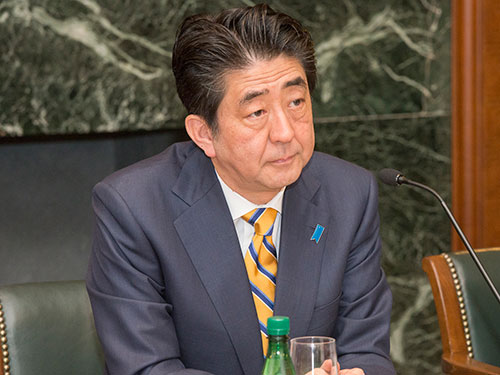
How Abe is Losing the Narrative on Japan’s New Security Laws

The Prime Minster of Japan, Shinzo Abe. Image: vrchase/Flickr

This article was originally published by the East Asia Forum on 9 October, 2015.

Japan’s new security laws, which were passed on 19 September and allow for limited forms of collective self-defence, have been described as a ‘move away from pacifism’, the opening of a ‘Pandora’s box’ and the ‘unsheathing of a new Japanese sword’. But considering the bill’s extreme limitations and significant domestic constraints — including a greying and shrinking population, mounting domestic debt and deeply embedded pacifist norms — one wonders how and why this narrative has taken root so deeply.

Got Landpower?

Marines from Headquarters & Service Company, 3rd Battalion 3rd Marines, conducting a dawn patrol in Nawa District, Afghanistan. Image: Sgt. Mark Fayloga/Wikimedia

This article was originally published by War on the Rocks on 6 October, 2015.

The armies of the Islamic State running roughshod over government forces in Iraq and Syria. Russian little green men infiltrating eastern Ukraine following the military annexation of Crimea. Houthi rebels overthrowing the Yemeni government and seizing large swaths of the country. Taliban fighters seizing an Afghan provincial capital and carving out ever-larger strips of the countryside. Groups inspired by Al Qaeda and the Islamic State attacking government forces in the Sinai, Libya, West Africa and Pakistan.

AirSea Battle seems so yesterday.

The Rise of Diyanet: the Politicization of Turkey’s Directorate of Religious Affairs

Official logo of Diyanet, the Turkish Directorate for Religious Affairs. Image: Mark Morgan/Flickr

This article was originally published in the Turkey Analyst, a publication of the Central Asia-Caucasus Institute and Silk Road Studies Program Center on 9 October, 2015.

BACKGROUND: Whether in Ottoman times or in the Republican era, the Turkish state has made control of religious affairs a priority. In Ottoman times, this function was fulfilled by the Ulema under the leadership of the Sheikh ul-Islam, himself appointed by the Sultan. Following the creation of the Republic, the Diyanet Işleri Başkanlığı, or Directorate for Religious Affairs, fulfilled this role. Diyanet was created in order to maintain control over the religious sphere of Islam. All imams in every mosque across Turkey were appointed by Diyanet, which wrote their Friday sermons. Diyanet was a key institution of the Republic: it helped legitimize the modernization and westernization of Turkey from a religious perspective, and prevented the mosque from becoming a central focus point for reactionary activity. In this, it largely succeeded; and it is no coincidence that it is considered among the three key institutions of the republican era, together with the Army and the Ministry of Education.

Categories
Regional Stability

Rethinking Secession: Why Spain and Catalonia Should Not Take Stability for Granted

Secessionist statement on a mural in Vilassar de Mar, Catalonia. Image: 1997/Wikimedia

This article was originally published by LSE EUROPP, a blog hosted by the London School of Economics and Political Science, on 2 October, 2015.

Catalonia’s independence movement secured a majority of seats in the regional parliament on 27 September, but fell short of winning an outright majority of the vote. The result strengthened the case for a referendum, which Madrid has for long rejected, but weakened the case for independence: after years of campaigning and mobilising Catalans, the pro-independence camp is still unable to secure half the regional vote.

The path to independence will remain a long, contentious and indeed controversial one. But what lessons can Spain draw from other secessionist movements around the world? The primary lesson is that secession, whether it takes place in Europe, the Middle East or Africa, in industrialised democratic countries or war-torn developing countries, tends to bring more problems than it solves.

Categories
Humanitarian Issues

Making Peace in a Divided World: New Roles for the United Nations?

President Obama chairing a session in the UN Security Council. Image: The White House/Wikimedia

This article was originally published by the Centre for International Policy Studies (CIPS) on 1 October, 2015.

There is no more annoying phrase in discussions of international affairs than “If the United Nations did not exist, we would have to invent it!” It is certainly true that the world urgently needs an effective collective security organization today. But the organization it needs bears only a passing resemblance to the UN we currently have.

A genuinely “fit for purpose” UN would have the tools to manage three dangerous trends in international conflict. The first is the resurgence of major power competition in trouble spots such as the eastern Ukraine, South China Sea and Syria. The second is the proliferation of transnational violent extremism in the Middle East and North Africa. The third is the problem of chronic instability in fragile states and regions such as the two Sudans.