Categories
Humanitarian Issues

What Are ‘Hotspots’? The Inevitable Rise of Detention in the Quest for Asylum Solutions in the EU

Migrants in Hungary near the Serbian border, August 2015. Image: Gémes Sándor/SzomSzed/Wikimedia

This article was originally published by the Centre for International Policy Studies (CIPS) on 16 October, 2015.

The Syrian refugee crisis has finally grabbed the world’s attention and is testing the sustainability of the European Union and its common asylum adjudication procedures. Policymakers are struggling to find solutions from under a complex latticework of administering and securitizing refugee and immigration admissions policy.

This struggle is amplified by the revelation that the influx may represent only the tip of a much larger cohort. As president of the European Council Donald Tusk predicted at a recent EU leaders summit: ‘The greatest tide of refugees and migrants is yet to come.’ These future asylum seekers are not only from Syria but also from Iraq, Afghanistan, and other impoverished, violent, and at-war states.
Categories
CSS Blog

Mediation Perspectives: Building Consensus on Security Sector Transformation in Zimbabwe

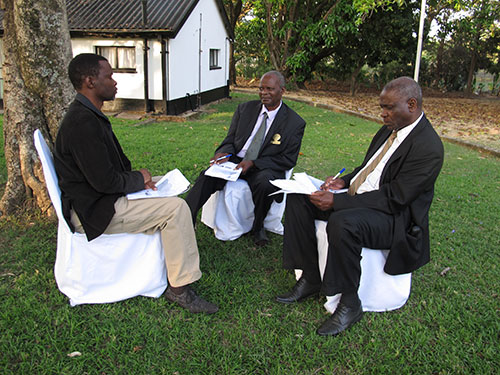
Traditional leaders in Zimbabwe preparing a mediation role play exercise. Image: Valerie Sticher/Center for Security Studies (CSS), ETH Zürich.

This article was originally published in the Bulletin on Swiss Security Policy, a publication of the Center for Security Studies (CSS) at ETH Zurich, on 27 October, 2015.

After years of estrangement, Zimbabwe and the West have slowly started to re-engage with each other. The popular approval of a new constitution in 2013 – which introduced significant civil rights – and the subsequent peaceful elections provided the impetus for the thawing of relations. This included the easing of European Union (EU) restrictive measures imposed in 2002 following Zimbabwe’s controversial land reforms.

But that’s not to say that the country’s myriad challenges have been resolved once and for all. The unresolved succession of 91-year-old President Robert Mugabe, who has ruled Zimbabwe since independence in 1980, continues to paralyze the country’s politics and economy. High levels of unemployment and empty state coffers make economic survival most Zimbabweans’ main concern. Finally, there’s a growing need to undertake a series of far-reaching institutional reforms, particularly when it comes to Zimbabwe’s security sector. But how do you tackle such an undertaking in a country where there is a lack of political will and capacity for such sensitive reforms?

Categories
Humanitarian Issues Terrorism

‘Ungoverned Space’: the Concept that Puts Humanitarian Aid in the Firing Line of the War on Terror

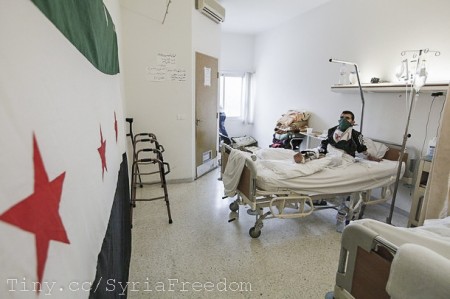
Syrian Hospital. Source: Syrian Hospital, courtesy of Freedom House

This article was originally published by The Conversation on 16 October, 2015.

The hospital bombed by US troops in Kunduz, Afghanistan, treated trauma patients, no matter whether they were civilians or Taliban fighters. The bombing happened as Afghan and US forces fought to drive Taliban out of the city the latter had captured just days before.

If the targeting of the hospital, which killed at least 22 people, had been an accident, it would leave no doubt about the return of war to the urban centres of Afghanistan. But knowledge of the hospital’s GPS coordinates by the US and Afghan armies and the precision of the attack suggest otherwise.

Both Afghan and US officials at one point in the aftermath suggested that they were targeting Taliban fighters on the hospital’s grounds, something that Médecins Sans Frontières‎, which runs the hospital, denies was the case. If the attack was in fact intentional, how can we make sense of such a breach of the Geneva conventions that forbid attacking humanitarian structures?

The CIA Battled the Kremlin With Books and Movies

Seal of the Central Intelligence Agency. Image: Truthout.org/Flickr

This article was originally published by War is Boring on 2 May, 2015.

During the Cold War, Moscow’s Ministry of Culture was a master of censorship. The Kremlin’s cultural bulwark screened non-Russian films, suppressed literature and shaped the lives of Soviet artists.

The U.S. Central Intelligence Agency also dabbled in the dark arts of cultural influence. Except it preferred the carrot to the stick.

Words matter. A society’s books and movies impact the world. Books, in particular were often internationally influential during the Cold War. Both the ministry and the agency understood this.

The CIA funded the production and distribution of individual literary projects. It made sure Russian-language copies of Boris Pasternak’s Doctor Zhivago flooded into the Soviet Union. Further, the agency directed more comprehensive operations.

Categories
Business and Finance Regional Stability

Illegal Fishing in the Shadow of Piracy

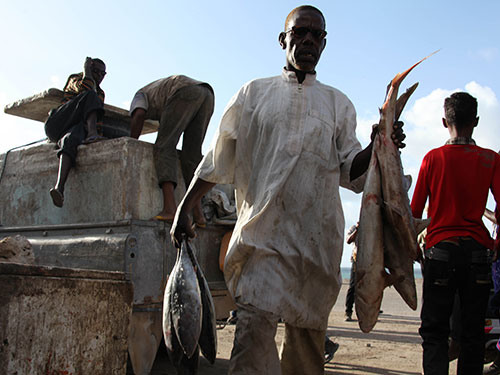
A Somali fisherman carries fish from a car in Hamar Weyn distrct’s fish market. Mogadishu, Somalia. Image: AMISOM Public Information/Flickr

This article was originally published by the World Policy Blog on 6 October, 2015.

Extensive illegal fishing by foreign vessels in Somali waters threatens economic development in the Horn of Africa. Somali fishermen are unable to compete because the foreign fishers are better equipped and better skilled. Some Somalis believe that the only way to protect their resources and make a living is by committing piracy.

Piracy slowly grew from unorganized vigilante “coast guards” in the 1990s to transnational organized crime networks, wreaking havoc on the global shipping industry, in the early to mid-2000s. It reached its peak in 2011, when more than 28 vessels were hijacked in the waters off the Horn of Africa. Maritime crime has declined intensively over the past few years, as international naval patrols and armed guards on ships have increased. However, a recent report by Secure Fisheries, warns that those advances could be reversed if illegal fishing is not stopped.