Categories
Regional Stability

Chinese Government Caught Flat-footed by Separatist Attack

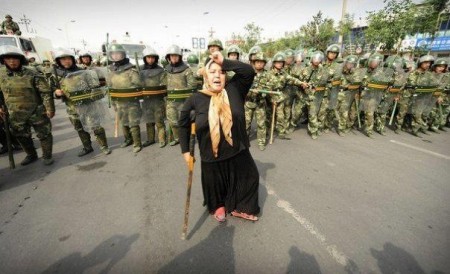
Uyghur woman and Chinese military personnel.

In the aftermath of the 2009 Han–Uyghur riots in Urumqi, the Chinese government made a number of changes to its policies in Xinjiang, including transferring out the region’s unpopular party chief. Since the arrival of President Xi Jinping, monitoring of Uyghurs in Xinjiang has intensified too.

But while a number of violent incidents were reported in Xinjiang in 2013, it is almost impossible to tell whether Uyghur-related violence is increasing in China. It is unclear whether the reporting of more incidents than in the past is due to actual increases in violence or simply new government media directives. The reports themselves are often uninformative. However, recent events, including the knife attack at Kunming, suggest that the Chinese government’s policies to counter Uyghur unrest are having unforeseen consequences well outside of Xinjiang. And the government is likely increasingly concerned that its post-2009 measures have been unsuccessful, given reported changes in policy toward Xinjiang.
Latin America Governed by Crime

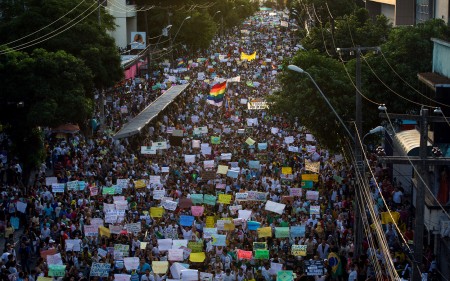
The ‘Tropical Spring’ protest against corruption in Recife, Brazil.

Yet another scandal flooded the pages of newspapers in Ecuador in 2012 and 2013: the former governor of Manabí, César Fernandez, was caught trying to smuggle drugs – and not for the first time. Fernandez had only just been released from prison following a 2003 conviction on the same charges: that time using his connections in the port of Manta, nearby a US military base, to transport drugs for the Sinaloa and Cali cartels.

This is not a one off case, nor is it exclusive to Ecuador. The nexus between illicit networks and politics is a major threat to the integrity and effectiveness of democracy today, and many countries in Latin America are struggling against it. In Colombia, the murky relationship between Members of Congress and organized crime are well known at home and abroad. The parapolítica scandal shook politics at every level, and continues to do so.

Categories
Regional Stability

Russia-Ukraine Crisis Alarms Central Asian Strongmen

Euromaidan Kiev 2014-02-18. Image: Wikipedia.

This article was originally published by EurasiaNet.org on 4 March 2014.

The Russia-Ukraine crisis is having a profoundly unsettling effect on authoritarian-minded governments in Central Asia. On the one hand, they are keen to keep the forces unleashed by the Euromaidan movement at bay; on the other, they appear unnerved by the Kremlin’s power play.

State-controlled media outlets in Central Asian states are reticent when it comes to covering developments in Kyiv, Crimea and elsewhere in Ukraine. The parallels between the ousted and allegedly corrupt president of Ukraine, Viktor Yanukovych, and leading members of Central Asian elites are obvious to many in the region, so it’s not surprising that the Euromaidan Revolution has received little play in Central Asia’s press.

Categories
Regional Stability

China, India and the Three Cs

Image: www.uberoffices.com

World attention is presently focused on the display of force between China on the one hand, and Japan and the United States on the other hand, played out via a conflict over a couple of small islands in the East China Sea. But China’s maritime activities might also bring it into conflict with India. However, if China and India can transform their fragile and unstable relationship into something more cooperative, this could have an enormous positive impact on the two countries—and on global politics.

Categories
Terrorism

Saudi Arabia, Syria and Bin Laden’s Ghost

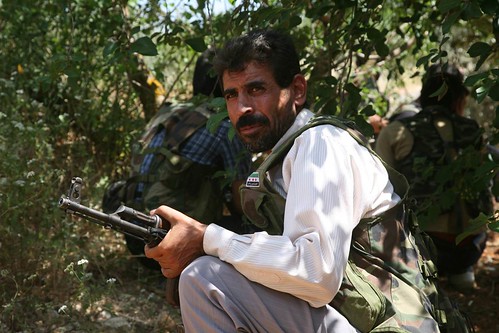
Rebels from the Justice Brigade

This article was originally published by the Middle East Institute on 14 February 2014.

Osama bin Laden may be dead, but his ghost was in Riyadh the other day, hovering over Saudi Arabia’s King Abdullah as he issued a decree making it a crime for any Saudi citizen to take part in a war outside the kingdom.

The obvious motivator was the civil war in Syria, where hundreds of young Saudis have been spotted in the ranks of the most radical jihadi groups battling both the government and other less extreme rebels. But the roots of the king’s action, and the problem it was designed to address, can be traced to the 1980s war against the Soviet occupation of Afghanistan.