
Categories
Terrorism

What’s Eating Turkey? Ankara and the Islamic State

Protesters expressing their solidarity with the victims of the Suruc terror attack. Image: Voice Of America/Wikimedia

This article was originally published by War on the Rocks on 30 July, 2015.

On July 20, Turkey suffered one of its deadliest suicide bombing attacks in recent memory, which claimed more than 30 lives. While the Islamic State of Iraq and the Levant (ISIL) has not yet claimed responsibility, all signs point toward them as the culprits. The location, timing, and the identity of the victims were just too specific to think otherwise.

The setting of this grisly attack was the town of Suruc, the pathway to the Syrian town of Kobane, where ISIL lost a long and bloody battle to the YPG (People’s Protection Units), which enjoyed American air support. The timing was also distinctive. The suicide attack took place the day after Syrian Kurds and their sympathizers in Turkey celebrated the third anniversary of the “Rojava [Western Kurdistan] Revolution” of 2012,when the PYD (Democratic Unity Party) formally declared its intention to govern and defend Kurdish-populated areas in Syria in the wake of the withdrawal of Syrian President Bashar al-Assad’s forces from these enclaves.

The Trouble with Japan’s New Security Bills

Flag Emblem on a Japanese Military Uniform. Image: Koalorka/Wikimedia

This article was originally published by the East Asia Forum on 3 August, 2015.

The debate over Japan’s new security bills, which seek to overhaul post-war defence policies, has shifted to the upper house and the streets, as Prime Minister Shinzo Abe presses on to secure their passage into legislation. On 16 July the lower house passed the package of bills in a vote that was boycotted by opposition parties as tens of thousands protested outside the Diet.

Abe has extended the parliamentary sitting by three months to secure the outcome before he faces re-election to the presidency of the Liberal Democratic Party (LDP) and therefore the prime ministership. He rammed the bills through the lower house in the knowledge that, even should the House of Councillors reject them, ultimate passage of the bills would be secured after a 60 day reconsideration and re-passage with a two-thirds majority through the House of Representatives. So, with enactment of the unpopular proposals almost guaranteed even if all of the opposition parties band together to block them in the upper house, why is the Abe government in trouble over the issue?

Categories
Regional Stability

The Breakdown of the Kachin Ceasefire and its Implications for Peace in Myanmar

Kachin rebels
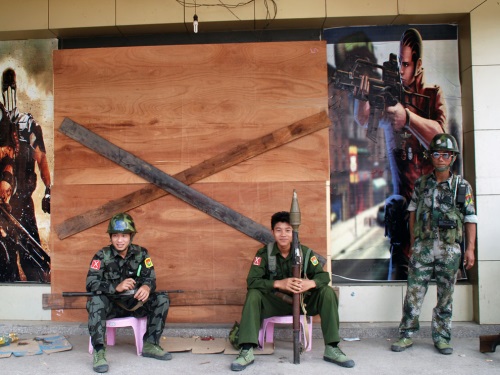
Kachin rebels in front of a gaming shop that closed after fighting broke out again. Source: David Brenner.

Hopes were once high that Myanmar’s transition to semi-civilian government in 2011 would be accompanied by the settlement of its decades-old conflicts with its ethnic minorities. However, many of the country’s insurgencies have escalated since then, plunging the north back into renewed civil conflict. As things currently stand, government forces are battling various ethnic armed groups – including Kachin, Kokang, and Palaung movements – resulting in heavy losses on both sides and the displacement of up to 200,000 civilians in Shan and Kachin States.

Russia and the Crisis in Ukraine: Implications for European Security

Bullets between Ukraine and Europe. Image: Torange.de.com

To some observers, the ongoing crisis in Ukraine symbolizes the gradual erosion of Europe’s security architecture, as established by the Paris Charter, and the emergence of a new Cold War between Russia and the West. But are these pessimistic assumptions about the current state of East-West relations and Europe’s security actually justified? And if they are, then how can the West improve its ties with an increasingly bellicose Russia? These and other questions were the focus of the Center for Security Studies’ (CSS) latest Evening Talk. The guest speakers were Hanns Maull, who is a Senior Distinguished Fellow at the Stiftung Wissenschaft und Politik (SWP), and Andreas Wenger, who is the Director of the CSS. During their presentations and follow-on Q&A period, the two scholars elaborated on the broader security implications of the Ukraine conflict, the origins of Russia’s support for pro-Moscow rebels in the east of the country, and what adjustments the West (particularly Europe) should make to its Russia policies.

Why Borders Matter

The Sykes-Picot line, separating Syria and Iraq. Image: Royal Geographical Society/Wikimedia

This article was originally published by the Foreign Policy Research Institute (FPRI) on 23 July, 2015.

Events in the Middle East seem to make some commentators and officials forget the fact that borders matter—everywhere, including the Middle East.  Most borders reflect the vagaries and irrationalities of history.  Sometimes they look arbitrary—history does not usually produce straight lines.  Borders frame states, and states are the constituents of the international system and order.  Borders bound sovereignty.  Their recognition implies acceptance of power within boundaries.  For these reasons alone, governments and commentators should take them seriously and be wary of too-easy calls to change them.  Just look at the Balkan bloodbaths of the last 150 years for examples other than those in Iraq and Syria of what can happen when borders are torn up or control of borders becomes a politico-military issue.  In short, borders are at the heart of international peace, order, and prosperity.