
Categories
Humanitarian Issues Terrorism

Could a Long-Term Solution to Boko Haram Come from the World Bank?

Muhammadu Buhari, president of Nigeria. Image: Chatham House/Wikimedia

This article was originally published by the Institute for Security Studies on 7 August 2015.

When it comes to the fight against Boko Haram, Nigeria’s new president Muhammadu Buhari has been busy. He has finally got the Multinational Joint Task Force up and running, which combines troops from Benin, Cameroon, Chad, Niger and Nigeria into one regional force: a necessary weapon against what has always been a regional rather than national problem.

He has worked to repair frayed relations with regional leaders like Idriss Déby of Chad and, more recently, Cameroon’s Paul Biya. His visit to Cameroon in July culminated in an agreement to allow troops from both countries to engage in ‘hot pursuit’ across borders, which will make it harder for militants to skip across national boundaries to evade capture.

Categories
Regional Stability

Is the EU Losing the Western Balkans? What Local Experts Think

The EU-flag in Serbia. Image: Jonathan Davis/Flickr

This article was originally published by the European Council on Foreign Relations on 5 August, 2015.

No business as usual in the Western Balkans

The Western Balkans remain Europe’s unfinished business, not only for the continuing stalemate in Bosnia or tensions in Macedonia and Northern Kosovo, but also because broader geopolitical developments shaping the EU’s neighbourhood are materialising in this region too – and in ways that could be detrimental to European interests.

Tensions and perception of a stalemate in the Balkans are enhanced by “the five year freeze”, while emerging forms of rule are at odds with the EU’s founding tenets and the integration narrative. Indeed, the same competition of models, that we see in other parts of Europe, which pits more or less pluralist democracies against populists or illiberal democracies in the mould of Viktor Orban or even “Putinism”, is played out in the Western Balkans too, with uncertain outcomes for this fragile region. Ironically, in the very part of the world where the EU is in the lead and where its influence, through its transformative power, should be at its most potent, local experts concur that the EU is no longer the leading actor and that its leverage has decreased.

Why the Next Fighter Will Be Manned, and the One after That

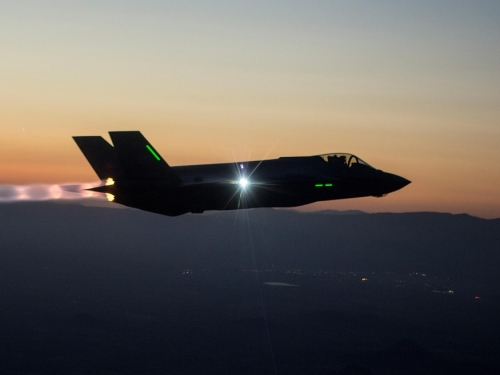
An F-35 Lightning II Joint Strike Fighter. Image: skeeze/Pixabay

This article was originally published by War on the Rocks on 5 August, 2015.

Sometimes a technology is so awe-inspiring that the imagination runs away with it — often far, far away from reality. Robots are like that. A lot of big and ultimately unfulfilled promises were made in robotics early on, based on preliminary successes.

– Daniel H. Wilson

The F-35 should be, and almost certainly will be, the last manned strike fighter aircraft the Department of the Navy will ever buy or fly.

– Ray Mabus, Secretary of the Navy

The Privatization of Space: When Things Go Wrong

SpaceX-rocket taking off. Image: SpaceX-Imagery/pixabay

A few weeks ago, Space X’s Falcon 9 rocket carrying an unmanned Dragon capsule destined for the International Space Station (ISS) exploded. The explosion was likely caused by a failed strut. In October of last year, Orbital Sciences had a rocket destined for the ISS explode for unrelated reasons, just after they were awarded a $1.9 billion contract with NASA. In the wake of these incidents, it may be time to assess the implications of private sector involvement in state-sponsored space programs.

Why Don’t Defense Contractors Do Cyber?

Cyber security – why are America’s big contractors departing the field? Image: Ivan David Gomez Arce/Flickr

This article was originally published by the Atlantic Council on 1 August, 2015.

Going on eight years now, Raytheon has been mounting a strategic campaign in cyber security. This past April, the company spent $1.7 billion on Austin-based Websense, the 13th cyber business it has purchased since October 2007 (Defense Mergers & Acquisitions Daily, 20 April 2015). In Forbes, defense industry booster Loren Thompson called the transaction “bold”—the value roughly matched that of the 12 preceding deals. That pattern suggests that Raytheon has been learning along the way how to build a successful business. More recent evidence was Raytheon’s selection this month as a finalist in DARPA’s Cyber Grand Challenge, in which some of the top teams in the US have been working to create self-healing code. As Byron Callan of Capital Alpha Partners wrote, that alone “suggests it’s doing something right,” whatever misgivings investors and their analysts may have had about Raytheon’s long-running strategy.