How Gulf States Have Undermined Israel’s Case on Iran

President Obama meeting leaders of the Gulf nations at Camp David. Image: Pete Souza/Wikimedia

This article was originally published by the European Council on Foreign Relations on 13 August, 2015.

In its relentless opposition to the Joint Comprehensive Plan of Action (JCPOA), the nuclear agreement between Iran and the world powers that was signed on 14th July, Israel has argued that the deal would pose a grave danger to the entire region. Israel’s case against the nuclear deal with Iran has shifted away from attacks on the substantive terms to focus on its regional implications. Prime Minister Benjamin Netanyahu has repeatedly outlined that Saudi Arabia and the other Gulf States are at least as concerned as it is regarding the dangers of the nuclear deal, and the possibility that Tehran will use the lifting of sanctions to cause mayhem throughout the Middle East. Now, Israel’s case has been dealt a serious blow with the public backing, albeit cautious, of the Arab Gulf States for the Iran nuclear deal.

Peace Goal Requires Bridge Building between Old and New Powers

American and Afghan soldiers in farah Province, Afghanistan. Image: Lt. Col. Leslie Pratt/Wikimedia

This article was originally published by the Danish Institute for International Studies (DIIS) on 17 August, 2015.

The omission of violent conflict and fragility is one of the biggest shortcomings of the otherwise heralded Millennium Development Goals. The gap in MDG performance between fragile and conflict-affected states and other developing countries remains wide, and the OECD estimates that by 2020 extreme poverty will be concentrated mainly in fragile states.

Categories
Terrorism

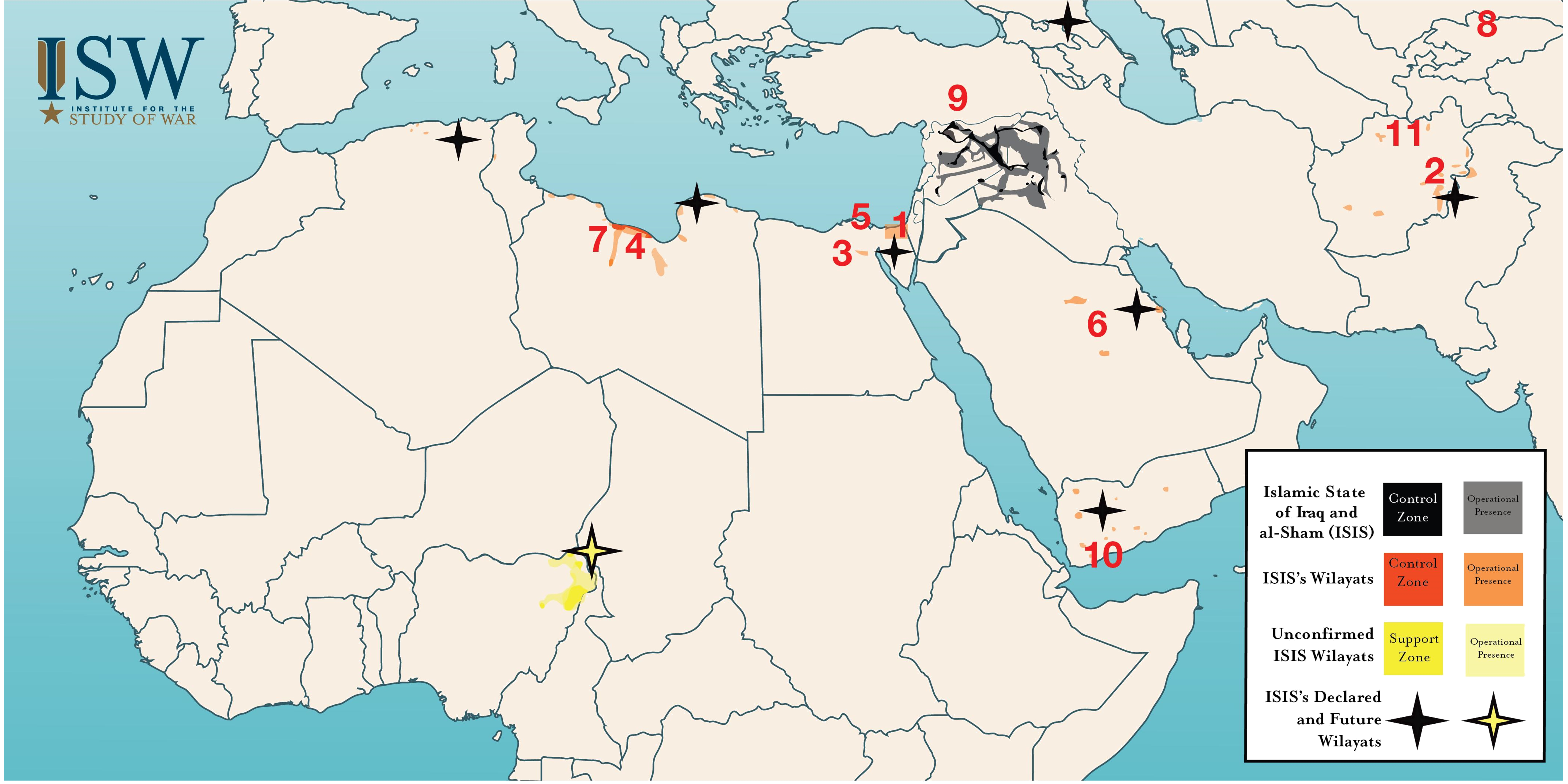
ISIS-Linked Regional Activity (Institute for the Study of War)

Regional activity of ISIS in July 2015 (click for detailed view). Image: Institute for the Study of War

This report was originally published by the Institute for the Study of War on 7 August, 2015.

Reports that the U.S. is considering establishing forward bases to counter ISIS’s affiliates in Libya and Afghanistan reflect the increasing regional capability and momentum of the group in the Near Abroad. ISIS will likely gain new support in Afghanistan and possibly globally due to the death of the Taliban’s leader, Mullah Omar. ISIS is also expanding operations in Yemen, Libya and Egypt, which may provoke direct conflict between ISIS and al Qaeda. ISIS will likely intensify regional operations, possibly within Turkey, as it faces pressure within Syria and Iraq from Turkey and other anti-ISIS forces. ISIS will also likely attempt to open other border crossings between ISIS’s interior and Near Abroad positions.

Veiled Ambitions: Understanding Iran’s Nuclear Posture

Propaganda poster of Ayatollah Khomeini in Teheran. Image: Adam Jones/Wikimedia

Anchored between the unelected Guardianship Council, Islamic Revolutionary Guard Corps (IRGC) and the supreme leader Ali Khamenei, Iran’s foreign policy reflects a complex mix of political, military and ideological interests. The recently-brokered deal between the P5+1 and Tehran is a case in point. While Iran’s elected President Hassan Rouhani and Foreign Minister Mohammad Javad Zarif successfully negotiated the end of sanctions in exchange for limits on Iran’s nuclear capabilities, neither wield significant decision-making power within the Islamic Republic’s theocratic structure. At best, the presidency is the office of choice for international communications because it retains the trappings of a republic—an executive body with (apparently) executive authority. Consequently, Rouhani cannot pursue foreign policy goals without the consent of the Ayatollah, the Council and Guards.

Poland’s New Hawkish President Could Be Shape of Things to Come from Warsaw

Andrzej Duda, newly elected President of Poland. Image: Piotr Drabik/Wikimedia

This article was originally published by The Conversation on 7 August, 2015.

Where next for Poland? That is the big question following the swearing in of Andrzej Duda for a five-year term as the new president.

The 43-year-old lawyer’s shock victory in May’s presidential election has shaken up Polish politics. It means that for the first time since 2010, Poland’s president is from a different party to the prime minister. Duda represents the right-wing Law and Justice party, while prime minister Ewa Kopacz is from the centrist Civic Platform.

Duda’s victory prompted speculation about whether there would be a significant shift in Polish international relations. Up to a point, is the short answer. Real executive power lies with the prime minister, but the Polish president is not simply a ceremonial figure. According to the constitution, the president has informal oversight and a coordinating role over foreign policy.