Categories
Coronavirus CSS Blog

Mediation Perspectives: Why COVID-19 Ceasefires Remain an Exception

Image courtesy of Jeffery Harris/DVIDS

Mediation Perspectives is a periodic blog entry that’s provided by the CSS’ Mediation Support Team and occasional guest authors.

Humanitarian ceasefires are intended to open up windows of relief for affected civilians during armed conflict. With COVID-19 spreading across the world and the UN Secretary General’s call for a global ceasefire, hopes were high that ceasefires could help contain the pandemic and ease civilian suffering. The small number of COVID-19 ceasefires, however, is sobering. This might be explained by how a ceasefire declared in response to the coronavirus pandemic can appear to entail far-reaching commitments with uncertain benefits and high costs. In contrast to usual humanitarian ceasefires, pandemic ceasefires hence seem as too big of a risk to take. Tying ceasefire calls to concrete objectives with clear temporal and geographic limitations could help to counter this obstacle.

China and the US’ Internal Challenges

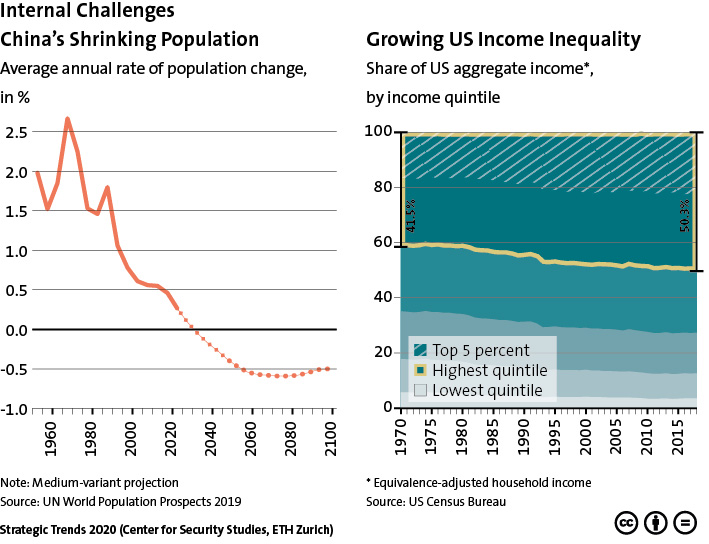
China and the US may be economic superpowers, but they are both facing significant internal challenges. As an example of these challenges, this graphic points out how China’s annual population rate is rapidly shrinking, while in the US income inequality is growing.

For more on China, the US and the world order, read Jack Thompson’s Strategic Trends 2020 chapter here.

Categories
CSS Blog

Mediation Perspectives: Trump, the Bible, and the Instrumentalization of Religion

Image courtesy of The White House/Flickr

Mediation Perspectives is a periodic blog entry that’s provided by the CSS’ Mediation Support Team and occasional guest authors.

In the evening of 1 June, one week into nationwide protests in the wake of the murder of George Floyd, US President Donald Trump left the White House and made his way to nearby St. John’s Church. He stopped in front of the church and posed for the media holding a Bible.

The Politics and Science of the Future

Assembling Future Knowledge and Integrating It into Public Policy and Governance

This article is the concluding chapter of The Politics and Science of Prevision: Governing and Probing the Future, published by Taylor & Francis Group. To read this open access book, click here.

In a world of complexity, interconnectedness, uncertainty, and rapid social, economic and political transformations, policy-makers increasingly demand scientifically robust policy-advice as a form of guidance for policy-decisions. As a result, scientists in academia and beyond are expected to focus on policy-relevant research questions and contribute to the solution of complicated, oftentimes transnational, if not global policy problems. Being policy-relevant means to supply future-related, forward-looking knowledge – a task that does not come easy to a profession that traditionally focuses on the empirical study of the past and present, values the academic freedom of inquiry, and often sees its role in society as confronting and challenging power and hierarchy.

Categories
CSS Blog

Eurasia’s Trade Partners


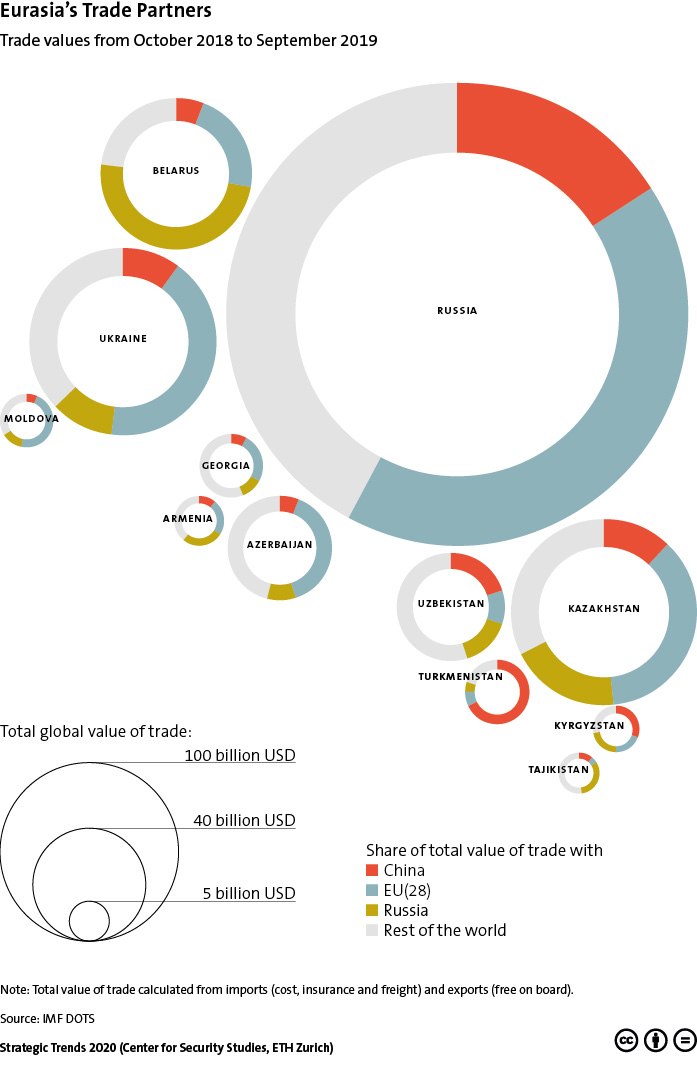
This graphic illustrates the total values of Eurasian countries’ trade with China, the EU, Russia and the rest of the world – including imports and exports – between October 2018 and September 2019.

For an insight into the impact of China’s Belt and Road Initiative (BRI) on Eurasia, read Benno Zogg’s chapter in Strategic Trends 2020, which can be found here.