Forget the Subs: What Taipei Can Learn from Tehran about Asymmetric Defense

Courtesy of sagesolar/Flickr. (CC BY 2.0)

This article was originally published by War on the Rocks on 6 April 2017.

Ahead of the Donald Trump-Xi Jinping summit this week at Mar-a-Lago, Taiwan is understandably anxious. Trump’s ascendance to the American presidency has injected uncertainty into the U.S. approach to China and Taiwan — an element of foreign policy that is traditionally carefully calibrated to avoid upsetting the precarious cross-strait arrangement. Taiwanese President Tsai Ing-wen’s unprecedented phone call with then-President -elect Trump in early December seemed to herald a new, more muscularly pro-Taiwan approach. This impression was subsequently belied by Trump’s suggestion that Taiwan could be traded away as part of a grand bargain with China. Speculation about Trump’s interest in upending this long-standing U.S. policy died down after the president affirmed his support for the “one China policy” in his first conversation with Xi. The next month, Secretary of State Rex Tillerson adopted China’s verbiage regarding a “new model of great power relations” during his trip to Beijing.

Whether and how Trump and Xi will address the one China policy remains to be seen. “We are preparing for every scenario,” one unnamed Taiwanese official told The Washington Post. Yet the underlying problem is clear. As Taiwan’s recently released Quadrennial Defense Review argues, Chinese military power is increasing at the same time as the new administration’s plans for “the United States’ Asia-Pacific strategic direction and troop deployment” remain uncertain. These shifting geopolitical currents come at the same time as growing strain between Taiwan and China. Beijing regards Tsai’s traditionally pro-independence political party as antagonistic to its interests and, since her inauguration last May, has undertaken a campaign of increased economic, political, and military pressure.

The Threat of US Cuts: Helping Peacekeeping Help Itself?

Courtesy of Thomas Hawk/Flickr. (CC BY-NC 2.0)

This article was originally published by IPI Global Observatory on 30 March 2017.

As the prospect of United States funding cuts hangs over the United Nations and its flagship peacekeeping operations like the sword of Damocles, many are asking whether the threat might in fact provide the impetus for necessary reforms. The picture will become clearer at the April 6 Security Council thematic debate on peacekeeping, which the US is organizing. If UN member states remain focused on reform and reinvest in political strategies, and if the bureaucracy helps itself by initiating real rather than merely rhetorical change, a positive outcome is possible.

Reports of proposed US cuts have generated much panic around Turtle Bay for the past couple of months. This started with a January draft US presidential executive order—never signed into action—recommending “eliminating wasteful and counterproductive giving” to the world body. It culminated in March with the release of the US federal budget blueprint for 2018, which confirmed the White House’s intention to cut 40% of the State Department’s $2.2 billion annual contribution to the UN’s overall peacekeeping budget, which comes to just under $8 billion.

Is it Time to Drop the F-Bomb on Russia? Why Putin is Almost a Fascist

Courtesy of Jez/Flickr. (CC BY-NC-ND 2.0)

This article was originally published in Volume 34, Number 1 of the World Policy Journal in Spring 2017.

Abstract

Vladimir Putin’s Russia meets the classical definition of fascist state, says Maria Snegovaya, except for one factor-the Kremlin can’t yet unite the public around a clearly articulated nationalist ideology. This missing piece constrains the aggressiveness of the state. Without it, the Russian people will not accept fighting foreign wars indefinitely.

The word “fascist” gets casually bandied about. After falling into relative disuse, it has once again become a go-to term to dismiss a person or government as irredeemably intolerant and totalitarian, and few hurl the F-bomb as liberally as the Kremlin. Following Russia’s invasion into eastern Ukraine in 2014, Russian nationalists called the democratic movement in Ukraine “fascist,” referencing the collaboration of Ukrainian independence leader Stepan Bandera with Nazi Germany. One of Russia’s most popular TV propagandists, Dmitry Kiselev, spent five minutes on air explaining how all 14 features of the Italian scholar Umberto Eco’s definition of fascism applied perfectly to Ukraine.

Categories
Terrorism

Can Military Might Alone Defeat al-Shabaab?

Courtesy of Surian Soosay/Flickr. (CC BY 2.0)

This article was originally published by IPI Global Observatory on 21 March 2017.

Developing a “security pact” to tackle insurgent jihadists al-Shabaab, who continue to stifle state-building efforts, is one of the key agenda items at the upcoming high-level conference on Somalia scheduled for May this year in London. This complex challenge first depends on identifying what makes al-Shabaab such a resilient movement. Despite some success on the battlefield, this is an understanding that has largely escaped Somalia’s various security forces—and their international supporters—until now.

Donors such as the United Kingdom, European Union, and United States have spent hundreds of millions of dollars on Somalia’s security services, including 1.8 billion euros pledged in September 2013 as part of the “New Deal Compact.” Yet al-Shabaab remains a potent force throughout most of the country. The London conference thus presents an opportunity to develop security architecture—and associated justice mechanisms—more in line with previous political progress in Somalia.

Oman’s Unique Approach to Mediation: A Solution for Sunni-Shia Conflicts?

Mediation Perspectives is a periodic blog entry that’s provided by the CSS’ Mediation Support Team and occasional guest authors. Each entry is designed to highlight the utility of mediation approaches in dealing with violent political conflicts. To keep up to date with the Mediation Support Team, you can sign up to their newsletter here.

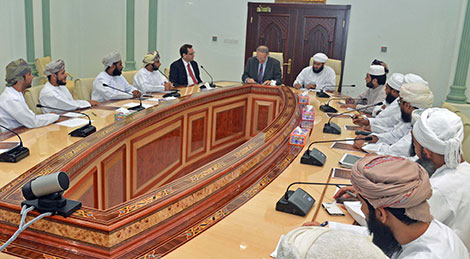
The Sultanate of Oman is a peaceful country on the southeastern shores of the Arabian Peninsula. The 2016 Global Terrorism Index gives the country a score of “0”, which means there is “no impact of terrorism” within its borders. It’s noteworthy that Oman is the only country in the Middle East and North Africa (MENA) with such a score, which makes it one of the safest countries in the world.

There are several factors that explain Oman’s internal security. It is a relatively wealthy nation, its ruler – Sultan Qaboos – believes in progressive governance, and Omanis share a meticulous approach to mediation, which is shaped in part by Ibadi Islamic law. (Ibadism is the form of Islam practiced by the majority of the population in Oman. It’s an ancient and ascetic branch of Islam that dates to the first century A.H. and is respected by both Sunni and Shia jurists for its rigorous and scholastic approach to jurisprudence, among other features.) Given these helpful influences and the stature of Ibadism, it is justifiable to argue that Oman’s unique method of mediation may provide one of the keys to resolving conflicts that have both intra-extra-Islamic dimensions.