
Categories
Humanitarian Issues

Why the AU Needs to Get Policing Right

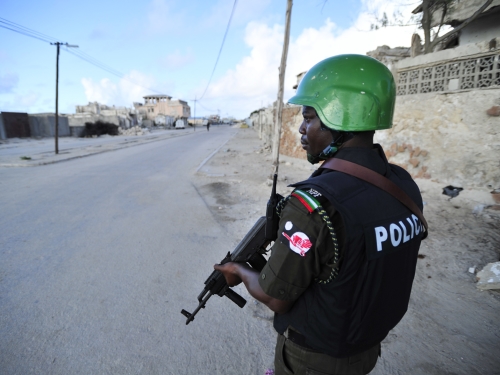
A Nigerian police officer, as part of AMISOM’s Foreign Police Unit, conducts a foot patrol near Lido Beach in Somalia’s capital Mogadishu. Image: TOBIN JONES/Flickr

This article was originally published by the Institute for Security Studies (ISS) on 1 July 2015.

While the role of police in peace support operations used to be limited to tasks of monitoring and observing, it has changed to encompass complex and substantive roles. These include helping to rebuild the capacity of police and broader law enforcement institutions that have suffered the consequences of violent conflict.

Usually in the aftermath of conflict, these institutions are critical in rebuilding public confidence in the rule of law, which has typically been either diminished by the conflict or, in some cases, totally destroyed. Following the Brahimi Report (2000), police roles were viewed in the wider context of the rule of law, protection of civilians and human rights. New areas of focus include emerging threats such as terrorism, organised transnational crime and corruption.


Categories
Humanitarian Issues

Why Term Limits Matter for Africa

Burundian President Pierre Nkurunziza. Image: AMISOM Public Information/flickr

Africa has a problem of presidents not leaving office when it’s time to do so.  The latest illustration of this is the maneuvering of Burundi’s President Pierre Nkurunziza. After 10 years in office, he is attempting to stay on for a third five-year term – in contravention of Burundi’s constitution that limits presidents to two five-year terms.

Nkurunziza’s determination to stay in power has brought the country to the brink of another civil war. (It’s estimated that 300,000 people were killed in Burundi’s ethnically-based civil war of 1993-2005). The government’s hardline response to protests against a third term has resulted in more than 100 deaths, the arrests of some 500 media and civil society leaders, a fracturing of the military, and the exodus of some 200,000 refugees since April.

Unfortunately, Nkurunziza is not alone among African leaders who defy the fundamental requisite of democracy that leaders must step down when their terms expire. In fact, the continent as a whole is in the midst of a wider battle over governance norms. Burundi’s relevance to this larger struggle compels assertive action on the part of key African and Western governments interested in upholding the rule of law.

Categories
Humanitarian Issues

International Law and the Changing Face of Conflict

Global Justice and International Law. Image: geralt/Pixabay

On 20 May 2015, the ISN hosted an Evening Talk on “International Law and the Changing Face of Conflict,” which featured the University of Notre Dame’s Dr. Tanisha Fazal, who is an Associate Professor of Political Science and Peace Studies there. Today, we feature 1) her presentation on the proliferation of international humanitarian law (IHL) and its unintended consequences, and 2) highlights from the subsequent questions and answers session, which was moderated by the ISN’s Peter Faber.

Categories
Humanitarian Issues

Team UN, World Police: Why We Need an Emergency Peace Service

South African blue helmet during training, 17th of July 2013. Image: MONUSCO Photos/Wikimedia

This article was originally published by The Conversation on 29 May, 2015.

It’s been more than 25 years since the Cold War ended, more than a dozen since we created an International Criminal Court, and a decade since the UN World Summit recognised the Responsibility to Protect civilians – and yet there’s been scant progress in preventing armed conflict and responding rapidly enough to protect civilians.

It’s not the fault of UN peacekeepers themselves, who won the Nobel Peace Prize in 1988 and have helped to manage and improve conditions in 69 armed conflicts worldwide, with 56 operations since 1988. Indeed, May 29 is recognised as the International Day of UN Peacekeepers.

Categories
Humanitarian Issues

Peacekeeping in Haiti: A Laboratory for Pacification in Rio de Janeiro?

A Brazilian soldier stands security during a walking tour of downtown Port Au Prince, Haiti. Image: Communication Specialist 1st Class Chad J. McNeeley/Wikimedia

This article was originally published by Strife on 28 May 2015.

With contingents of up to 3200 soldiers, over twice the number of the country’s current contribution to the UN Stabilisation Mission in Haiti (MINUSTAH), the Brazilian Armed Forces are at present occupying large parts of the favela agglomeration Complexo da Maré in Rio de Janeiro. After the mission in Alemão and Penha (Operação Arcanjo, November 2010 – June 2012), this is the second occasion on which the Armed Forces have significantly contributed to the Pacification programme.