The world has entered the digital age. We rely on the internet for information, communication and so much more; and technology influences almost every aspect of modern society, from personal banking to the management of global conflict. As an area of academic study, ‘cybercrime’ is still very much in the initial stages of development, as even the experts struggle to come to terms with ever-quickening pace of technological change and proliferation. This syllabus provides insight into some of the sources currently available on cybercrime and cybersecurity (with an additional focus on the controversial issue of ‘cyberwarfare’).
It's week 36 on the ISN's editorial calendar, Photo: Sebastian Crump/flickr
We’ll be highlighting the following topics this week:
In ISN Insights on Monday, University of St Andrews Professor Gerard DeGroot asks whether the international order has largely moved beyond large-scale conflict.
Tuesday’s ISN Special Feature takes a closer look at power politics and the state of the European project.
On the eve of the 10-year anniversary of 9/11, Dr Shalva Weil of Hebrew University explores the little-known Israelite connections of the Taliban, in Wednesday’s ISN Insight.
Thursday’s ISN Special Feature dissects the historical argument for great power retrenchment.
Friday’sISN Podcast discusses post-9/11 trends in intelligence.
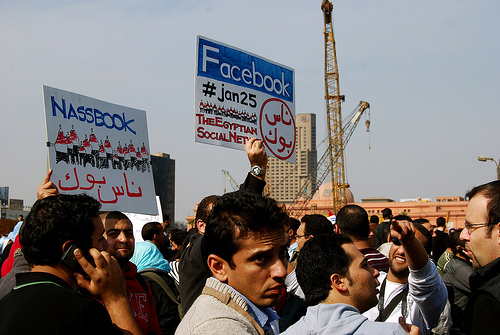
Don't you dare take it away. Photo: Rowan El Shimi/flickr
The role that social networks have played in the ‘Arab Spring’ has been much-discussed in recent months, and many a Master’s thesis these days must be written on how the Internet – and social media in particular – is changing political dissent movements. Given the Internet’s ability to quickly disseminate information, and to allow like-minded individuals to find each other and mobilize support for a cause, one might assume that Facebook and other forms of social media would advantage popular struggles against centralized power — and that switching them off would be a tactic of choice among weary dictators.
Quite the opposite, says Navid Hassanpour, who has used a dynamic threshold model for participation in network collective action to analyze the decision by Mubarak’s regime to disrupt the Internet and mobile communications during the 2011 Egyptian uprising.
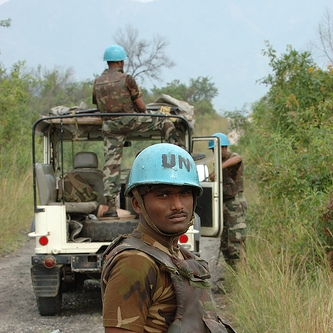
A UN Peacekeeper in Africa. Photo: Flickr/Julien Harneis
I often play Pub Quiz on my iPhone as I’m waiting for the bus. Recently, I was
intrigued by one question in particular – or more specifically, by the answer:
In which country – apart from India and Bangladesh – is Bengali an official language?
A) United States
B) Sierra Leone
C) Canada
The correct answer is: Sierra Leone. Did you get this right?
Civil Defense was published in Switzerland in 1969 (left, courtesy of Histamut/Wikimedia Commons) and re-published in Japan for the third time in 2003 (right, courtesy of Amazon.co.jp)
The question intrigued me. When abroad, I am used to being asked whether it was true that all Swiss men had a military rifle at home. But, before a Japanese friend asked me about it the other day, I had never heard about a book called Civil Defense, which in the 1960s was apparently handed out to every household by the Swiss government. What was she talking about? And why on earth is a dated Swiss book, unknown to me, popular among the Japanese?
The volume was known in Switzerland as the “red booklet“, which is a double irony: the ‘booklet’ is 320 pages long and full of anti-communist ideology. Zivilverteidigung (Civil Defense) was published in 1969 and 2.6 million copies were distributed to Swiss households for free. It served two purposes: 1) as a guide for the Swiss population about how to behave during, and prepare for, national disasters, including nuclear war; and 2) to instill a spirit of patriotism and resistance towards everything foreign and dangerous (at that time, mainly communism).
The red booklet included lyrics of patriotic songs and, most interestingly, two versions of a story in which Switzerland is threatened by revolutionary forces supported by an outside power. In the first version, written on the right-hand pages of the book, the Swiss people resist and save their country; in the second version, written (of course) on the left-hand pages, the revolution succeeds and Switzerland collapses.
Just a year after its publication in Switzerland, in 1970, Civil Defense was translated into Japanese, and that’s not all: Minkan Bōei (民間防衛), as it’s known in Japanese, was re-published in 1995 and again in 2003. With 150,000 copies sold in all, it isn’t quite a best-seller. Nevertheless, the red booklet remains popular in Japan.
Not so in Switzerland, where it was already out of fashion at the time of its original publication: