Next Tuesday, September 20th, the Centre for International Governance Innovation (CIGI) is hosting a one-day conference under the provocative title, “Can Think Tanks Make a Difference?”, as part of its 10th anniversary celebrations.
When institutions celebrate such occasions, the tone can sometimes become overpoweringly self-congratulatory; CIGI – a think tank – instead decided to put itself in the ‘line of fire’. Active in the innovative thinking business, they are utilizing this opportunity to reflect on how think tanks operate, and how they achieve influence.
It's week 37 on the ISN's editorial calendar, Photo: Tom Magliery/flickr
We’ll be highlighting the following topics:
In ISN Insights on Monday, King’s College London’s Dr Harsh Pant analyzes the impact of Anna Hazare’s movement on Indian democracy.
On Tuesday, we’ll showcase an upcoming partner event, run by the Center for International Governance Innovation (CIGI), about the impact of think tanks.
Peter Buxbaum puts US-German relations under the microscope in ISN Insights on Wednesday.
On Thursday we present our latest syllabus on national and transnational terrorism.
Friday’s ISN Podcast discusses troop withdrawal in Afghanistan.
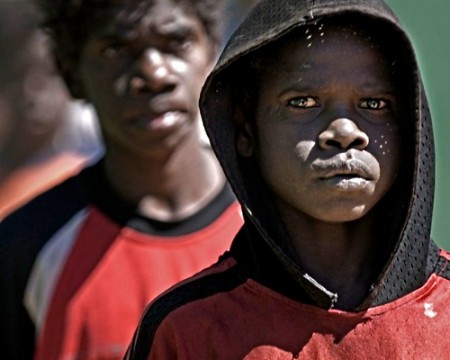
Indigenous teenagers in Arnhem Land (Photo: Rusty Stewart/flickr)
Last week Australia performed extraordinarily well in the Global Liveability Survey and can now claim four of the top ten ‘most liveable cities’ in the world. One shining performer was the West Australian capital, Perth, which came in at 8th Place, just below Helsinki and just above a rival Australian city, Adelaide. You can take it from a proud Perth inhabitant – it’s a beautiful place to visit and even more remarkable place to live.
Unless, of course, you are an indigenous Australian, in which case there’s a very good chance you will be spending some time in Perth’s least beautiful locations – namely Hakea, Casuarina, or Bandyup maximum security prisons.
Last week a report was released by the government-established Productivity Commission, assessing the ongoing welfare (or lack thereof) of indigenous Australians. Throughout Australia, indigenous people are 14 times more likely to be incarcerated than non-indigenous people. In Western Australia specifically, indigenous people make up just less than 4% of the total Western Australian population, yet they make up 40.4% of the total male prison population, and 51.5% of the female prison population (Australian Bureau of Statistics).
The historical expansion of the EU. Image: Ssolbergj/Wikipedia
Ten years ago, people were going long on Europe. In 2002, an influential article in Policy Review described Europe as “entering a post-historical paradise of peace and relative prosperity,” even “the realization of Kant’s Perpetual Peace.” Those familiar with that article, Robert Kagan’s “Power and Weakness,” know that this was praise of a certain kind. What made this Europe possible, according to Kagan was, actually: “the United States… mired in history, exercising power [out] in the anarchic, Hobbesian world.” Though Kagan clearly did not believe that Europe circa 2002 was an illustration of Kant’s vision of human progress in history — in which the working out of our “unsocial sociability” would eventually lead to a global alliance of peaceful republics — it was the image he used. And it was a compelling one.
When that article was written, the idea of Europe as paradise was plausible. The Euro had just entered circulation, membership of the EU was about to reach for the first time behind the old iron curtain, and people were getting used to the prospect of Europe as a second superpower alongside the United States. Perhaps Kagan’s article was so influential because it suggested what few at the time believed: that what Europe had achieved in preceding decades would not easily or inevitably be repeated elsewhere in the decades to come, that European advances were themselves contingent and fragile. That power was not obsolete.
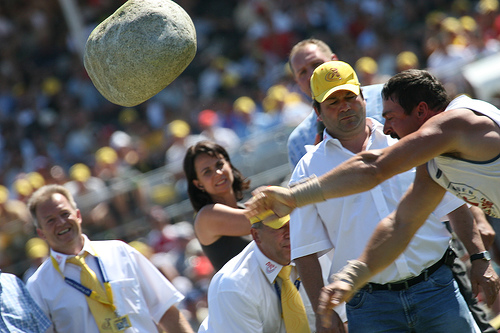
Never mind it’s a duplicate. Photo: Patrick Frauchiger/flickr
Fans of yodeling, dancing and schwingen got their money’s worth last Sunday at Switzerland’s biggest celebration of traditional culture, the Unspunnen festival. If the sight of men wrestling in lederhosen isn’t exciting enough for you, the festival showcases another pearl of entertainment: stone throwing. No less than 83kg of massive granite has to be shifted by each competitor, the further the better.
The first Unspunnen festival was held in 1805. Napoleon had just invaded Switzerland, and the event – and the ‘Unspunnen Stone’ with it – became a symbol of Swiss unity. But it was not until 1984 that the stone rose to international fame, when it was abducted by a group of Bélier activists – part of quiet Switzerland’s very own separatist movement.

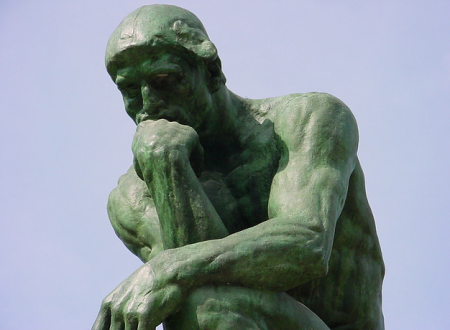
 Next Tuesday, September 20th, the Centre for International Governance Innovation (CIGI) is hosting a one-day conference under the provocative title, “Can Think Tanks Make a Difference?”, as part of its 10th anniversary celebrations.