Categories
CSS Blog

Mediation Perspectives: What is Mediation?

Pictured here are US Secretary of State John Kerry and Swiss Federation Council President Didier Burkhalter at the Geneva II conference on Syria. Image: Wikimedia

On 25 November 2014, the German Ministry of Foreign Affairs, together with various German mediation support NGOs, organized a conference on peace mediation. The aims of the conference were to explore the role that Germany can play in this field and to raise the country’s profile as a conflict mediator. As part of the discussion, one of the working groups focused on the types of human resources and institutional structures needed for effective mediation and mediation support. In this context, the first question to arise was “what is mediation?” Indeed, only once this question is answered can the relevant resources and institutions be assembled to effectively provide the desired forms of ‘mediation.’ This implies that the first step for organizations seeking to expand their role as mediators is to be clear about what exactly they have in mind.

Categories
Humanitarian Issues

Minimum Criteria for Sustainable Global Governance

The globe. Image: geralt/Pixabay

Strong statist positions and a fixation on state sovereignty once inhibited progress toward more just and effective models of global governance. However, there can be no denying that globalization has not only led to the unprecedented transformation of our societies, but also the role that states play in the international system. Yet, even as states gradually share more responsibilities with corporations, sub-national entities and international organizations, their structural significance still remains indisputable – particularly when it comes to finding near-term solutions for better modes of global governance. This should result in a more equitable and representative international state system to which global governing structures will remain accountable.

Order and Change in Global Politics: Assessing the “Return of Geopolitics”

Hegel with Students. Image: Wikimedia

This article was originally published by e-International Relations on 4 November, 2014.

The unfolding global international predicament, with a crescendo of tensions in recent months, has prompted a more upfront reflection on the kind of international order currently prevalent and what future order appears as desirable.

Contours of the Debate

In a piece published by Foreign Affairs entitled “The Return of Geopolitics: the Revenge of the Revisionist Powers,” Walter R. Mead (Mead, 2014) has articulated the view that, after a long interval following the end of the Cold War, the post-historical condition described by Francis Fukuyama in his famous book The End of History and the Last Man (Fukuyama, 1992) may be over for good. That post-historical condition entailed the dissolution of all major ideological conflicts, and consequently of major geopolitical struggles for the control of the planet, as mankind stepped firmly and irreversibly on the path of liberal representative democracy and free market capitalism. Professor Mead argues that both Russia and China, the two large illiberal powers, are now “pushing back against the political settlement of the Cold War.” Consequently, a new confrontation between great powers is looming, in the pretty familiar fashion of conflict over land, sea lanes, the control of continental masses and possibly the oceans. Russia and China are depicted as revisionist powers, whose march towards the final stage of liberal democracy and capitalistic economy can be long and tortuous, while in the meantime “such figures as Putin still stride the world stage.”

The Foreign Policy Essay: The Fault Lines in China’s New Empire

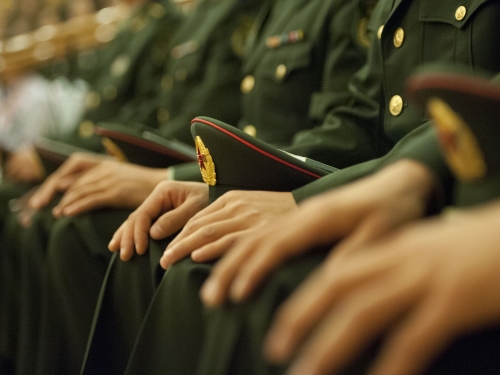
Cadets of the Peoples LIberation Army. Image: US Department of Defense/Flickr

This article was originally published by the Lawfare Blog on 9 November 2014.

Editor’s Note: Under President Xi Jinping, China appears more aggressive and dictatorial: a worrisome combination as China’s wealth makes it more influential and helps it build a stronger military. Drawing on her piece in the latest issue of Foreign Affairs, Elizabeth Economy of the Council on Foreign Relations argues that Xi’s “China Dream” is not coming to pass: his attempt to transform the country is encountering resistance, and the resulting divisions and weaknesses are likely to limit Beijing’s influence in the years to come.

Chinese president Xi Jinping is attempting to reform—even revolutionize—political and economic relations within China as well as between China and the rest of the world. He has articulated a vision for China that is well encapsulated in his “China Dream,” or the rejuvenation of the great Chinese nation. In practical terms, this means Xi Jinping himself is at the top of a strong Communist Party, at the forefront of the political system, in command of a robust and innovative Chinese economy, and fostering an expansive foreign policy in which all roads lead to Beijing. It is a Chinese empire with socialist characteristics.

Categories
Regional Stability

Chemical Disarmament in Syria and the Future of the Chemical Weapons Control Regime

Soldiers wearing protection suits. Image: Percy Jones/Wikimedia

What questions has the Syrian conflict raised about the current and future efforts to dismantle and destroy all known stockpiles of chemical weapons? To answer this and a host of other questions, our parent organization, the Center for Security Studies (CSS), hosted an Evening Talk on 23 October 2014 that offered a Swiss perspective on the global chemical weapons control regime and related developments in Syria. The guest speakers were Ambassador Benno Laggner, who is the Head of Security Policy at the Federal Department of Foreign Affairs, and Stefan Mogl, who currently leads the Chemistry Division at the Spiez Laboratory, which analyzed suspected chemical warfare samples in the aftermath of the August 2013 chemical attacks in the Ghouta suburbs of Damascus.