
Chinese Firm Planning a Canal Through Nicaragua Has PLA Ties

The proposed canal routes (red) crossing through Nicaragua. The Panama canal is marked blue. Image: Soefrm/Wikimedia

This article was originally published by Offiziere.ch on 5 December, 2014.

A Chinese company is preparing to begin work on the Nicaragua Interoceanic Canal. Once — and if — the canal is ever finished, it will size up to more than 170 miles (about 275 km) and connect the Caribbean Sea to the Pacific Ocean, with Lake Nicaragua in the middle. It’s a major project — larger than any other geo-engineering project underway in the world. Officially, it’s an opportunity for development championed by Nicaraguan President Daniel Ortega. But critics look at the canal as a boondoggle, and a means by which Ortega is developing a long-term relationship with Beijing — and China’s geopolitical interests. The builders of the canal also have important ties with the Chinese People’s Liberation Army (PLA).

Indonesia’s Seaward Shift: A Break from the Past

Pinisi ships dock at the Sunda Kelapa Harbor, Jakarta. Image: Phinisi#11/Wikimedia

This article was originally published by CIMSEC on 4 December, 2014.

In his inaugural speech as the President of Indonesia, Joko Widodo communicated a vision of prosperity for his country based on a tradition of maritime trade. Indonesia, he said, is to become a sea-going trading power once again. With a new Ministry of Maritime Affairs and a US $6 billion investment in maritime infrastructure, he’s putting his proverbial money where his mouth is. While this seems like an obvious path for archipelagic Indonesia to take, there are very important reasons why this signals a profound shift in the strategic thinking of the country from an internal threat perception to an external one. Although some analysts believe Jokowi’s pronouncement is code for abandonment of Indonesia’s non-alignment policy, it is likely his words had nothing to do with external actors and everything to do with growing confidence in Indonesia’s democracy to effectively address its historically troubled internal security.

Summing Up Switzerland’s 2014 Chairmanship of the OSCE

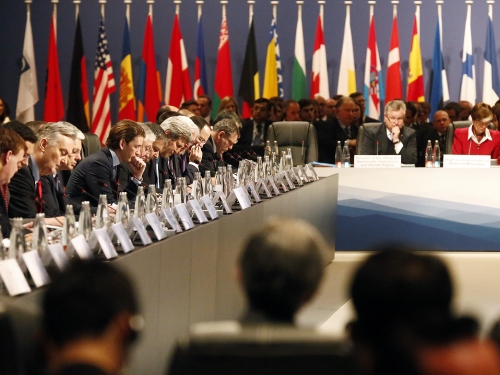
The OSCE Ministerial Council in session in Basel, December 2014. Image: Bundesministerium für Europa, Integration und Äusseres/Flickr

The Swiss presidency of the Organization for Security and Cooperation in Europe (OSCE) was dominated by the escalating Ukraine Crisis. Dealing with one of the worst crises in the Euro-Atlantic area since the end of the Cold War was a huge challenge for Swiss diplomacy. Switzerland emerged as an innovative, impartial, and effective crisis manager, but the Ukraine Crisis also clearly demonstrated the limits of the consensus rule within the OSCE. In the end, it led to a serious erosion of trust in the security architecture designed in 1975 and fully implemented after 1990.

With the conclusion of the 21st Ministerial Council of the Organization for Security and Cooperation in Europe (OSCE) – held in Basel on 4-5 December – Switzerland’s 2014 Chairmanship of the organization can now be assessed. As Swiss Ambassador to the OSCE Thomas Greminger has argued since April of this year, the Ukraine Crisis has been both a curse and an opportunity for the OSCE.

Lethal Robots and the Conduct of Warfare

The military robot “Atlas”, developed by Boston Dynamics for DARPA . Image: DARPA/Wikimedia

This article was originally published by the ASPI Strategist on 5 December, 2014.

The use of lethal robots in conflict is inevitable. When it happens, it’ll create a significant shift in the ways of warfare. A discussion has already begun (see here and here) on how such capabilities might be developed and applied.

Robots in general are becoming smaller, smarter, cheaper and more ubiquitous. Lethal robots are becoming more deadly and discriminating. The degree of autonomy will be a key driver of a robot’s role in conflict and is likely to evolve in three generations; the semi-autonomous, the restricted-autonomous, and ultimately the fully-autonomous generation.

Mitchell Belfer on Small States and Security

The Persian Gulf. Image: Hégésippe Cormier/Wikimedia

Trying to define what, exactly, constitutes a ‘small state’ remains a matter of interpretation. The World Bank, for example, defines such a state as a country with a population under 1.5 million, while the United Nations’ Forum of Small States (FOSS) has over 100 (and often more populous) members. In today’s podcast, Mitchell A. Belfer explains why there isn’t a ‘one-size-fits-all’ definition of a small state. He also reveals 1) what inspired him to study the contributions that small states make to security; 2) why small states such as Bahrain are often good indicators of the security and geopolitical forces that shape a particular region; and 3) reveals which small states warrant greater attention on the international stage.


Mitchell A. Belfer is the founder and Head of the Department of International Relations and European Studies at Metropolitan University Prague, Czech Republic, and Editor in Chief of the Central European Journal of International and Security Studies (CEJISS).

For more information on issues and events that shape our world, please visit ISN Security Watch or browse our resources.