Categories
Humanitarian Issues

Why Term Limits Matter for Africa

Burundian President Pierre Nkurunziza. Image: AMISOM Public Information/flickr

Africa has a problem of presidents not leaving office when it’s time to do so.  The latest illustration of this is the maneuvering of Burundi’s President Pierre Nkurunziza. After 10 years in office, he is attempting to stay on for a third five-year term – in contravention of Burundi’s constitution that limits presidents to two five-year terms.

Nkurunziza’s determination to stay in power has brought the country to the brink of another civil war. (It’s estimated that 300,000 people were killed in Burundi’s ethnically-based civil war of 1993-2005). The government’s hardline response to protests against a third term has resulted in more than 100 deaths, the arrests of some 500 media and civil society leaders, a fracturing of the military, and the exodus of some 200,000 refugees since April.

Unfortunately, Nkurunziza is not alone among African leaders who defy the fundamental requisite of democracy that leaders must step down when their terms expire. In fact, the continent as a whole is in the midst of a wider battle over governance norms. Burundi’s relevance to this larger struggle compels assertive action on the part of key African and Western governments interested in upholding the rule of law.

Categories
CSS Blog

Mediation Perspectives: Professionalizing Mediation through Negotiation Simulations

Illustration by Howard John Arey

Emotions are high and words are flying fast, when suddenly the head of the negotiation delegation gets up and leaves the room. There have been numerous tactical walk-outs during the past 24 hours of marathon negotiations to reach a peace agreement, but this time things are different. Just when the parties are close to signing, one of the delegations is told by their government to insist on an additional clause in the final document. The other party refuses to accept the change. The minutes tick by with frantic efforts by the mediator to find a last minute solution acceptable to all. However, all is in vain. The head of delegation feels it would be a bad deal for her constituency and she still distrusts the other side – so she walks out for good. Both parties blame the other side for the subsequent escalation of violence.

The International Dimension of Tunisia’s Success Story

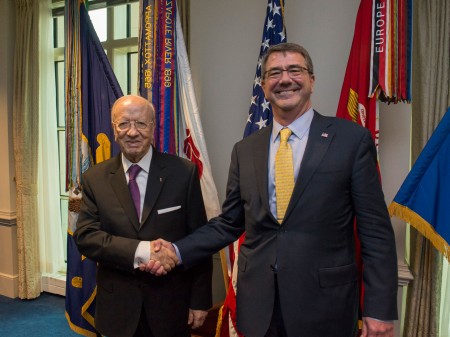
US Secretary of Defense Ash Carter with Tunisian President Caid Essebsi at the Pentagon, 21 May 2015.

Tunisia’s transition process remains one of the few bright spots of the Arab Spring. While the transitions initiated in Egypt, Libya and Yemen have experienced numerous setbacks and repeated outbursts of violence, if not outright civil war, Tunisia appears to be well on its way to securing a genuine democratic space for itself. This view is shared, for example, by the latest Freedom in the World Report, which ranks Tunisia as the first ‘free’ country in North Africa since Freedom House began its worldwide assessments of political rights and civil liberties in 1972.

Although there is a fast-growing body of research that attempts to explain Tunisia’s comparatively smooth democratic transition, the Western media has not been as upbeat. Most analysts have focused on the challenges Tunisia faces, including the instability being generated by neighboring Libya and the broader Middle East and North Africa (MENA) region. As a result, other important aspects of Tunisia’s external relations, particularly those that have had positive implications for its transition, have gone unnoticed.

Most importantly, Tunisia’s new political order appears to have benefitted substantially from the staunch support of those external actors who have the most leverage over the country. In contrast, those with a more critical attitude towards the transition have largely lacked the ability to influence the trajectory of the transition in less positive ways. These circumstances are far from accidental, by the way. They’re the consequence of the country’s history.

Categories
Humanitarian Issues

International Law and the Changing Face of Conflict

Global Justice and International Law. Image: geralt/Pixabay

On 20 May 2015, the ISN hosted an Evening Talk on “International Law and the Changing Face of Conflict,” which featured the University of Notre Dame’s Dr. Tanisha Fazal, who is an Associate Professor of Political Science and Peace Studies there. Today, we feature 1) her presentation on the proliferation of international humanitarian law (IHL) and its unintended consequences, and 2) highlights from the subsequent questions and answers session, which was moderated by the ISN’s Peter Faber.

Death From Above

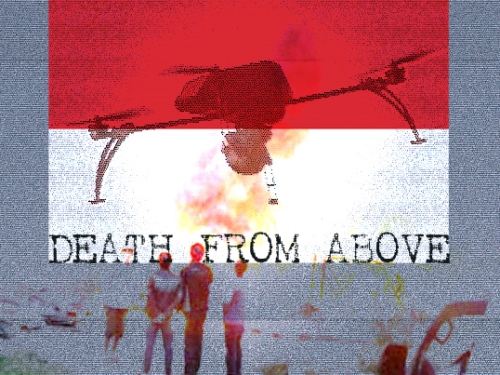
“Death from above” . Image: AK Rockefeller/Flickr

This book review was originally published by the Center for International Maritime Security (CIMSEC) on 28 May, 2015.

Andrew Cockburn. Kill Chain: The Rise of the High-Tech Assassins. Henry Holt Publishers. 307pp. $28.00.

It’s not often that a book review coincides with current events. Books, particularly nonfiction, are usually written and published months, if not years after an event has occurred. That’s because good nonfiction is written in retrospect: writers have spent some time absorbing their subject, researching and analyzing the facts; authors are hesitant to be rash in judgment or thought.

However, there are exceptions. Some pieces of nonfiction, particularly journalists’ works, are appropriate now — not later. Andrew Cockburn’s new book, Kill Chain: The Rise of the High-Tech Assassins, is one of them.  Cockburn’s book is timely.  In just the past few weeks there has been a flood of reporting from media outlets stating that a drone strike killed an American and an Italian hostage when targeting a group of Al-Qaeda members operating near the Afghanistan-Pakistan border.