
Values and Interests in EU Foreign Policy

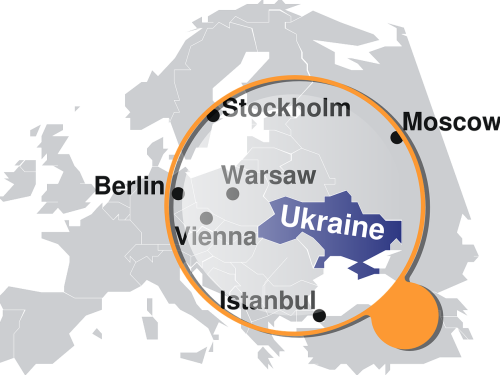
European map with Ukraine in focus. Image: ClkerFreeVectorImages/Pixabay

Anyone remotely familiar with EU foreign policy will be no stranger to invocations of European values underpinning, and, indeed, driving, European external action. From policies on climate change and agriculture to trade to defence and security, the rhetoric generated by various EU bodies typically elucidates a “set of common values” that the respective policies promote or embody. A crucial nuance is that ‘values,’ which have been incorporated into the primary law of the European Union through the Lisbon Treaty, are juxtaposed to ‘interests.’  This juxtaposition often means that if and when the EU fails to live up to its much-touted values, it is charged with ‘hypocrisy.’  The inconvenient truth, however, is that like all actors, Europe has interests as well as values, and these are frequently at odds with each other across virtually every policy area. More often than not, interests, far from being ‘inspired’ by values, have proven insular, short-sighted, and at times downright mercenary. At the same time, it is naïve to expect Europe’s policymakers to pay more attention to the plight of Syrian refugees than domestic populations’ preoccupation with keeping their own welfare and prosperity undisturbed by crises engulfing much of the world outside the Continent.  The solution, it would then seem, lies in doing away with the gratuitous narrative emanating from Brussels that continues to raise unjustified expectations by placing values at the rhetorical heart of European foreign policy.

Categories
CSS Blog

Mediation Perspectives: Where Do Norms Come In?

Two people negotiating. Image: Georgie Pauwels/Flickr

After months of seemingly endless negotiations in a country that has seen years of conflict, the moment has finally come to sign a peace agreement. Exhausted, the mediator is preparing herself for the ceremony, which will take place in a few hours. But before she gets ready to leave, a representative of an international organization enters the mediation office, with a glum expression on his face. “Your text is not nearly as gender-sensitive as we would have liked; you omitted several of our clauses. We counted on you and you failed to put them into the agreement. You have to change it, or we will not endorse the agreement!”

Although fictional, the above example reflects how common it has become in mediation to push aggressively for the inclusion of norms. Mediators are faced with ever-higher expectations when it comes to including normative demands into peace agreements – not just from advocacy groups lobbying for their interests but increasingly from mandating authorities like the United Nations, the European Union or state governments. This raises many questions about how to treat these demands.  If they represent diverging interests, some of them may have to be tempered or sequenced. But it also raises another, perhaps more fundamental, question: to what extent is it a mediator’s role to promote norms in a mediation process?

Categories
Regional Stability

Nuclear Talks to Resolve the East-West Standoff?

A defunct missile silo in Ukraine. Image: Andy Shustykevych/Flickr

The Ukrainian crisis has entered its second summer. While the ferocity of the clashes in East Ukraine has eased since the Minsk Agreement in February, deadly fighting continues on a daily basis. In the meantime, the conflict has fallen somewhat off the radar of Western media, while the suffering of the civilian population in eastern Ukraine continues. There are no signs on the horizon of any accommodation between the governments of Ukraine and Russia. Must Europe accept an ongoing, low-intensity military conflict on its fringes as the new normal?

The Western bloc’s response to Russia’s annexation of Crimea in March 2014 and subsequent sponsoring of an anti-government insurgency in Donbass has remained remarkably coherent so far. It is also having an effect: as Alexei Kudrin, Putin’s Minister of Finance from 2000 to 2011, remarked last month, “Russia is in the midst of a fully-flegded crisis.”  In part because of the West’s co-ordinated economic pressure the Russian Central Bank expects the country’s GDP to shrink by up to 4% in 2015.   So far this has not prompted a shift in Russian attitudes towards key issues regarding Ukraine. Putin continues to enjoy sky-high domestic approval ratings while the Russian government’s creeping takeover of the media landscape is eliminating political dissent from mainstream outlets. Spinning a tale of aggressive American intervention in Russian affairs, the national media are rallying nationalist sentiments and pushing a narrative of a declining, decadent West, all while successfully maintaining that Russia is not involved in a military conflict with its neighbour Ukraine.

The origins of the East-West stand-off over Ukraine are systemic in nature: neither side is prepared to give any ground. For the West, matters of principle are at stake: the inviolability of Ukraine’s sovereign borders as guaranteed by the Budapest Accords, and the right of nations to choose their alliances freely and without external interference. For the Kremlin, the conflict has become deeply intertwined with wider calculations about regime survival, making unilateral concessions unlikely.

Some 20 years ago, the US and Russia began a process of sustained engagement that culminated in the end of the Cold War. Then, as now, efforts at nuclear arms control could generate the initial diplomatic capital needed for a wider improvement in relations.

Categories
Regional Stability

How Could the Baltic States Deter a Russian Invasion?

Lithuanian President Dalia Grybauskaitė participating in a military ceremony. Image: Kapeksas/Wikimedia

Commentators have used Moscow’s tacit support for separatists in eastern Ukraine as an opportunity to speculate whether the Baltic states possess the capability to deter a similar Russian intervention. While this ‘scenario’ is unlikely to happen any time soon, it nevertheless warrants serious consideration given that NATO’s north-eastern flank is home to a sizeable ethnic Russian community. As a starting point, strategic planners in Estonia, Latvia and Lithuania might want to factor Russia’s 2008 military campaign against Georgia into their calculations. Doing so might help them to determine the most effective response for the ultimate ‘worst case scenario’ – an all-out invasion by Russian forces.

The High Stakes of the Iran Nuclear Deal

The wall of the former US embassy covered in anti-US-murals. Image: Phillip Maiwald/Wikimedia

Those opposed to the nuclear deal currently being negotiated by Iran and the P5+1 typically make a number of criticisms: Iran may still be able to build a bomb at some point in the future; the United States should not ‘allow’ Iran to maintain uranium capabilities; the deal goes against traditional U.S. nonproliferation policy; and so on.  Though these critics rarely offer clear alternatives—after all, negotiating a better deal than the current one appears all but impossible—many still favor one option in particular: military strikes against Iranian nuclear facilities.  This course of action, however, would be counter-productive.  Not only does the current deal with Iran draw on the successful track record of U.S. nonproliferation policy, it was developed in concert with other major powers and international nuclear norms.  On balance, it remains the best possible means of affecting the calculus of the Iranian leadership regarding its potential nuclear weapons program. By contrast, military strikes would only increase Tehran’s desire for nuclear weapons and could dramatically shorten the timeframe in which it would be likely to acquire them.