
Saudi Arabia and Pakistan’s Evolving Alliance

The Saudi-financed Shah Faisal Masjid Mosque in Islamabad, Pakistan. Image: Imrankw/Wikimedia

This article was originally published by The National Interest on November 19, 2015.

In early November, Pakistan’s chief of army staff, General Raheel Sharif, made an important visit to Saudi Arabia. The general met with King Salman and other top officials in Riyadh, where he stressed Islamabad’s commitment to ensuring the safety and protection of Mecca and Medina, as well as Saudi Arabia’s territorial integrity. The Saudi officials, in turn, called for peace and stability in Pakistan and praised the Pakistani military’s efforts to fight terrorism in the ongoing Zarb-i-Azb campaign. Dignitaries from both sides issued a joint statement emphasizing their “responsibility towards Muslim ummah” and mutual fears stemming from the plethora of ongoing regional security crises.

The Upcoming OSCE Ministerial Council Meeting in Belgrade: No Reason to Celebrate

Organization for Security and Co-operation in Europe

This article was originally published by Security and Human Rights, formerly Helsinki Monitor, on 30 November 2015.

The 22nd OSCE Ministerial Council (MC) will meet on 3 and 4 December in Belgrade, Serbia. The MC meeting, which takes place once a year in the country holding the OSCE Chairmanship, is attended by foreign ministers or their representatives from the 57 OSCE participating States as well as from the 11 Partners for Co-operation.

The Belgrade MC meeting was originally supposed to be a significant meeting at which OSCE participating States had hoped to commemorate the 40th anniversary of the signing of the 1975 Helsinki Final Act with the successful conclusion of the so-called Helsinki+40 process and the adoption of a landmark OSCE document. OSCE states had planned to adopt a document that would provide strategic guidance for the Organization’s future role and for the setting up of a “common and indivisible Euro-Atlantic and Eurasian security community”, a vision that OSCE Heads of State had agreed to by consensus at the 2010 OSCE Astana Summit.

Categories
CSS Blog

Mediation Perspectives: Dealing with the Problem of Patriarchy

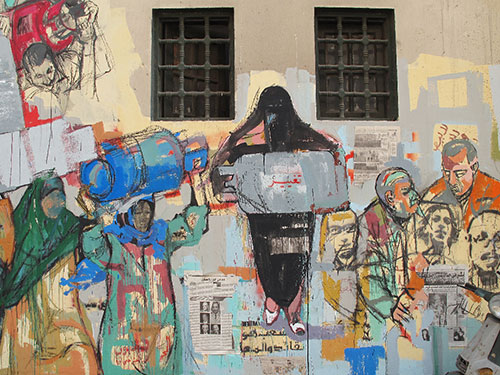
Hanaa El Degham’s graffiti of women queuing for cooking-gas canisters instead of standing in the voting line on the day of the post revolution parliamentary elections. Image: Mia Gröndahl (© 2013).

This article is based on a collection of insights published in “Gender in Mediation: An Exercise Handbook for Trainers”, produced by the Center for Security Studies at ETH Zurich in November 2015.

How can conflicts be resolved without one side imposing their view of what is right and good on the other side? This is at the heart of mediation as a method to deal with conflict, and also at the heart of a transformative understanding of gender equality. Both approaches question paternalistic and patriarchic ways of resolving conflict, where a leader decides what is right for others without listening to their views. Rather than seeing gender equality as a question of political correctness and normative necessity, we should explore it as a fundamental shift in how we shape societies and deal with conflict: questioning patriarchy and fostering cooperative decision-making processes.

Hypersonic Missiles and Global Security

Indian-Russian “BrahMos”-type missiles. Image: Mubeenk02/Wikimedia

This article was originally published by The Diplomat on 13 November, 2015.

Between 2014 and June 2015, China conducted four major tests of its hypersonic missiles (with a fifth test in August). The fourth test of Wu-14, its ultra high-speed nuclear delivery vehicle, demonstrated a capacity for “extreme maneuvers.” It was assessed as travelling at a speed of Mach 10 (flying at 10 times the speed of sound or approximately 7,680 miles per hour). To understand this in comparative terms, a missile flying at subsonic speed can reach a maximum of 500-600 miles per hour.

To qualify as “hypersonic,” a missile would have to move at least five times the speed of sound (Mach 5), as well as be able to evade counter-fire and strike with great precision. To date, no country has achieved this performance but several nations are working on it.

Why North Korea is So Corrupt, and Why that May Be Good

North Korean Dictator Kim Jong Un. Image: Surian Soosay/Flickr

This article was originally published by NK News on 16 October, 2015.

North Korea is probably the most corrupt country in Asia. Measuring corruption levels is difficult, and existing ratings (like the well-known index published annually by Transparency International) should be taken with a pinch of salt. Nevertheless, anecdotal evidence appears persuasive enough: Official corruption in North Korea has been exceptional over the last 20 years.

In my frequent discussions with North Koreans, I have discovered the fact that most of them take a high level of corruption for granted. They assume that any official who is in a position to ask for bribes will. In fact, they are surprised if officials refuse bribes. Simply put, corruption is part of the fabric of daily life in North Korea today.