
Swapping Land, Changing Priorities?

According to Bulgarian sources, the Serbian government is considering a land swap with Kosovo. In exchange for a territory in northern Kosovo mainly inhabited by Serbs (grey area in map below), they would offer parts of the Presevo valley in southern Serbia, where a majority of the population is Albanian (shaded red area on the right.)
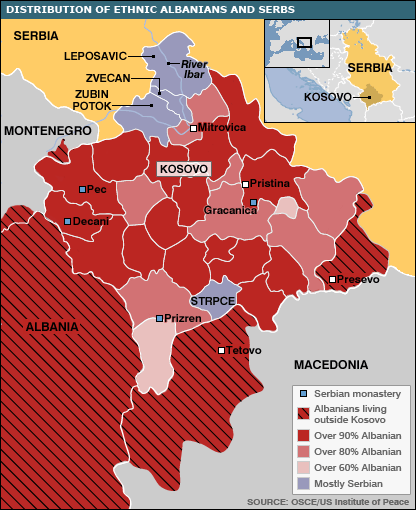
Ethnic map of Kosovo and neighboring regions / © BBC

Yet, Kosovars don’t seem to like the idea. The prime minister of neighboring Albania has also rejected the idea, arguing that it is important to keep political borders in the region as they are.

Trying to carve out ethnically homogeneous polities is indeed problematic, simply because it will never work. Neither the Presovo valley, which would be added to Kosovo, nor the northern parts of Kosovo, which Serbia claims, are inhabited by the respective ethnicity exclusively. There will always remain an ethnic minority, whose rights need to be protected.

There is an interesting aspect to the Serbian “proposal”, though. By suggesting a land swap with Kosovo, does the Serbian government not somehow recognize the country’s sovereignty, which officially is still part of Serbia? The plan adds at least evidence to the argument that Serbia attaches less and less importance to the status of Kosovo. If Serbia will eventually have to choose between the EU and Kosovo, as Igor Jovanovic suggested last week, will it choose the EU?

To me it seems it will. To admit so, however, would be suicide for the current Serbian government.
Categories
Uncategorized

Elusive Employment

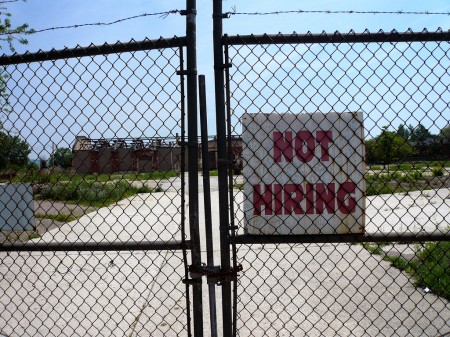
Sign of a sickly job market in Chicago, photo: ChiBart/flickr

With unemployment in many parts of the world the worst of the post-World War II era, policymakers are scrambling for solutions. This week the ISN examines the long-term unemployment trends of this ‘Great Recession’ and puts forward some potential policy prescriptions.

This ISN Special Report contains the following content:

  • An Analysis by Dr Dean Baker, co-director of the Center for Economic and Policy Research, on the worst US unemployment figures in the post-World War II era – and why Europe is faring better.
  • A Podcast interview with Dr Johannes Jütting of the Organization for Economic Cooperation and Development examines how workers in developing countries are adjusting to increasing job insecurity – namely by moving deeper into the informal labor market.
  • Security Watch articles about job security crises from Spain to Honduras, the US to India, and much more.
  • Publications housed in our Digital Library, including an analysis from the US Congressional Research Service on the current trend in long-term unemployment compared with that during previous recessions.
  • Primary Resources, like the US Bureau of Labor Statistics report on how governments measure unemployment.
  • Links to relevant websites, such as the International Labor Organization’s Youth Employment Network.
  • Our IR Directory, featuring Women in Informal Employment: Globalizing and Organizing, a global research-policy network that seeks to improve the status of the working poor, especially women, in the informal economy.

Mexico – A Democracy for the Brave Few

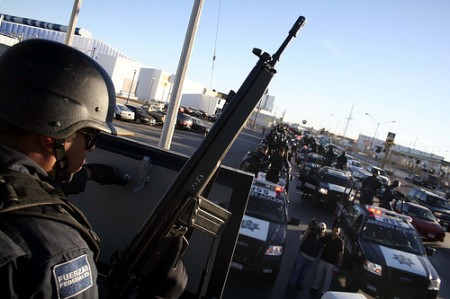
In Ciudad Juarez, Federal Police were deployed in attempts to stop the drug-related violence, courtesy of Jesus Villaseca Perez/flickr

Mexico is at a crossroads. As last week’s gubernatorial elections demonstrated, the Mexican state can no longer provide basic security and ensure the rule of law in many urban environments, signaling that Mexico might soon join the ranks of international failed states like Somalia, Afghanistan, and Haiti.

The New York Times adopted an optimistic perspective, noting the strength of the Mexican democracy amidst all the violence perpetrated by the drug cartels, as evidenced by the surprisingly positive voter turnout in many areas. These elections, however, also witnessed “the most blatant evidence of traffickers interfering in politics since Calderon came to power in late 2006,” with voter turnout at historic lows. Coming close to a stand-still in areas where drug violence has been prominent—in Ciudad Juarez, voter turnout was only 20 percent, and in the state of Chihuahua  as whole, only one-third of voters showed up—turnout can be explained by the violence surrounding electoral campaigns. Leading up to the elections, candidates had been killed and threatened, campaign offices had been bombed and general fear of the power of Mexico’s infamous drug cartels had uncomfortably set into everyday life in the country.

Categories
Uncategorized

ISN Quiz: Inside Israel

In our latest Special Report we explored the heterogeneity and complexity of Israeli society- now you can put your knowledge to the test!

[QUIZZIN 29]

Sarkozy’s Bid to Bottle Up the Media

Television, courtesy of dailyinvention/flickr

Perhaps Nicolas Sarkozy has always been a political figure excessively focused on publicity, ratings and the attention of the media. Yet, as of late President Sarkozy has started to open up about his ambitions of becoming the puppeteer of the French media landscape, grasping for control of some of the most influential institutions of the French press.

In short, President Sarkozy tried to become the majority shareholder of Le Monde (a renowned newspaper), he changed the law in order to be able to appoint the director of France Télévisions (the publicly-owned syndicate who, among others, controls France 2 and France 3), and he might be able to exert direct influence on Agence France-Presse (the third largest news agency in the world) if the latter successfully turns into a public firm.

It seems legitimate to ask whether France is currently going through a similar process of centralization of media control as Italy under Berlusconi. Despite all the evidence suggesting that this is the case, the situation in France is still different. While major parts of Italian media remain under the direct control of Berlusconi, the French media is dominated by small parts of the French establishment instead. Unlike Berlusconi, Sarkozy is not (yet) a majority shareholder of any private media companies and as the Guardian notes, he relies on a powerful network of close friends who are instead.