Categories
Uncategorized

OSINT Report 2/2010

OSINT Report 2/2010

In our second Open Source Intelligence Report, Felix Juhl gives an introduction to cloud computing and its security implications. He argues that appropriate risk analyses, proper service level agreements and professional provider management are key to building and maintaining sustainable cloud information architectures.

Jan Störger theoretically approaches the role of OSINT for the intelligence community. He separates Open Source Intelligence from Non-Open Source Intelligence both in terms of sources and the means required to collect and exploit those sources. Furthermore, he suggests a model that describes its potential usefulness for non-state OSINT contributors.

Florian Schaurer looks into the use of social tagging within enterprises, addressing the importance of accurate taxonomies for collectively allocating and making best use of a broad range of sources.

He also examines the theory and application of academic source criticism, claiming that even in the digital age with its unparalleled variety, velocity and volume of information, the methods developed by historical and related sciences for working with sources are still crucial and up to date.

The Report is available in German. See also the ISN’s further resources on OSINT.

Categories
Uncategorized

Feast or Famine?

Wrestling with questions of how to feed a burgeoning population, photo: Mr Kris/flickr

Growing population demands and the shrinking availability of arable land and groundwater resources raise questions about the sustainability of agricultural production. This week the ISN takes a closer look at the threats to the future of agriculture, and the technological advances that could help promote – or in some cases undermine – global food security.

This ISN Special Report contains the following content:

  • An Analysis by Peter Buxbaum on the promises and pitfalls of agricultural biotechnology.
  • A Podcast interview with Dr Ronnie Coffman on the dangers of wheat rust and the global efforts to develop more resistant varieties of wheat to mitigate the coming epidemic.
  • Security Watch articles about reducing pesticide use, racially motivated land grabs and much more.
  • Publications housed in our Digital Library, including the recently published Center for Global Development Working Paper on ‘Pulling Agricultural Innovation and the Market Together’.
  • Primary Resources, like the full-text of the US Department of Agriculture’s projections to 2019.
  • Links to relevant websites, such as to the World Bank’s Agriculture and Rural Development Department.
  • Our IR Directory, featuring The Borlaug Global Rust Initiative, which pursues the systematic reduction of vulnerability to stem, yellow and leaf rusts of wheat.

UNpopular – Public Resistance to UN Peace Missions

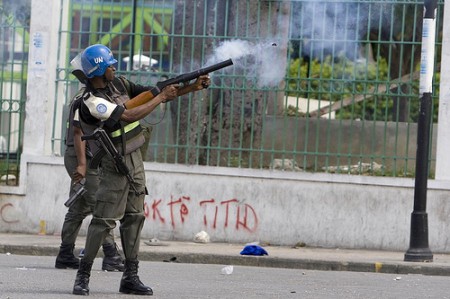
MINUSTAH peacekeepers fire tear gas to disperse demonstrators in Port-au-Prince, courtesy of UN Photo/Logan Abassi

Most UN peace missions established during or after conflict need the permission of the host country in order to deploy international troops. Once deployed, UN operations come to play a formative role in helping to re-build the state apparatus. They operate by, among others, establishing the rule of law, providing security, jump-starting economic development programs, and helping the host government build its capacity to form functioning state institutions.

However, government consent does not necessarily translate into popular support for such a strong foreign presence, which can be seen by local populations as too intrusive and pugnacious. A recent wave of popular backlash against UN missions has brought into question the universality of the UN’s internationalist norms and practices.

In Sri Lanka, following the government’s defeat of the Tamil Tigers’ 25-year armed campaign for an independent Tamil state, Secretary-General Ban Ki-Moon appointed a three-member panel to advise him on allegations of human rights violations that allegedly occurred during the protracted conflict. Resistant, a Sri Lanka government cabinet minister, Wimal Weerawansa, calling on Ban Ki-Moon to dissolve the panel, is leading hundreds of Sri Lankans in protest outside the UN office in Colombo, blocking access to the UN offices as well as harassing and intimidating officials.

Categories
Uncategorized

ISN Quiz: Unemployment

This week’s Special Report dealt with the issue of unemployment in the wake of the financial crisis. How much do you know about the topic?

[QUIZZIN 30]

Campaigning at the Expense of the World’s Weakest

photo: Kiss the boy/flickr

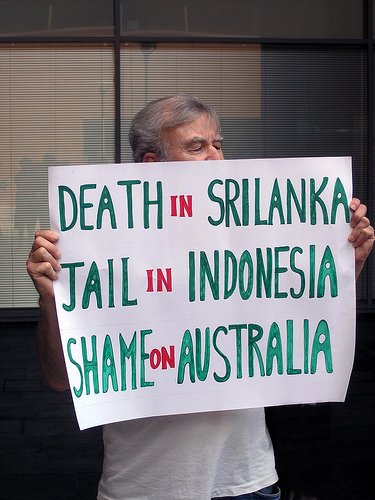
This week the tiny nation of East Timor found itself caught up in the vicissitudes of Australia’s domestic politics. In her first policy speech as prime minister, Julia Gillard proclaimed the country’s interest in a regional solution to an apparently regional problem. She announced a plan to create a regional hub for processing refugees on East Timor as a means of deterring mainly Sri Lankan and Afghan asylum seekers from paying criminal syndicates for passage to Australia.

The Prime Minister stated she had discussed the issue with East Timor’s president Jose Ramos-Horta. She had, however, neglected to include East Timor’s Prime Minister Xanana Gusmao in the discussion, who then allowed his own party to join in a unanimous condemnation of the plan in parliament (considering the only thing Timorese politicians seem to agree on is their lack of love for Australia, there was probably never a big chance of the plan going anywhere anyway.)