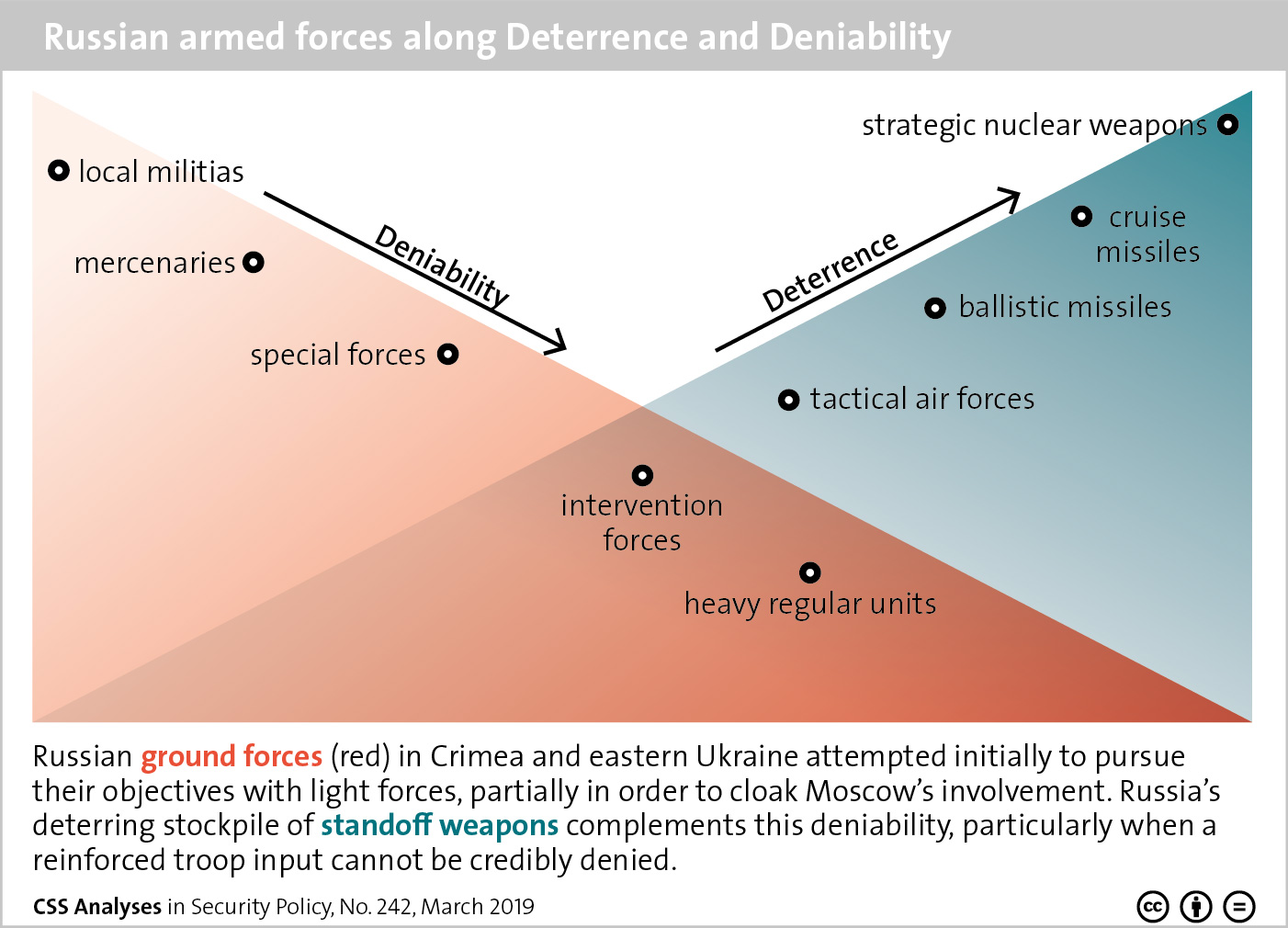
This graphic maps how Russian armed forces’ capabilities relate to their deniability and the deterrence they provide. It also describes how Russia made use of these capabilities in Crimea and eastern Ukraine. To find out what Western planners and strategists have learned from the war in Ukraine, read Niklas Masuhr’s addition to the CSS Analyses in Security Policy series here.
Since 2013 China has clearly called for the creation of a new security architecture in Asia. The May 2015 white paper on China’s military strategy explicitly advocates promoting ‘the establishment of a regional framework for security and cooperation’. This call was reaffirmed in October 2016 and detailed further in China’s white paper, published in January 2017, on security cooperation in Asia-Pacific. Since then, Chinese officials have repeatedly declared, one way or another, that the region needs to be restructured. On 16 February 2019, at the 55th Munich Security Conference, Politburo member Yang Jiechi declared that ‘China supports security dialogue among the Asia-Pacific countries and efforts to explore a regional security vision and architecture that fits the reality of this region’. 2
It’s rare to hear firsthand accounts of daily life amid the conflict in Donbass. But we do have a few. The photographer Paula Bronstein captured the broken bodies and tormented souls of elderly people. The documentary filmmaker Simon Lereng Wilmont shot the war through the eyes of a 10-year-old orphan boy living in a small village with “The Distant Barking of Dogs.” My colleague Ioulia Shukan, a French sociologist, keeps a blog on ordinary citizens affected by the war in Eastern Ukraine. She recounted the everyday life of three female villagers in the grey zone, their fear of shells and their cohabitation with soldiers. She also told the story of a young family that left the little Ukrainian town of Marinka — where there is still no heating and no drinking water — for the separatist-held city of Donetsk to escape immediate danger and precarious conditions. These Ukrainians’ stories highlight not only the human cost of the ongoing war, but also the perils of the Ukrainian government — and its Western partners — ignoring that cost.
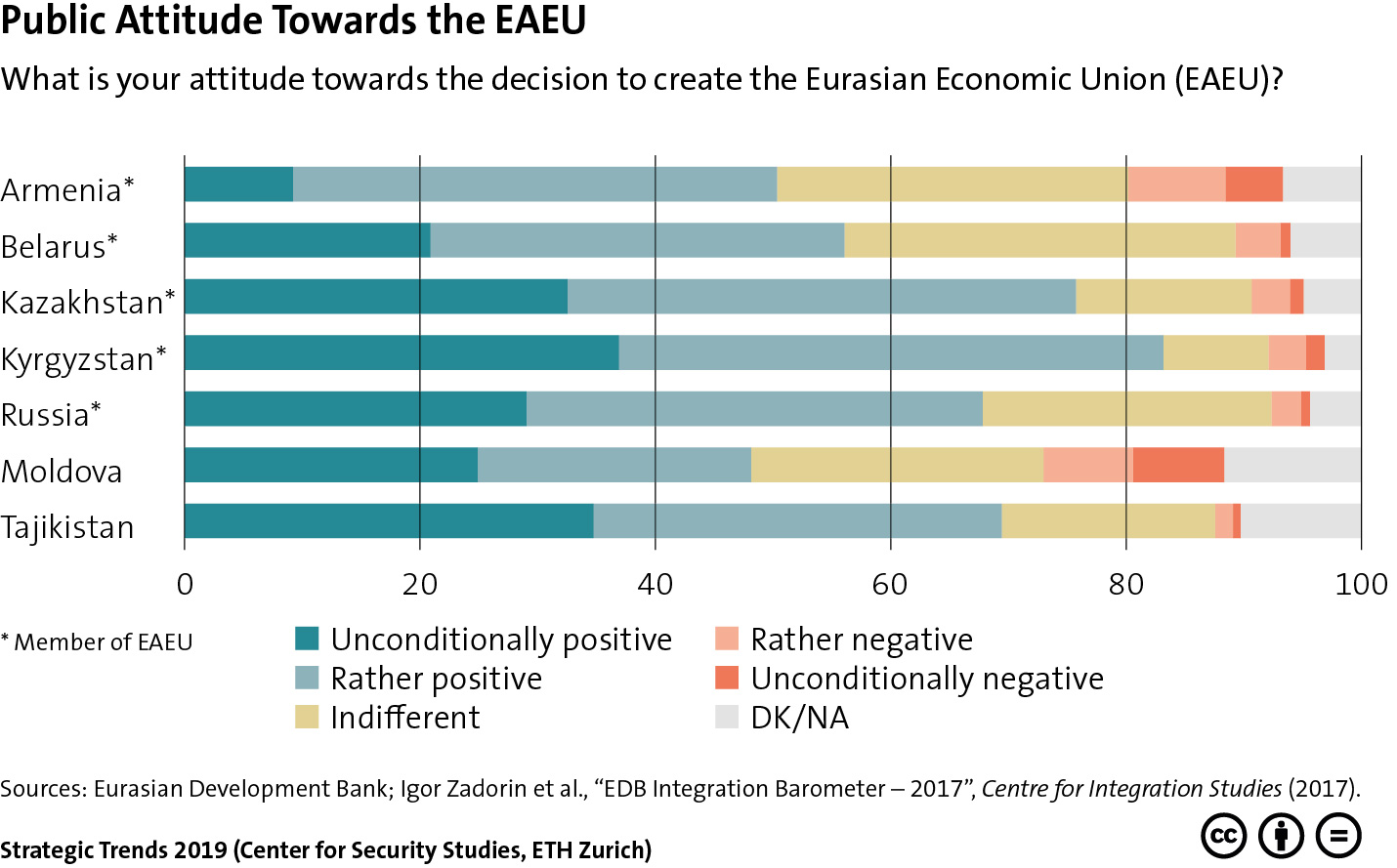
This graphic displays public attitudes in Eurasian Economic Union (EAEU) member states towards the creation of the organization. For an insight into the role of the EAEU in Russia’s Eurasian strategy, see Jeronim Perović’s chapter for Strategic Trends 2019 here.
Following five years of periodic controversies and criticism – some factual, others contrived – President Xi Jinping used the Belt and Road (BRI) Forum in April to set the agenda for the next five years of his hallmark project. At the forum’s second edition, meant to promote a “stronger partnership network,” the Chinese leader pledged to “clean up,” stressed “zero tolerance” to corruption, and emphasized readiness to adopt “internationally acceptable” standards in the bidding process of BRI projects in the future. This language indicates Beijing’s openness to constructive criticism and willingness to objectively tweak some inherent weaknesses in the strategy and implementation mechanisms for the BRI during the 2013-2018 period. It also sets the stage for the start of “BRI 2.0,” where the stress is likely to be on the qualitative, rather than just quantitative, attributes. The following are some analytical pointers on how BRI 2.0 is likely to be different from version 1.0, especially keeping in mind what Chinese Minister of Foreign Affairs Wang Yi referred to as a “high-quality” shift from “big freehand” to “fine brushwork” in planning BRI’s future projects.