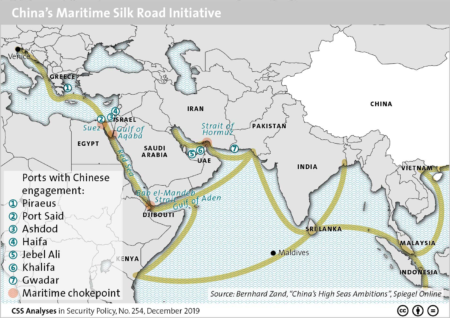
China’s Belt and Road Initiative (BRI) has both a land-based and a maritime component. This graphic provides an overview of the maritime element, the Maritime Silk Road Initiative (MSRI) which connects connects China to Europe and Africa via the Middle East. For an insight into the BRI in the Middle East, including its implications for China’s impact on the region, read Lisa Watanabe’s recent CSS Analyses in Security Policy here.
In this new series, experts give their quick responses to five questions about the most important news of the day.
What should the United States be most concerned about regarding possible meddling by Russia in US elections?
Jesse Driscoll: I think three things are pretty concerning. First, it’s concerning that the kinds of interventions we have evidence of can easily be “up-scaled” without necessarily violating laws. Second, I find it concerning that the Russian government is so entrepreneurial about identifying polarizing issues that do not seemingly have anything to with US-Russia policy—suggesting they may be fine-tuning models of voter turnout suppression that could induce disgust and be micro-targeted. Third, and most importantly, I think it’s clear that Russia is just experimenting. It’s easy to imagine other countries doing more, with more resources, in the near future.
A common refrain in Denmark is that China is too far away to be a threat to Danish economic, foreign and security policy interests. This is no longer the case. Danish policy-makers acknowledge that China’s rise as a global superpower presents Denmark with new challenges. However, transforming this strategic thinking into practice is no simple task.
Over the past few years, political leaders in Europe and elsewhere increasingly link the risk of terrorism to immigration. This includes moderate politicians in countries targeted by terrorism such as the German Chancellor Angela Merkel as well as leaders of states that are less frequently hit by terrorist attacks, such as the Polish president Andrzej Duda. In this context, our article investigates the impact of terrorism on immigration attitudes across Europe. Specifically, we ask whether terrorist attacks can propagate migration concern from targeted countries to their neighbors.