The International Dimension of Tunisia’s Success Story

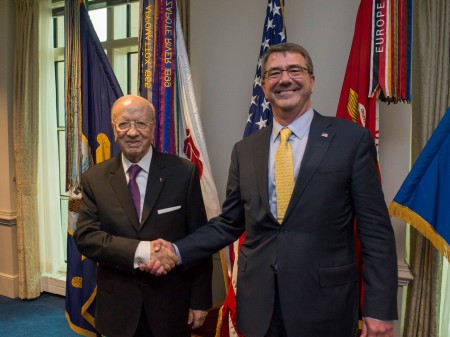
US Secretary of Defense Ash Carter with Tunisian President Caid Essebsi at the Pentagon, 21 May 2015.

Tunisia’s transition process remains one of the few bright spots of the Arab Spring. While the transitions initiated in Egypt, Libya and Yemen have experienced numerous setbacks and repeated outbursts of violence, if not outright civil war, Tunisia appears to be well on its way to securing a genuine democratic space for itself. This view is shared, for example, by the latest Freedom in the World Report, which ranks Tunisia as the first ‘free’ country in North Africa since Freedom House began its worldwide assessments of political rights and civil liberties in 1972.

Although there is a fast-growing body of research that attempts to explain Tunisia’s comparatively smooth democratic transition, the Western media has not been as upbeat. Most analysts have focused on the challenges Tunisia faces, including the instability being generated by neighboring Libya and the broader Middle East and North Africa (MENA) region. As a result, other important aspects of Tunisia’s external relations, particularly those that have had positive implications for its transition, have gone unnoticed.

Most importantly, Tunisia’s new political order appears to have benefitted substantially from the staunch support of those external actors who have the most leverage over the country. In contrast, those with a more critical attitude towards the transition have largely lacked the ability to influence the trajectory of the transition in less positive ways. These circumstances are far from accidental, by the way. They’re the consequence of the country’s history.
Is France Taking a Strategic Holiday?

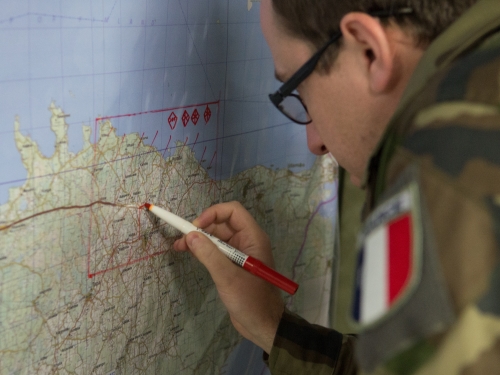
A French army soldier plots a course on a map during the command post exercise portion of Exercise Steadfast Jazz. Image: US Army Europe/Flickr

This article was originally published by European Geostrategy on 31 May, 2015. Republished with permission.

The title of this article may seem like a staggeringly misplaced and ill-timed question. After all, is France not militarily engaged in Mali, the Central Africa Republic and Syria? Is Paris not involved in the type of crises that have a direct impact on European security, when so many of its fellow European states shy away from military action? Has France not jostled its way alongside London as the United States’ partner of choice on military affairs? Did France not recently agree to spend an extra €3.8 billion on defence over the next four years?

Categories
Humanitarian Issues

International Law and the Changing Face of Conflict

Global Justice and International Law. Image: geralt/Pixabay

On 20 May 2015, the ISN hosted an Evening Talk on “International Law and the Changing Face of Conflict,” which featured the University of Notre Dame’s Dr. Tanisha Fazal, who is an Associate Professor of Political Science and Peace Studies there. Today, we feature 1) her presentation on the proliferation of international humanitarian law (IHL) and its unintended consequences, and 2) highlights from the subsequent questions and answers session, which was moderated by the ISN’s Peter Faber.

Categories
Regional Stability

Military-wise, There Is No Europe

Image: geralt/Pixabay

This article was originally published by War on the Rocks on 3 June 2015.

For two decades a wide variety of plans, guidelines and roadmaps have been published and issued on European defense matters. The adoption of the European Security and Defence Policy (ESDP), the creation of the European Union Military Committee and European Union Military Staff, the development of the European Defence Agency, the inception of the European Union Battlegroups, and the implementation of several military crisis management operations from Kosovo to Somalia and Iraq to Guinea-Bissau, are all examples of the process by which European states are trying to facilitate the creation of a new post-Cold War era military dimension to European politics. In other words, these above-mentioned projects have been attempts to form a European-wide approach to security and defense policy.

Categories
Terrorism

‘You Have to Neutralise Terrorists through Terrorists’: Is There a Method to This Madness?

Defense Minister Manohar Parrikar addresses the media during the Naval Commanders’ Conference 2015. Image: Indian Navy/Wikimedia

This article was originally published by Strife on 2 June 2015.

While attending a function in New Delhi On May 21st, India’s Defence Minister Manohar Parrikar said ‘You have to neutralise terrorists through terrorists’. He was referring to the threats to Indian national security from an alleged Pakistan sponsored proxy war. It was a profound statement, as it came from a defence minister of a right-wing nationalist government that came into power with an absolute majority riding on the election promises of giving a befitting reply to provocations originating in Pakistan.