
The AU’s Plans for an African Passport a Pie in the Sky?

Stamps in an African Passport. Image: Jon Rawlinson/Wikimedia

This article was originally published by ISS Africa on 15 July, 2015.

Amid the furore over Sudanese President Omar al-Bashir’s attendance, along with celebrities like Angelina Jolie, some of the discussions at last month’s African Union (AU) summit in Johannesburg went largely unnoticed.

One of these is a renewed call for African countries to open their borders and for regional economic communities (RECs) to do this by no later than 2018.

Is the AU way ahead of its time? Or is this just a desperate measure to find alternatives for Africans who are so eager to leave their own countries that they risk life and limb to settle elsewhere?

From Yemen to Gaza and Beyond – UK Arms Export Controls are Broken

Anti-arms trade protest at Occupy London. Image: duncan c/Flickr

This article was originally published by Open Democracy on 17 July, 2015.

The humanitarian crisis being inflicted on the people of Yemen is only getting worse. Over 2000 people have died in the Saudi-led bombardment that, according to the World Health Organisation, has left over one million people displaced. The long term consequences are likely to be no better; the UN has warned that over 20 million civilians are in need of urgent assistance. The situation has been exacerbated by a Saudi imposed blockade that is stopping food and other basic essentials from reaching those in need.

Categories
Terrorism

Combatting Terrorism: Soft Power Approaches

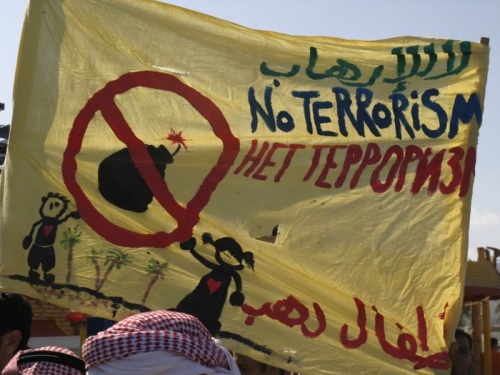
Bedouin protest over the recent terrorist attacks in 2006. Image: John Barker/Flickr

This article was originally published on 20 July 2015 by The Strategist, a blog run by the Australian Strategic Policy Institute (ASPI).

Over a decade of securitised transnational approaches to combatting terrorist activity and propaganda have shown that such approaches are ineffective on their own. Sometimes, these ‘hard power’ measures can actually damage efforts to roll back the appeal and participation in violent extremism.

While such steps may be justified in domestic contexts where threats are critical or imminent, failure to accompany these with robust ‘soft power’ initiatives will prove fatal in the longer-term. If we are to succeed in countering violent extremism, these are some key strategies to invest in:

Categories
CSS Blog

Mediation Perspectives: Where Do Norms Come In?

Two people negotiating. Image: Georgie Pauwels/Flickr

After months of seemingly endless negotiations in a country that has seen years of conflict, the moment has finally come to sign a peace agreement. Exhausted, the mediator is preparing herself for the ceremony, which will take place in a few hours. But before she gets ready to leave, a representative of an international organization enters the mediation office, with a glum expression on his face. “Your text is not nearly as gender-sensitive as we would have liked; you omitted several of our clauses. We counted on you and you failed to put them into the agreement. You have to change it, or we will not endorse the agreement!”

Although fictional, the above example reflects how common it has become in mediation to push aggressively for the inclusion of norms. Mediators are faced with ever-higher expectations when it comes to including normative demands into peace agreements – not just from advocacy groups lobbying for their interests but increasingly from mandating authorities like the United Nations, the European Union or state governments. This raises many questions about how to treat these demands.  If they represent diverging interests, some of them may have to be tempered or sequenced. But it also raises another, perhaps more fundamental, question: to what extent is it a mediator’s role to promote norms in a mediation process?

Has Egypt’s Judiciary Become the New Theatre of the Absurd?

Young Egyptians protestig Morsi and the military. Image: Hamada Elrasam for VOA/Wikimedia

This article was originally published by the Institute for Security Studies (ISS) on 7 July 2015.

The recent death sentence passed down on former Egyptian president Mohamed Morsi, along with 106 others, is far from being the only politically motivated conviction made by the Egyptian courts. Mass trials have become common since the July 2013 coup, which ousted Morsi, Egypt’s first democratically elected president.

Collectively, these court decisions have raised serious questions about the independence of the judiciary, and suggest that the courts are merely an extension of the military regime, rather than an independent arm of the state.

Characteristic of these trials is the lack of due process throughout investigation and trial proceedings, the absence of objective evidence presented during trials and increasing numbers of defendants held incommunicado without access to legal representation. Lack of transparency is also evident, with courts refusing to make judgements public, proof that the judicial functions in the country are fast becoming politicised.