
Whodunnit? Russia and Coercion through Cyberspace

Blue Circuit
Courtesy of Yusuke Umezawa / Flickr

This article was originally published by War on the Rocks on 19 October 2016.

Late in May 2014, a group calling itself CyberBerkut leaked a map of the Ukrainian Dnipropetrovsk Oblast administration’s IT resources, information on the Central Election Commission of Ukraine’s servers, and the correspondence of its staff. In the following days, which included the country’s presidential election, CyberBerkut claimed they had again compromised the election commission’s servers, leaked more confidential information, conducted a distributed denial of service (DDoS) attack the commission’s website (which instructed potential voters how and where to vote), and blocked the phones of election organizers. The group also released documents implying that the recently appointed governor of the Dnipropetrovsk Oblast, Igor Kolomoisky, was complicit in pro-European Ukrainian plans to promote the “correct” candidate for president of Ukraine.

Despite the best effort of the Russian group behind CyberBerkut, the center-right, pro-European Petro Poroshenko won the Ukrainian presidency. But CyberBerkut wasn’t finished. Almost exactly five months later, the group used similar tactics in the days preceding the Ukrainian parliamentary elections. The results were largely the same: Pro-European candidates won the majority of seats. An uninitiated observer might be keen to discard these events as failed electioneering. After all, Moscow did not succeed in getting its men elected. But to label the operation a failure is to assume that the primary goal was to get pro-Russia officials elected. Over the course of the past four months, we have seen similar operations unfold in the United States, and — as was the case in Ukraine — there are reasons to believe that swaying the election is not the primary objective. Just as in the case of the CyberBerkut incidents, among the key observers of these operations in the United States have been cyber-security firms like FireEye. The manager of their information operations analysis team recently shared some of their findings with me, which informs the analysis below.


Categories
Terrorism

What Can Mali Teach the UN About Confronting Terrorism?

Dunes
Courtesy of Boris Savluc / Flickr

This article was originally published by the IPI’s Global Observatory on 18 October 2016.

There was little media coverage of last month’s United Nations ministerial meeting on Mali—opened by Malian President Ibrahim Boubacar Keïta and UN Secretary-General Ban Ki-moon—held on the sidelines of the General Assembly in New York. This was in stark contrast to four years ago, when United States presidential candidate Mitt Romney mentioned the conflict in northern Mali during a debate with Barack Obama. Does this mean that Mali is falling off a busy multilateral agenda dominated by the refugee crisis, Syria, and the transition to a new UN secretary-general?

The optimists would see it as a sign that the situation is not as bad as it once seemed, and that the UN Multidimensional Integrated Stabilization Mission in Mali (MINUSMA), deployed in July 2013, is—alongside French counterterrorist force Barkhane—helping to prevent terrorist groups reoccupying northern Mali. Yet this goes against observations of “a doubling in the number of attacks perpetrated by violent extremist groups in northern Mali” and the fact that “attacks have spread to the center of the country” as Ban noted in his most recent Mali report to the Security Council.

Categories
CSS Blog

Mediation Perspectives: Seven Avenues for Research in International Mediation

Peter Wallensteen
Peter Wallensteen speaking at the 2016 International Conference on Mediation.

What are new avenues for research in international mediation? This question was discussed at the International Conference on Mediation, which took place in Basel, Switzerland, in June 2016. It was jointly organized by the Centre for Mediation in Africa (CMA) at the University of Pretoria, the Global South Unit for Mediation (GSUM) at the Catholic University of Rio de Janeiro, and swisspeace, which is an associated institute of the University of Basel.

The utility of the conference lay in its focus on two topics. First, trying to bridge the research–practice gap by having both mediation researchers and practitioners attend the event. Second, the conference sought to bridge the North-South gap by hosting researchers and practitioners from both the Global North and Global South, and thereby helping to rebalance the present research asymmetry that exists in the world.

By drawing on a variety of perspectives, the conference highlighted the following areas of research as being particularly relevant for the further development of the mediation field.

Seven Worrying Trends in the European Refugee Crisis

Sea Storm, Blue Moon
Courtesy stainedglassartist/Flickr

This article was originally published by the European Council on Foreign Relations on 13 October 2016.

EU leaders could soon come to regret having crossed their fingers and moved the refugee crisis off the urgent pile in their in-tray.

As part of his final UN General Assembly, President Obama hosted a leaders’ summit on refugees. In his speech he termed the global refugee crisis one of ‘the most urgent tests of our time’. But the list of commitments coming out of the summit did not live up to this description. The Bratislava EU summit earlier this month barely touched on refugee issues among the list of priorities to address, and there seems to be a general sense that Europe has more or less weathered the refugee storm that appeared so threatening in 2015.

There is some truth to this – for now. The number of sea crossings to the EU in the first nine months of 2016 was indeed down, at around 300,000, compared to 520,000 in 2015. But despite this there are a number of worrying trends that EU leaders would be foolish to ignore.

North Korea’s Testing Decade

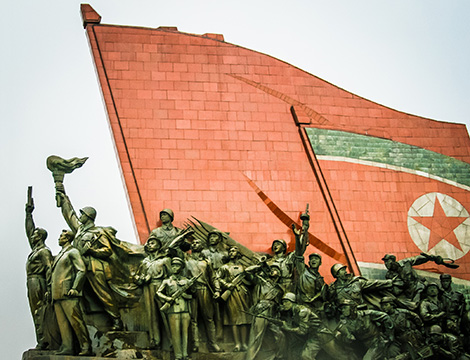
North Korean Monument
Courtesy Gilad Rom/Flickr

This article was originally published by the Council on Foreign Relations on 7 October 2016.

A decade has passed since North Korea first tested a nuclear weapon, on October 9, 2006. It conducted its fifth nuclear test last September, and there are rumors that a sixth will come within weeks or months. The United States has tried to both negotiate with and sanction North Korea while strengthening deterrence with South Korea and conducting shows of force to underscore the U.S. commitment to South Korean defense, but these measures have not halted, much less reversed, North Korea’s nuclear program.

Instead, following the leadership transition from Kim Jong-il to Kim Jong-un, North Korea has elevated its nuclear program to a primary strategic commitment, reigniting debates among U.S. experts over whether the U.S. goal of “complete, verifiable, and irreversible denuclearization” is feasible. North Korea has conducted four tests during the Obama administration, and the president reiterated after the latest one that the United States “does not, and never will, accept North Korea as a nuclear state.” Yet the longer that North Korea is able to expand its nuclear delivery capability, the more empty U.S. condemnations may become and the closer North Korea will edge toward winning de facto acceptance of its nuclear status.