Northern Kosovo: Status Quo, for Now

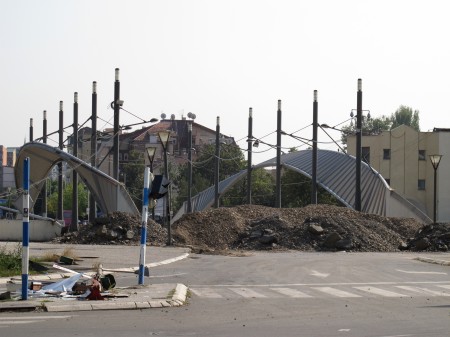
Serbian roadblocks in the divided town of Mitrovica
You choose your borders, we choose ours. Photo: Valerie Sticher

Last week’s outbreak of violence between ethnic Serbs and NATO forces at the border between Kosovo and Serbia may not have been large in scale, but this latest of a number of incidents points toward an escalation of long-simmering tensions in Northern Kosovo. The developments are not just  important symbolically; disagreements over the status of the North are the main obstacle to reconciliation between Belgrade and Pristina. They have implications for the wider region and, in effect, keep Serbia out of the EU and Kosovo out of the UN.

The positions are relatively clear-cut:

  • Belgrade’s motto is ‘partition, then recognition’: it has made clear that the only way it will accept Kosovo’s independence is if Northern Kosovo becomes a part of Serbia
  • Serbs in Northern Kosovo, who make up a large majority of the population, uniformly identify with Serbia and refuse to be part of an independent Kosovo
  • For Pristina, partition is unacceptable
  • The international community also wants to avoid changes to Kosovo’s borders, for fear of destabilizing the western Balkans and playing into the hands of Kosovo’s nationalists. The EU and the US have consistently insisted that Serbia accept Kosovo’s territorial integrity and work with its government on practical matters

Categories
Uncategorized

This Week at the ISN…

It's week 40 on the ISN's 2011 editorial calendar, Photo: Jon Jordan/flickr

We’ll highlight the following topics:

  • In ISN Insights on Monday, Jody Bennett uncovers a little known US-Saudi defense deal to keep revolution in the Kingdom at bay
  • On Tuesday, we’ll discuss the security situation in northern Kosovo in the context of Serbia’s relationship with the EU
  • In Wednesday’s ISN Insight, Simon Saradzhyan of Harvard’s Belfer Center examines the implications of Putin’s return to the Kremlin
  • On Thursday, we continue our Great IR Thinkers series with: Kenneth Waltz
  • In Friday’s ISN podcast, Myriam Dunn discusses the real and imagined dangers of cyber warfare

And in case you missed any of last week’s coverage, you can catch up here on: China’s space policy; security curves and neorealism; organized crime and social media in Latin America; Islamic fundamentalist recruitment online; and democracy and change in Liberia

Categories
Business and Finance

Now, Seriously: Financial Transaction Tax

A tax that won't hurt, except for gamblers. Image: artuemuestra/flickr

Liberal-minded economists are usually skeptical of taxation: taxes distort markets and lead to the inefficient allocation of resources. However, some taxes are better than others, and financial transaction taxes, such as the Tobin Tax, are certainly in that category.

Now, the European Commission is getting serious about introducing a financial transaction tax. Their proposal: levy a tax of 0.1% on every financial securities transaction performed by a financial institution based in the EU.

Islamic Fundamentalist Recruitment Online


An internet cafe in Taipei. Photo: Jared Tarbell/flickr

The idea that Islamic extremists use the internet for terrorist purposes is not exactly a revelation – terrorists have been coordinating attacks and spreading propaganda via email since the 1990s. Nevertheless, recent reports from the White House, as well as the Centre for Strategic and International Studies, suggest that the internet is being used more and more as a platform for extremist recruitment. With the rise of ‘Web 2.0’, or user-generated web content, extremists are now able to reach and interact with audiences of all ages, genders, backgrounds across geographic boundaries. Consequently, there has been a sharp increase in the number of ‘non-affiliated cells’ willing to carry out potentially fatal attacks.

  The internet is now the most important method of spreading jihad and Islam.
  -Imam Samudra, orchestrator of the 2003 Bali Bombings

This audio-visual slideshow looks at the methods currently being used by Islamic extremists to radicalize individuals online and equip them for violence._

   
  For more information, please click here  

_


The internet can be a powerful weapon for spreading extremist messages. With the exponential growth of global internet connectivity, it is now more important than ever that NGOs, think tanks, and governments work together to generate effective strategies to counter the use of the internet for these purposes. As noted at the conference of the United Nations Counter-Terrorism Implementation Task Force (CTITF) on the Use of the Internet to Counter the Appeal of Extremist Violence in Riyadh earlier this year, for every harmful message on a particular internet medium, there should also be a counter-narrative on the same medium which provides a sound alternative to radicalized ideologies. Terrorist recruitment on the internet should not be a problem that is dealt with reactively– it needs to be defused before the real damage is felt.


For a much more detailed analysis on these topics, please read:


  • The United Nations CTITF Working Group on Countering the Use of the Internet for Terrorist Purposes – website

New ISN Partner: Climate Change and African Political Stability Program

We are happy to announce that the Climate Change and African Political Stability (CCAPS) Program based at the Strauss Center for International Security and Law has joined the International Relations and Security Network. CCAPS is a collaborative research program among the College of William and Mary, Trinity College Dublin, the University of North Texas and the Strauss Center at the University of Texas at Austin.

CCAPS examines the impact of climate change on political stability in Africa and develops strategies for how to prevent related conflicts. In the words of CCAPS, the program aims at answering three main questions:

  • Where and how does climate change pose threats to stability in Africa?
  • What is the role of government institutions in mitigating or aggravating the effects of climate change on political stability?
  • How effective is foreign aid in helping African countries adapt to climate change?