Categories
Terrorism

Is Terrorism an Effective Tool for Obtaining Territorial Concessions?

Image: Menendj/Wikimedia

This article was originally published by SIPRI on 7 July 2014. This blog post is published as part of a collaborative partnership between SIPRI and Economists for Peace and Security (EPS).

Terrorism is an important but complex issue that affects many countries. While we have a good understanding of the determinants behind terror campaigns, very little attention has been paid to the question of whether terrorism is an effective strategy for coercing the targeted country to grant political and territorial concessions. The lack of research is surprising, given that the answer to this question is critical to understanding why terror exists at all, and why it appears to be increasing in many parts of the world.

Categories
Humanitarian Issues Terrorism

Fear and Loathing in Jos, Nigeria

Image: ArnoldPlaton/Wikimedia

This article was originally published by Mats Utas on 14 July 2014.

Since 2001, Jos, Nigeria is internationally known for intermittent bursts of violent, inter-religious conflict. In addition, for the past several years Nigeria has faced terror attacks by the Islamist group Boko Haram, what many would call the worst violent crisis since independence.

On 20 May 2014, two bombs went off in the center of Jos, killing at least 118 people and injuring 56 more. The area targeted was Terminus Market, arguably the busiest and most densely populated location in town, a market used by all ethnic groups and by Christians and Muslims alike.

Categories
Terrorism Regional Stability

Al Qaeda and a Global Revolt

Al-Qaida training manual found in Afghanistan, courtesy of CIA/wikimedia commons

 This article was originally published by openDemocracy on 22 May 2014.

The collapse of Zine el Abidine Ben Ali’s regime in Tunisia in January 2011, soon followed by Hosni Mubarak’s in Egypt, had a profound impact across the Arab world. There was an eruption of protest in Oman, Libya and Bahrain, while an incident in the town of Deraa in southern Syria sparked demonstrations that grew and spread into regular events involving thousands of young people.

Almost from the start, Bashar al-Assad’s regime was determined to maintain power, with severe repression of demonstrations leading to violence, injury and death. As non-violent demonstrations escalated into rebellion, the regime’s response was to use greater force while insisting that the stability of the state itself was being threatened by terrorists.

For almost a year this mantra was pushed insistently. By late 2012 it had become something of a self-fulfilling prophecy: dedicated young jihadists had formed some of the most cohesive elements of the rebellion, attracting recruits from across the middle east and beyond.

Categories
Terrorism

Give Peace A Chance: It’s Time to Change How International Justice Works

The International Criminal Court in The Hague (ICC/CPI), Netherlands, courtesy Vincent van Zeijst/wikimedia

Imperatives for peace and for justice often seem to collide in many conflict and post-conflict situations. The immediate inspiration for this article was the recent arrest in Northern Ireland of Sinn Fein politician Gerry Adams in connection with the 1972 murder of Jean McConville. Coming right before European and local elections the arrest had immediate political consequences for the stability of Northern Ireland and the success of the ongoing peace process in the province. It also highlighted the continued lack of agreement for how to handle the legacy of past killings despite sixteen years of relative calm.

This problem is especially acute in modern conflicts. Today’s wars tend to be messy civil ones, often with a bewildering kaleidoscope of armed actors. Unlike the interstate wars of the past, there is often no obvious victor to a struggle, and often no clear-cut chain of command. Instead, there is a usually a messy list of atrocities, at the end of which is a patched-together political settlement that sometimes holds, and sometimes does not. To return to the example of Northern Ireland, many sources allege Gerry Adams to have been a senior Irish Republican Army (IRA) leader responsible for ordering bombings and murders in the 1970s and 80s (Adams denies this). His detention by police investigating the McConville murder could easily have led to widespread rioting in Republican parts of Belfast. It may yet lead to Loyalists withdrawing from the unity government, so toxic is the issue in the Protestant community.

Categories
Terrorism

Saudi Arabia, Syria and Bin Laden’s Ghost

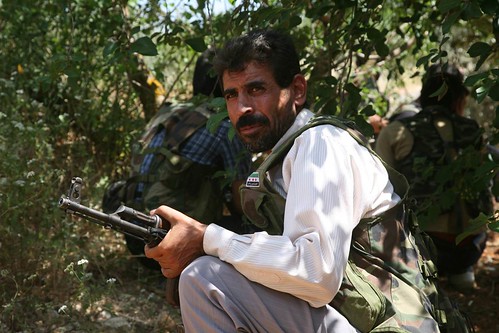
Rebels from the Justice Brigade

This article was originally published by the Middle East Institute on 14 February 2014.

Osama bin Laden may be dead, but his ghost was in Riyadh the other day, hovering over Saudi Arabia’s King Abdullah as he issued a decree making it a crime for any Saudi citizen to take part in a war outside the kingdom.

The obvious motivator was the civil war in Syria, where hundreds of young Saudis have been spotted in the ranks of the most radical jihadi groups battling both the government and other less extreme rebels. But the roots of the king’s action, and the problem it was designed to address, can be traced to the 1980s war against the Soviet occupation of Afghanistan.