Categories
Uncategorized

Gaddafi and Ahmadinejad: Beyond Provocation

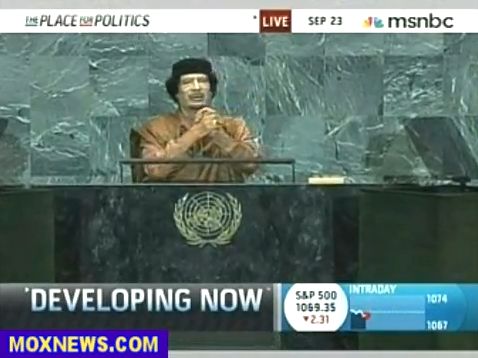
Gaddafi's speech at the UN General Assembly

Much of western media reports reacted with outraged dismissals to Ahmadinejad‘s and Gaddafi‘s UN speeches on Wednesday. However, despite their populist and provocative style, the message should be taken seriously.

While their lack of political correctness and exaggerations might have put you off, they shouted what a significant proportion of the world’s population believes.

The Huffington Post analyzes the main arguments in Gaddafi’s speech in five slides: the Palestinian plight; the unjustified Iraq war; unequal representation at the UN; the UN as a western product; and world domination by Security Council veto powers. This doesn’t sound particularly radical; these arguments are all over academic papers, too.

Ahmadinejad calls for everybody to drop their nuclear weapons instead of excusing himself for his own nuclear program. But it makes sense if you put yourself in his shoes. Why should Pakistan be allowed nukes and not Iran? In his speech at the Durban Review conference earlier this year, Ahmadinejad insisted strongly that Israel was a racist regime. You can find all sorts of explanations as to why Israel pursues the policies it does, but you can’t resent the Arab Israelis and the Palestinians for feeling discriminated against.

Don’t get me wrong: I don’t necessarily agree with the Iranian and Libyan heads of state. I just want to warn against dismissing them too quickly as authoritarian madmen. Western self-righteousness offends many, and they may choose to react in violent ways. Think al-Qaida, for example.

Indeed, the West would be wise to engage with Ahmadinejad and Gaddafi’s criticisms. These days, belonging to the liberal democracy club doesn’t necessarily equate moral superiority.
We Care for the Security of European Citizens

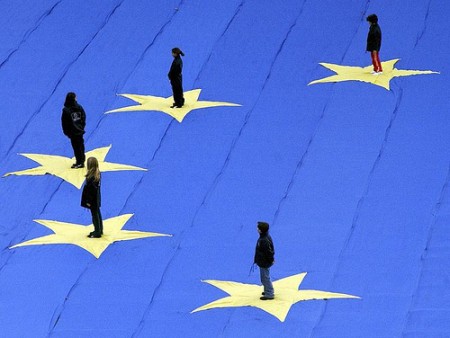
Photo: Council of Europe/flickr

It’s Sweden’s turn to organize the annual European Security Research Conference under its Presidency of the EU. The conference will be held in Stockholm 29-30 September 2009 bringing together around 800 representatives from research, industry, European institutions, public authorities and the security sector. This is the event of the year if you’re going to influence the shaping of policies and research options for Europe’s future.

As the world’s leading open access information service for international relations and security professionals, the ISN naturally attends this event. A series of promising European research projects will be discussed in Stockholm and we look forward to contributing our expertise and reach out to an ever wider audience. More news will follow.

Crossmedia Campaigning

Only three days left for 62.2 million eligible Germans to vote to elect a new parliament which, many fear, is likely to result in more of the same, a CDU-led grand coalition government together with the SPD. Out of those 62.2 million, about 3.5 million voters will cast their ballot for the very first time, with around 2.8 million of them members of one of Germany’s leading social networking forums: StudiVZ, SchülerVZ and meinVZ.

Given the dramatic twist of 2002’s German general election when the SPD won with a mere advance of 6.027 votes compared to the CDU/CSU, the attitudes of some millions of voters illustrate that in a democracy every vote counts.

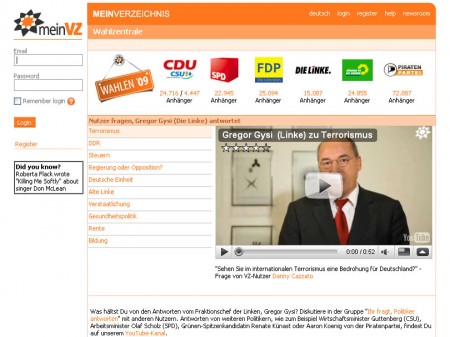
So how to best trace the hard-to-predict political attitudes of young voters? Right, start a massive crossmedia offensive with social networks, public television stations, newspapers, Twitter and YouTube working hand-in-hand to provide a platform with the hardly web 2.0-compatible name of “Erst fragen, dann wählen” (= ask first, then vote).

Fine, let us “ask first” then…

Screenshot of the "Erst fragen, dann wählen" website

ISN Weekly Theme: UN (Ir)Relevance

UN-toilet-paper
Photo: Bernardo Londoy/flickr

On the occasion of the 64th UN General Assembly the ISN asks whether the UN makes a difference in world politics.

In the ISN podcast this week, I ask Ambassador Christian Wenaweser of Liechtenstein to evaluate the work of the UN. Due to the media’s focus on peace and security, people tend to neglect the UN”s activities in the fields of human rights and development, says Wenaweser.

The UN faces management problems. The five permanent members of the Security Council are unhealthily influential, and this is not only in the Council. Yet, according to Wenaweser, the organization has achieved much, for example in responding to the 2004 tsunami disaster or in promoting international criminal justice.

What else do we offer on the UN?

  • Security Watch features a story by Radio Free Europe/Radio Liberty on the vast agenda facing UN leaders at the 64th General Assembly.
  • In our policy briefs section Eric Rosand of the Center on Global Counterterrorism Cooperation examines the strengths of the UN’s Terrorism Prevention Branch and identifies challenges lying ahead.
  • Rob Jenkins of the Crisis States Research Centre writes on the two-year old UN Peacekeeping Commission and its role in disseminating international norms, in our publications section.

This and more you’ll find on the ISN website.

Categories
Audio/Video

International Relations Podcasts- The Best and the Brightest

At home or on the go- podcasts, photo: _Morrissey_ /flickr

In the same vein as our list of interesting international relations actors on Facebook, we put together a list of interesting audio sources for you to explore (again, in random order).

1. Council on Foreign Relations Podcasts

2. London School of Economics Public Lectures and Events Podcasts

3. UCLA Burkle Center for International Relations Podcasts

4. World Radio Switzerland Podcasts on International Relations

5. The Economist Audio and Video

6. Carnegie Council Podcasts

7. C-SPAN Radio

8. New York Times World View Podcast

9. BBC Radio From Our Own Correspondent Series

10. World Politics Review Podcasts

Some, like C-SPAN, provide a live stream of congressional events, speeches and hearings (often on foreign affairs); others offer insights into current affairs drawn from expert interviews, while the Economist, for example, provides audio summaries of their Special Reports and a weekly podcast outlining the key events to look out for in the days ahead. The London School of Economics and the UCLA Burkle Center for International Relations provide audio and video files of speeches and public lectures held at the schools on a wide variety of topics and often by high profile speakers.

And remember that we can also be found on the audio airwaves – enjoy ISN podcasts at home or on the go!

Any other podcasters that deserve a mention?