Categories
Uncategorized

The Lisbon Treaty, Back in Fashion

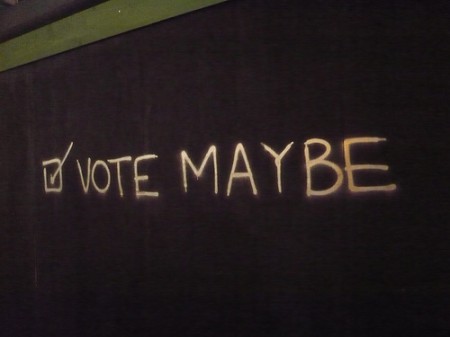
Vote Maybe to Lisbon- a recipe for more confusion? Photo: Tom Phillips / flickr

Today, 2 October, in an event likely to be a defining moment in the slow evolution of the European Union, the Irish are voting in a second referendum over the fate of the Lisbon Treaty. The Treaty, which aims to transfer more power to the EU and to streamline operations to match the new challenges faced by the Union as one unity, was rejected last year in Ireland in a campaign that brought emotive issues such as abortion into a debate over a legal document riddled with Euro jargon. The ingenious motto of the ‘No’ camp was, befittingly,  “If you don’t know, vote no.” It was more like, “If you don’t know- we’ll invent something for you”.

There were more than a few muted smiles around, particularly among Conservatives in neighboring England, when the Treaty was rejected. A pet project of more Eurocentric nations like France and Germany, the Treaty was received with hostility in smaller countries, and in traditionally Euroskeptic circles, where fears of political unaccountability and loss of control dominated EU-related debates.

But Europhiles persisted and pushed Ireland to think again. Bullying or not, the Irish were encouraged to reconsider and seem to have changed course. With familiarity comes acceptance and with acceptance a sense of purpose more in line with the majority of member states that have already, mostly through parliamentary ratification, accepted the Treaty’s status as the foundation of a new and improved Union.

Although much still depends on the staunchly Euroskeptic Czechs (their president more specifically) and possibly a soon-to-be Tory government in Britain (general elections there are set for the first half of 2010), a ‘Yes’ vote would mark a dramatic U-turn for the Irish in terms of the majority’s views of the EU and its future.

What gives?

Existential.yu

Graphic: Wikipedia/ISN

The break-up of Yugoslavia (in all of its incarnations) is now, it would seem, official. As of today, 30 September, websites using the .yu domain extension will be no more, thus ending any existential Yugoslavia debate.

Henceforth, there will be less ethno-nationalist website mystery: Serbian websites will be .rs; Montenegrin websites .me; Bosnian websites .ba (though here some mystery will persist as users will still be unsure without further investigation whether a particular website is from the Bosniak- and Bosnian Croat Federation entity or the Bosnian Serb-dominated Republika Srpska entity); and so on.

For many this may be a day of electronic mourning. Indeed, it is sad to see the last remnants of Yugoslavia erased – however small and ephemeral they were – and to be reminded of what has replaced this once thriving socialist republic.

Of course, for many of those who are old enough to have spent much of their childhood and even adulthood under the national Yugoslav banner (generations who arguably use the internet less frequently than their younger ‘countrymen’) this will not mean an end to Yugoslavia. Indeed, one can still find plenty of people who will forever call themselves Yugoslavs. For them, .yu will live on as an ideal rather than a mere nationality, flag or territory (or domain extension).

210 Million Euros for Europe’s Security

Remarkable interest in the ISN at the 4th European Security Research Conference

Europe aims to be the world’s most competitive and dynamic knowledge economy. To this end, the EU set up different framework programs (FPs) to fund research in almost all scientific fields. The budget of the current program (FP7) amounts to the remarkable sum of EUR 1.4 billion – a bunch of golden pots attracting researchers and practitioners from all over Europe.

Those working on the ‘security research‘ theme are currently in Stockholm at the SR Conference hosted by the Swedish EU Presidency. The objective of the security theme is to develop technologies and knowledge to protect citizens from threats such as terrorism, natural disasters and crime while respecting their privacy and fundamental rights. In his opening speech Vice-President of the European Commission Günter Verheugen reminded the representatives of the industries such as Boeing, Saab, Thales or EADS as well as civil servants and academics that technology alone cannot do the job pointing to the political and ethical dimension of security research. “Our security must be based on our values,” he stated.

The annual conference is the meeting place for security stakeholders to debate Europe’s research agenda. EU representatives outline the Union’s priorities and expectations to those interested in conducting the research and implementing the results. They then take the opportunity to coordinate their efforts, fine tune their proposals and find new partners to work with.

As a long-standing network for IR professionals offering information on a wide range of security related issues, the ISN is of great interest to the conference attendees. Some require to learn about a specific topic such as energy security, others are interested in joining our partner network, want to write for us or simply learn more about our activities such as e-Learning.

There are also those who know us already. Their compliments are very reassuring of the work we do and motivating to keep up our high standards. “I learnt about you at last year’s conference and am now a big fan of your Security Watch service, ” one of the visitors said.

Lobbying the Political Agenda

Sealing the deal, while setting the agenda? / Photo: thinkpanama/flickr

In mid-September, US President Barack Obama risked tense bilateral trade relations with China by opting for the imposition of an import tariff on tires. He legitimized his decision by saying that in the tire industry 5,000 jobs had been lost since 2004. Even though the loss of 5,000 jobs is bad for the economy, its repercussions are relatively minor compared to when tens of thousands of people are getting fired in the financial sector. The question of why the US wants to instate such a tariff remains.

The International Centre for Trade and Sustainable Development (ICTSD) gives the answer, noting that the United Steel Workers union (a US labor group) strongly acted for the imposition of the tariff to which Obama eventually agreed to.

The possible influence of lobby groups on the US political agenda is of particular interest. President Obama resisted support from such groups during his campaign, yet lobbying has always been an integrated part of US politics. Open Secrets, from the US-based Center for Responsive Politics, offers a list of the main industries that donate to political campaigns. Among the top ranking in 2008 were the pharmaceutical, utility and insurance industries as well as the oil and gas industry.

Coincidentally or based on necessity, the reform of the American healthcare sector is currently one of Obama’s main concerns. Will we eventually see Obama’s future agenda being set by these other industries? Moreover, Obama’s campaign enjoyed crucial support by various labor unions, with memberships comprised of domestic blue-collar workers and potential opponents to global free trade. Their influence on the democratic agenda has yet to fully unfold. If it does, bilateral trade with China might take another blow and the US might prompt other states to follow its lead to regulate and close down their economies against foreign influence.

Frantic in Zurich

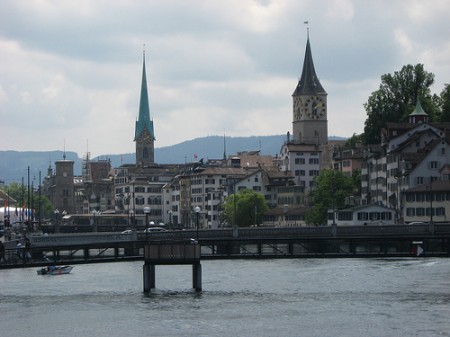
Zurich, Switzerland, courtey of Zug55/Flickr
Zurich, Switzerland, courtesy of Zug55/Flickr

Roman Polanski went missing in Zurich upon his arrival for the Zurich Film Festival.

The festival’s welcome comittee waited in vain at the airport for the director of such brilliant films like Rosemary’s Baby (1968), Chinatown (1974) and The Pianist (2003). He received an Oscar in absentia for the latter; in absentia because he has been a fugitive from US justice since 1978 when he pleaded guilty to having drugged a 13-year-old girl and forced himself upon her.

Instead of facing jail time, Polanski escaped to France, where he was safe from extradition to the US. Since then Polanski has been very careful not to travel to countries where the long arm of US justice might reach him.

However, this finally happened on Saturday when Zurich police arrested the 76-year-old on an international arrest warrant. It didn’t take long for the Swiss art and film scene to decry and condemn the move as “a slap in the face for the entire cultural community in Switzerland.”

Conspiracy theorists quickly pointed out the fact that Polanski had traveled to Switzerland before and even owns a house in the fancy mountain village of Gstaad. They believe that Switzerland wanted to suck up to the US authorities after the legal troubles of UBS and the attack on the country’s banking secrecy laws.

These theories however are probably complete nonsense.