Test your knowledge of Aussie foreign affairs, the topic of our latest Special Report.
[QUIZZIN 35]
 CSS Blog Network
Test your knowledge of Aussie foreign affairs, the topic of our latest Special Report.
[QUIZZIN 35]
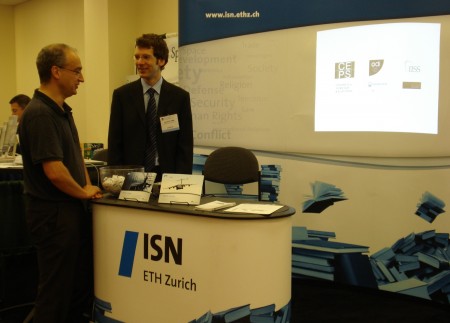
The program of the American Political Science Association‘s (APSA) 2010 Annual Meeting & Exhibition is 400 pages thick. It features hundreds of panels, plenaries, poster sessions and workshops covering topics from women and political research to international security and arms control.
More than 90 exhibitors populate the halls of the Marriott Wardman Park Hotel in Washington, DC. Among publishing houses and research institutes present there is also the ISN. We explain our services, talk to old acquaintances and discuss future partnerships. This is where the International Relations and Security Network really becomes tangible and personal.
I decided to start the day with a panel. Overwhelmed by the choice, one topic caught my interest: The Future of Blogging. Does political blogging have a future at all? Haven’t blogs been replaced already by still newer media such as Twitter, which require less time and allows for more instant communication?
Seven experts, political scientists as well as long-time bloggers talked about their research and experience, but didn’t quite manage to tell the future of blogging. Three ideas I picked up:
If you happen to be at the APSA Annual Meeting visit us at booth 1102 in Exibit Hall B at the Marriott Wardman Park. We look forward to meeting you.
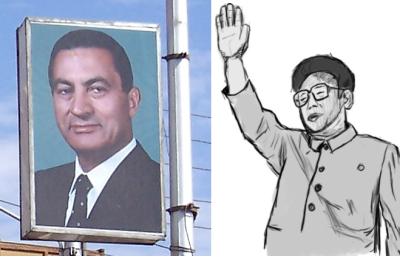
Do you get to bring your offspring to work once a year? Will that inspire them to follow in your footsteps or do they simply enjoy playing with office supplies and promotional freebies?
The world has seen two very inspiring dads in the past week. Hosni Mubarak and Kim Jong-Il have touchingly taken their sons along on their business trips.
Gamal Mubarak got a taste of one of Egypt’s main diplomatic conundrums: Israeli-Palestinian peace negotiations. Let’s hope that he made a good impression in Washington – he seems pretty serious about taking over his dad’s job.
Reports from South Korea signal that Kim Jong-Un has also probably been getting a little field training with his dad. Speculations that Kim Jong-Il introduced him to the Chinese president last Friday have been making the rounds.
Both authoritarian leaders’ health is ailing, but as professional statesmen they are making sure that the succession will be smooth.
Jean Sarkozy must be so jealous. But don’t worry, good old democracies offer hereditary career possibilities, too. Just ask Uncle George for advice.
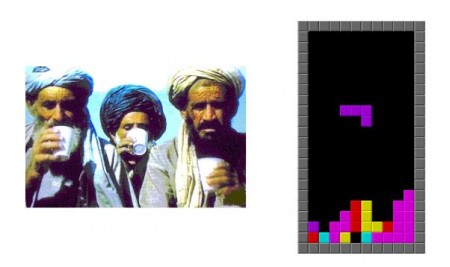
A video game recently created a big stir. Medal of Honor 8 allows you to play the role of a Taliban in Afghanistan and to fight against ISAF forces and the US Army. To their defense, the creators are saying that in any video game you should be able to play the role of the good guy and the bad guy. For example, in all World War II video games, you can to play the role of a German soldier.
Some are saying that Afghanistan is “too fresh” to allow people to play the role of a Taliban, and after all, Electronic Arts, the creator of the game, is part of the “western camp” and should support the “western cause” in its video games. In other words, they should have created a new America’s Army, the official video game of the US Army, with a real-life sign-up process built into the game’s menu.
The US Army, of course, is not the only entity that uses video games to promote itself.
Some political organization, like Hamas, have produced their own video game where you have to make your way through refugee camps and shoot at Israeli soldiers.
But video games are also not new to the world of politics and conflict.

Although it has a booming economy and holds a strategic position in the Asia-Pacific, Australia is often overlooked as a regional powerhouse. As geopolitical power shifts East, Australia’s foreign policy posture will become more prominent and the pressures to get policy right will grow. This week the ISN takes a closer look at Australia.
The Special Report contains the following content: