
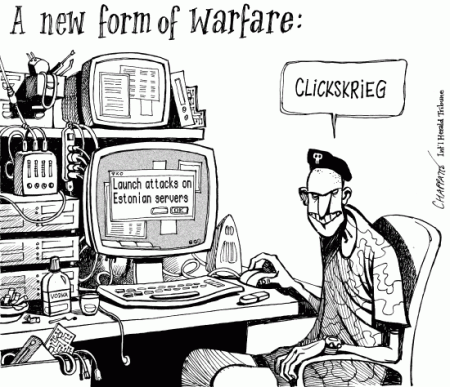
“Cyberguerillas” on the March

Cyberwar? © Chappatte/Globecarton
Cyberwar? © Chappatte/Globecartoon (permission to reproduce granted by creator, 10.12.2010)

Fans of WikiLeaks have launched numerous, high-profile Denial-of-service attacks (DDoS) on sites that turned against WikiLeaks recently. Targets as varied as Sarah Palin, Mastercard, the Swedish government, and the Swiss bank Postfinance have come under attack for either criticizing WikiLeaks or for refusing some services to Julian Assange.

I don’t know the details of all the services that have been refused to Assange, but in the Swiss case, Postfinance closed down the Swiss bank account of Julian Assange because Assange had provided a fake postal address in Geneva. The bank simply followed normal procedures vis-a-vis account holders that provide false information. The client may have been high profile, but the procedure was normal.

In revenge for a variety of acts designed to curtail WikiLeaks’ space for maneuver by the above-mentioned institutions, a group, calling themselves „Anonymous,“ has been waving a kind of cyberbattle in the name of free speech and in support of WikiLeaks. These attacks by “Anonymous” are problematic for several reasons:


Connections Count

The spectre of homegrown attacks, photo: Josh Gross/flickr

America and Europe have experienced a string of terrorist attacks perpetrated by “homegrown” terrorists. But the term “homegrown” is often conflated with “independent”. There are in fact two types of homegrown terrorists: those with external support and guidance and those without. In recent years a clear pattern has emerged. Technically sophisticated attacks, such as the 7/7 attacks in London and the airline liquid explosives plot, have with almost no exception been carried out by terrorists who where homegrown, but had received substantial training and guidance from terrorist groups outside Europe, usually based in Pakistan. Terrorists who lacked the connections to established terror networks had to resort to more primitive methods such as shooting or stabbing.

This importance of hands-on training has been neglected in the hype surrounding “homegrown” terrorism. It turns out that it is more difficult than it was once believed to teach bomb making and other essential terrorist skills over the internet. One indication for this is that intelligence agencies still presume that there are only a limited number of proficient bomb makers within al-Qaida’s ranks.

The internet, however, does play a role in radicalization processes. In May 2010 British student Roshonara Choudhry tried to stab MP Stephen Timms for his support of the Iraq war. When interrogated by the police shortly after the crime, she said that video sermons by the radical preacher Anwar Al-Awlaki, who resides in Yemen, had prompted her to “punish” Timms. She had also consulted an Islamist website which had called on Muslims to “raise the knife of Jihad” against MPs who had voted for the Iraq war in 2003. There is no question that Choudhry was not radicalized solely by watching a couple of videos featuring Al-Awlaki, but it is reasonable to assume that these contributed to her decision to attack Timms.

Fighting for Moderation

Fighting for Moderation in Islam, photo: Asim Bharwani/flickr

Too often we associate moderation with the supposedly weaker qualities of leadership: compromise, pragmatism, process over substance. In the context of the theological and public relations battles fought over the essence of Islam in recent times, it is hard to disagree that the extremists have been most effective in promoting their brand of violent fundamentalism.

But the battle is not over. In fact, for the moderate majority, the secret weapon may have arrived. He is Muhammad Tahir-ul-Qadri, the Islamic Shaykh and PhD holder who I was fortunate enough to hear speak recently at a US Institute of Peace event in Washington DC. He rose to prominence in March 2010 when he published his ‘Fatwa against Suicide Bombings and Terrorism’, though in fact his entire life has been one of public service and religious devotion – driven by a rigorous commitment to the peaceful tenets of his faith.

His resume is inspiring: Pakistan’s leading Islamic scholar with over 400 books published; a world renowned Islamic jurist and adviser to the Supreme Court of Pakistan; Chairman of the Board of Governors of Minhaj University in Lahore. Most consequential is his founding of Minhaj-ul-Quran International, whose educational branch has established over 570 schools and colleges in Pakistan, and whose humanitarian wing has sought to spread the message of peace around the world by building centers in more than 90 countries.

Categories
Uncategorized

New ISN Partner: European Space Policy Institute

European Space Policy Institute

We are happy to announce that the European Space Policy Institute (ESPI) has joined the ISN partner network.

Based in Vienna, ESPI provides decision-makers with an independent view and analysis on mid- to long term issues relevant to the use of space, according to its mission. The Institute, led by Prof Dr Kai-Uwe Schrogl, supports a network of experts and centers of excellence working with ESPI in-house analysts.

The ISN Digital Library features two publication series from our newest partner and as we go on, more and more ESPI publications will be included:

  • ESPI Reports are in-depth studies, which combine thorough independent analysis with perspective and vision as well as policy advice. See for example Spyros Pagkratis‘s report on  issues and trends in space policy 2009/2010, or the study by Jana Robinson on the role of extraterrestrial transparency and confidence-building measures.
  • ESPI Perspectives are short papers, presenting concise analyses and commentary or innovative ideas in the field of space policy. See for example the Perspective by Marcus Hornung, who argues that space might significantly contribute to the creation of a European identity, or the one by Max M Mutschler, who applies lessons learned from the Ottawa process to space-based weapons control.

We are honored to welcome ESPI as a partner. It will significantly enrich our information services in the areas of space policy and space security.

Categories
Uncategorized

ISN Insights: Look Back, Week Ahead

New ISN Insights week starts today, photo: Caro's Lines/flickr

Last week, ISN Insights focused on global health issues:

This week, we will be examining: Bosnia’s political outlook, nuclear weapons proliferation, the impact of ‘currency wars’ on Africa, corruption and much more.

Make sure to tune in each day for the newest ISN Insights package. And if you’re an active Twitter or Facebook user, look us up and become a follower/fan!