
Fund Peace, not War

Tunnel, courtesy of twicepix/flickr

Back in the days when I was practising for my driving test came the moment to overcome my first tunnel. There are lots of these in Switzerland, and they tend to be rather long… My teacher warned: “Don’t look at the wall, or you’ll crash right into it; focus on the middle of the lane instead”.

Indeed, one of our many cognitive biases is to focus too much on immediate dangers, while losing sight of the way out.

The US Congress was contemplating the wall and forgot about the lane when it voted to cut all of the funding for the United States Institute of Peace (USIP) on 17 February.

If you aren’t familiar with USIP yet, I recommend you take a look at their excellent publications series, or at this praise of their field work by Anthony C Zinni, a former commander in chief of the United States Central Command.

Meanwhile, a wave of support for USIP’s work has spread in the hope of persuading the Senate to vote otherwise. Two senior staff members argue here that it makes a lot of economic sense to invest in peace and conflict prevention rather than pay for the wars these efforts contribute to avoid. As Anthony Zinni puts it, “the institute’s entire budget [$43 million] would not pay for the Afghan war for three hours“.

Last autumn, a study by Media Tenor and the Institute for Economics and Peace measured peace reporting in international media. Their detailed case study of Afghanistan demonstrates that media coverage has been focusing on defence and crime, while neglecting news of progress in critical areas needed to build lasting peace.

Lack of visibility is a real problem when it comes to persuading busy non-experts to give you money. On the face of it, “I trained 20 people in negotiation skills this month” doesn’t sound quite as decisive for national security as “I killed an insurgent today”.

Building peace is not spectacular. It’s slow and a lot hard unrewarding work. But it’s still the most efficient way out of the tunnel. Good luck and a lot of courage to our colleagues at USIP!


International Women’s Day Centenary, 1911-2011

Only one in a growing number of proud women. photo: DVIDSHUB/flickr

Today, 8 March 2011, the world celebrates International Women’s Day. This year, nearly 1,500 mass rallies, business conferences, government activities, networking events, craft markets, theater performances, fashion parades, parties, and more around the globe will celebrate 100 years of women’s achievements.

In these 100 years, both women and their International Women’s Day (IWD) have come a long way. The IWD was commemorated for the first time on 19 March 1911 in Austria, Denmark, Germany and Switzerland, following its establishment during the Socialist International meeting the prior year. More than one million women and men attended rallies on that first commemoration. In 1975, during International Women’s Year, the United Nations began celebrating 8 March as International Women’s Day. Two years later, in December 1977, the General Assembly adopted a resolution proclaiming a United Nations Day for Women’s Rights and International Peace to be observed on any day of the year by Member States, in accordance with their historical and national traditions.

Today, the IWD is celebrated as a national holiday in Afghanistan, Armenia, Azerbaijan, Belarus, Burkina Faso, Cambodia, China (for women only), Cuba, Georgia, Guinea-Bissau, Eritrea, Kazakhstan, Kyrgyzstan, Laos, Madagascar (for women only), Moldova, Mongolia, Montenegro, Nepal (for women only), Russia, Tajikistan, Turkmenistan, Uganda, Ukraine, Uzbekistan, Vietnam and Zambia. In other countries, the IWD has the equivalent status of Mother’s Day where children give small presents to their mothers and grandmothers. In most countries, however, the IWD is simply the day for women to celebrate themselves and their achievements. Today, a global web of rich and diverse local activity connects women from all around the world ranging from political rallies, business conferences, government activities and networking events through to local women’s craft markets, theatric performances, fashion parades and more.

Most major events taking place at this year’s International Women’s Day Centenary are listed either on the official IWD website, or on the Women for Women International website. These are thus also the best places to find the IWD events taking place closest to where you are. Furthermore, the IWD is commemorated by the United Nations which continues to run themes on political and human rights, and gender equality, to create social awareness of the struggles of women worldwide. Its official theme for today’s International Women’s Day is Equal access to education, training and science and technology: Pathway to decent work for women.

From their mouths to God’s ear.

For a wealth of background information and analysis on this issue, see our Digital Library holdings under the keywords “women” and “ women’s rights”.

Categories
Uncategorized

ISN Insights: Look Back, Week Ahead

number seven
The new ISN Insights week starts today, stay tuned. Photo: Leo Reynolds/flickr

Last week ISN Insights took an analytical tour through Southeast Asia, Central Asia and the Middle East:

  • On Monday we took a closer look at the storied diplomatic history – and increasingly important ties – between India and Indonesia, thanks to an analysis from Dr Rupakjyoti Borah.
  • Tuesday’s article by the Jamestown Foundation’s Roman Muzalevsky examined the impact that increasing Tajik-Uzbek tensions are having on Iran’s regional economic ambitions.
  • Dr John CK Daly laid bare the rising human, political and fiscal costs of ISAF’s logistical supply missions on Wednesday – in particular how astronomical fuel prices are hampering the battle for Afghanistan.
  • On Thursday, the Center for Security Studies’ Danny Bürkli analyzed the details of the United Arab Emirates’ ambitious nuclear plans.
  • We closed out the week with a round-up of Syria – both its internal political and economic dynamics as well as regional relations – in a Friday podcast interview with the Economist Intelligence Unit’s David Butter.

This week we’ll dive into: how the reformed EU architecture outlined in the 2007 Lisbon Treaty is tackling the Arab uprisings; how the tiny, island nation of São Tomé and Príncipe is handling the big burden of newly discovered oil reserves; the regional impact of Pakistan’s renewed bilateral ties with Sri Lanka; the internal political dynamics propelling a harsh, new government crackdown on freedom of expression in Thailand and much more…

Venezuela – Oil Economy on Slippery Ground

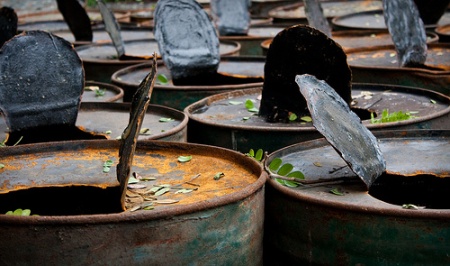
Rusty oildrums, by Gabe/flickr
Oildrums, courtesy of Gabe/flickr

Will Venezuela be next to stumble into a debt crisis – ironically, a country well endowed with the world’s most sought after resource? In its most recent issue, The Economist raises this question, as rumors swirl that the Bolivarian Republic might not be able to repay its international obligations between 2012 and 2015. The possible default of one of the world’s foremost oil producers should give the international community pause although any crisis is unlikely to materialize immediately. However, as soon as oil prices fall considerably below $100 per barrel, the Venezuelan economy will be deprived of its main foreign income, and a debt crisis might not be far behind – possibly threatening  President Hugo Chavez’ long rule.

L’état, c’est Hugo

Despite high oil prices, Venezuelan GDP has been contracting for the last three years and inflation has been over 20 percent since 2007. Exports have been falling steadily and because power and water infrastructure falls short of much needed investment, Venezuelans are often forced to take cold showers. Even productivity in the state-owned oil company PDVSA has decreased by a third since Chavez took power in 1999. Chavez is infamous for his erratic behavior and his dislike of the private sector. During his 12-year rule, he has nationalized hundreds of domestic and foreign companies, closely regulated the economy and eliminated market mechanisms. In this way Chavez has paved the way for widespread corruption and inefficiency. Moreover, he has been governing by decree since December 2010, which grants him almost unlimited power to push through policies without parliamentary control. In Venezuela l’état, c’est Hugo. In this atmosphere of impunity many Venezuelan entrepreneurs have given up their businesses, and foreigners are increasingly reluctant to invest. In a recent country risk assessment Venezuela ranked 93 out of 100 – with civil-war plagued neighbor Colombia ranking a much higher 51.

The Achilles heel

As the government has successfully dismantled the private economy, Venezuela’s dependence on revenues from oil exports has increased, and imports have risen as many goods are no longer produced in Venezuela. Oil production makes up about a third of GDP and generates the lion’s share of the government’s revenue. Fluctuating oil prices are thus the Achilles heel of the whole economy. As soon as oil prices fall, Chavez might find it difficult to keep up public spending and to repay international obligations (net public debt was 29 percent of GDP in 2010). This might not only lead to a debt crisis and hamper economic growth but also to a decline in Chavez’ popularity. With plans to run again for president in 2012, he is in dire need of oil money to subsidize basic goods such as food. Otherwise the poorest will be hit even harder by rising food and living costs, with their incomes eaten up by staggering inflation – perhaps just like Chavez’ personal political future.

* For more information, please see our extensive resources on Venezuelan Energy, Economics, Politics and Security.

New ISN Partner: Chronic Poverty Research Centre (CPRC)

We, the ISN family, gladly announce and welcome the Chronic Poverty Research Centre as a new partner.

The Chronic Poverty Research Centre (CPRC) is an international partnership of universities, research institutes and NGOs that exists to focus attention on chronic poverty. It was established in 2000 with initial funding from the UK’s Department for International Development and is based in Manchester, UK. It aims to stimulate national and international debate; deepen understanding of the causes of chronic poverty; and provide research, analysis and policy guidance that will contribute to its reduction.

CPRC expects its research and analysis to result in policy relevant findings which will be useful to all those working to combat poverty. This includes people in community level organizations, government and official agencies, NGOs, political parties, other researchers, the media, trade unions and the private sector.

The people who should ultimately benefit from CPRC’s research are those whose deprivation is sustained over many years and who are least likely to benefit from current national and international development efforts.

CPRC research themes aim to deepen our understanding of poverty dynamics and, in particular, our consideration of the nature, causes and remedies of chronic poverty, including:

  • Conceptualization of poverty dynamics and persistent poverty;
  • Empirical approaches to the study of poverty dynamics and economic mobility;
  • Empirical approaches to the study of the inter-generational transmission of poverty;
  • Insecurity, risk and vulnerability;
  • Assetlessness, low returns and inequality;
  • Adverse incorporation and social exclusion; and
  • Gender.

In the past, CPRC research has considered:

  • how chronic poverty can best be understood – through measurement,  “participatory” research, or other approaches
  • the characteristics of chronic poverty – in relation to other concepts such as the “ultrapoor”, inter-generational poverty, relative poverty, and durable poverty
  • the causes of chronic poverty, including: culture, social relations, agency and identity.

We are very happy to have the Chronic Poverty Research Centre as part of the International Relations and Security Network and look forward to a fruitful and mutually enriching cooperation.