Serbia’s Bid for EU Candidacy

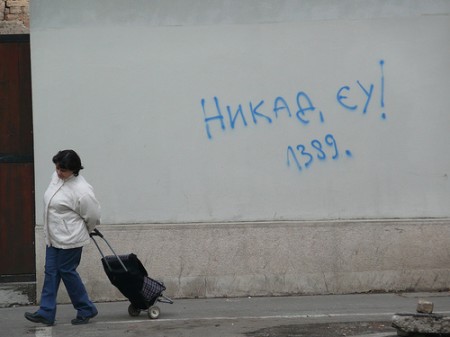
Wall with graffiti: Never, EU!
EU, never? Wait and see. Photo: Limbic/flickr

The timing could not have been any better. A few days from now, the chief prosecutor to the International Criminal Tribunal for the Former Yugoslavia (ICTY) will release a report which was expected to paint a damning picture of Serbia’s co-operation with the ICTY, thereby destroying Serbia’s chance of getting EU candidacy status this year. Considering today’s historic arrest of war criminal Ratko Mladic and his expected extradition to The Hague, some people at the ICTY will now have to work overtime to correct the draft report, .

Serbia’s move towards EU accession began back in 2008, with presidential elections and a parliamentary vote both demonstrating the appeal of the EU perspective to Serbia’s electorate. Even after Kosovo unilaterally declared its independence, a majority of Serbians continued to resist nationalistic demagogy. Of course the nationalist ideology had not disappeared, but its political significance started to diminish.

Serbia officially applied for EU membership in December 2009, after seeking to secure the broadest possible support among member states. In October last year, the EU member states referred Serbia’s application for membership in the EU to the European Commission, while reiterating that further steps toward membership would depend on Serbia’s “full co-operation” with the ICTY. The Netherlands in particular took a tough stance, reiterating that their consent was dependent on the arrest of General Mladic and Goran Hadzic.


100% Green Electricity: the Battle over Investment

Countries look forward to attract investment. Photo: Tim Snell/Flickr

Scotland and Albania want to produce 100% of their electricity from renewable sources by 2020. Their commitment, both prime ministers argue, is not only a huge step towards a more sustainable society but will also comprise the creation of thousands of “green collar” jobs. This is good news for the environment and also for their respective populations. But with little more than 8 years to go, isn’t this target too ambitious for the nations’ actual capacities?

The governments’ announcements come at a crucial moment. Investors have started to shift their business to China, and last month a report by the group CBI warned that the United Kingdom was not attractive for investment in renewables. But the recent disaster at the Fukushima nuclear plants and the long-standing urge for clean energies have shifted public opinion in Europe to make way for a new reality. A second green revolution is building as European countries renew their commitment to clean energies as the way forward.

Nobel Women’s Initiative 2011

Image
Survivors of sexual violence at a women’s centre. photo: Amnesty International/flickr

Yesterday, 23 May, the third international gathering of the Nobel Women’s Initiative opened its gates in Quebec, Canada. This year it carries the title Women Forging a New Security: Ending Sexual Violence in Conflict. For three days, over 120 civil society activists, corporate and security sector leaders, military and peacekeeping personnel, academics from around the world, and numerous Nobel Peace Laureates are convening to discuss strategies for tackling sexual violence in conflict.

Sexual violence in times of war or turmoil is not at all a new phenomenon. Rape has shadowed war for as long as armies have marched into battle. In the past four decades, however, the scale of sexual violence has come to reach almost surreal proportions. While “traditional” warfare was, in the past, characterized by a clash of armed forces, wars have developed more and more into internal armed conflicts. The targets are increasingly often civilians, turning rape and sexual attack into useful forms of war and a core military strategy in conflicts around the world, from Sudan to Burma to Colombia.

Rape is the most intrusive of traumatic events. Sexual violence is as damaging as a bullet. It destroys not only the body of the victim, but the basic social fabric of the community. Where sexual violence has been a way of war, it destroys the way of life. Rape shatters traditions that anchor community values, disrupting their transmission to future generations. Children accustomed to rape and violence grow into adults who accept them as the norm.

Missing Ai Weiwei

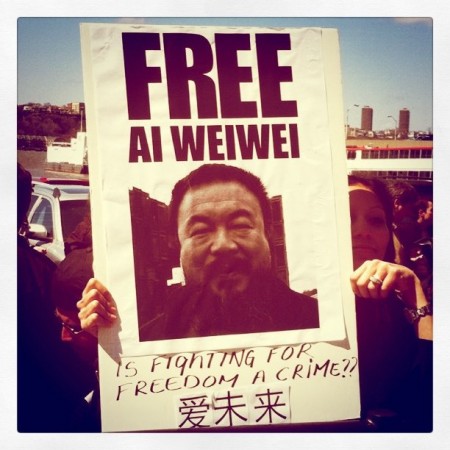
Ai Weiwei Protest in New York: “1001 Chairs for Ai Weiwei” in New York, 17 April 2011.
Ai Weiwei Protest in New York: “1001 Chairs for Ai Weiwei”, 17 April 2011. Photo: Jason B. Chen/flickr

China’s Ai Weiwei has recently been removed from the creative scene. Absent and yet present, he is an artist whose work has become renowned all over the world in recent years.

Special attention was given to Ai particularly because of his creative criticism and involvement in social and political questions concerning China. In 2007, for example, at the Documenta 12, one of Europe’s biggest art fairs, Ai provoked his public by inviting along 1001 Chinese compatriots. His statement was simple yet powerful. Ai’s experiment raised awareness about how China is booming, but at the same time, about how it remains separated from the West.

Despite the regime’s restrictions, new art in China has found diverse channels of expression in the years since 1989, ranging from direct criticism of Western consumption, to mocking stereotypes of Maoist propaganda or to addressing the weaknesses of the communist regime. Ai Weiwei belongs to the latter group of creatives. He is one of China’s best-known artists and at the same time one of China’s most despised dissidents.

Ai’s arrest at the beginning of April 2011 was met with consternation by the international public. Yet the most recent wave of repression affected not only Ai, but the entire Songzhuang art district, in the eastern suburbs of Beijing. This community of artists had elected a suggestive name for their latest exhibition: Sensitive Zone. The exhibition was in itself a provocation, a powerful collection of sensitive subjects, which were not only expected but also surely intended to lead to consequences.

Belgium: Time to Move Forward

Working on common features. Photo: Everjean/flickr

No more caretaker government, demands the King of Belgium. After almost one year of failed attempts to reach an agreement between the French and Dutch-speaking parties, King Albert II has officially asked Elio di Rupo, a French-speaking socialist, to lead a government.

For too long both communities have been struggling over the country’s institutional set up. Several negotiators attempted to break the deadlock, but without success. Now everyone, including the King, is tired of the impasse and Elio di Rupo will receive a second chance to break the cycle.

Last year he failed to create a government coalition, but his role will be slightly different this time. Until now the King had only appointed politicians to find a consensus for a new government, the so-called “preformateurs”. Now he actually asked Elio di Rupo to  form his own government and become Prime Minister. A new strategy that triggers a paradoxical feeling: either the situation will soon be solved, or things will get really desperate.

Even if Elio di Rupo succeeds, the real problem will yet have to be solved. The separatist Flemish Nationalist party, which won the largest share of votes in last year’s general elections, will not simply give up on achieving more autonomy. They argue that they are tired of subsidizing the poorest part of the country, French-speaking Wallonia. A state reform appears inevitable.