Categories
Global Voices

Serbia: Controversy Over Draža Mihailović’s Rehabilitation

Serbian officers in the company of a British nurse on the Salonika front. Lieutenant Draza Mihailovic (kneeling). Image from Wikimedia Commons.

Dragoljub Draža Mihailović was a commander of the Yugoslav Army in the Homeland, also known as the Chetnik movement, during World War II. In 1946, he was captured by the communist Yugoslav authorities, convicted of high treason and war crimes, sentenced to death and executed.

The tribunal for his rehabilitation, which began in June 2010 on the request by Draža’s grandson Vojislav Mihailović, is nearing the end now. Although the request has been supported by some academicians, professors and politicians, the public in Serbia is divided. For some, Draža Mihailović is an innocent victim, for others, he is a justly convicted collaborator of the occupiers, who committed crimes not only in Serbia, but in Bosnia and Herzegovina and Croatia as well.
Categories
Global Voices

Bolivia: A Serious Bid to Lift UN Ban on the Coca Leaf?

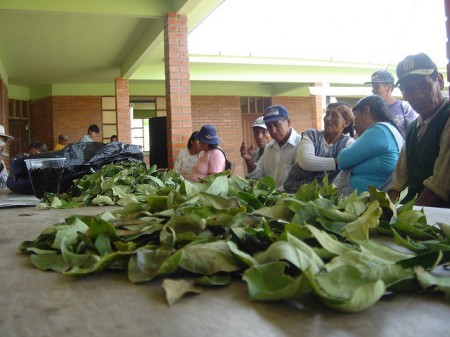
Coca leaves on a table at a coca-growers' meeting. Image by jusada/Flickr.

Demonstrations and public acts, led by both coca growers and traders, took place on Monday, March 12, 2012, in many cities in Bolivia demanding the international depenalisation of the coca leaf.

Local media informed [es] that 40 thousand people were due to join “coca-chewing day” [referred to in Bolivia as acullicu orpijcheo].

These public events are part of the Bolivian government’s international strategy for depenalising the coca leaf, and took place at the same time that President Evo Morales, himself a former coca grower and union leader, was addressing the Commission on Narcotic Drugs at the United Nations Office on Drugs and Crime (UNODC) in Vienna, Austria three years after his last visit.

Categories
Global Voices

Russia: Online Petition Seeks to Increase Controls on Foreign-Funded NGOs

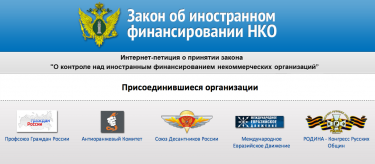
Podkontrol.ru, an online petition calling for stricter controls on foreign-funded Russian NGOs.

Back in early February 2012, Vladimir Putin published the fourth op-ed of his presidential campaign: a lengthy treatise titled “Democracy and the Quality of Government” [ru]. About 1,500 words deep into that article, Putin proposed that the Russian parliament should automatically consider the legislative applications of any online petition successful in gathering more than one-hundred thousand signatures.

No Universal Solutions: The Politics of Biotechnology in Europe and the United States

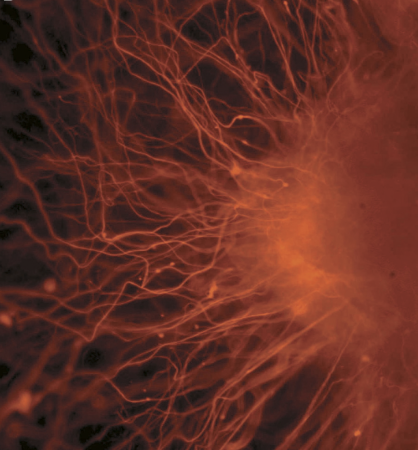
Neurons derived from human embryonic stem cells (hESC). Image from Wikimedia Commons.

In May 2003, the United States and several cooperating countries filed a case at the World Trade Organization (WTO) charging the European Union (EU) with maintaining an illegal, non-science based moratorium on genetically modified (GM) food and crops. Almost three years later, in February 2006, the WTO concluded that EU inaction between 1998 and 2004 had constituted “undue delay” in product approvals in violation of treaty requirements. That decision, however, did not immediately open European markets to American GM products. Indeed, in mid-2010 the European Commission proposed a legally controversial plan to allow member states to decide for themselves whether they wished to grow or ban GM crops—a sign of Europe’s continued inability to harmonize national differences concerning the implications of modern biotechnology for agriculture, environment and trade.

Categories
Humanitarian Issues

Swiss Humanitarian Aid: Sharing Responsibility

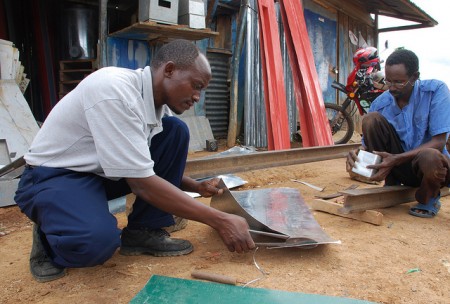
Workshop on making metal silos for grain storage, Kenya. Image from cimmyt/Flickr.

Drought forces thousands of people to cross the border from Somalia to Kenya every day. Violence erupts in a refugee camp in Ethiopia due to insufficient shelter. Rebel groups evict people from their homes. Insufficient water supply causes death and illness. Children turn to painting to depict the trauma caused by the massacres which they have witnessed.

The Annual Conference of the Humanitarian Aid held in Basel on 23 March 2012 addressed these issues under the motto “sharing responsibility” and explored how Switzerland can help to relieve people from such suffering.