Categories
Uncategorized

Making Waves: Debates Behind China’s First Aircraft Carrier

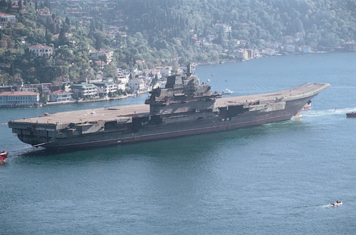
Image by roberthuffstutter/Flickr.

China commissioned its first aircraft carrier, the Liaoning, on September 25, 2012. It was a milestone that owes much to the vision of Admiral Liu Huaqing, who commanded the Chinese navy – formally the People’s Liberation Army Navy – from 1982 to 1988 and served as a vice-chairman of the Central Military Commission until 1997. In those positions, he helped shape China’s maritime outlook and shift its navy from a coastal defense force to one capable of projecting power into the western Pacific. Liu argued that for the navy to fully transform it had to have an aircraft carrier. Ultimately he prevailed over resistance from the army and within his own service, though he did not live to see the Liaoning underway at sea.

While the aircraft carrier is not a revolutionary combat platform today, it remains symbolic of a navy that has reached the world’s first rank. Since China accelerated its naval modernization in the 1990s, its shipyards have produced scores of new vessels that range from nuclear-powered ballistic missile submarines to amphibious assault ships. And over that time, Chinese naval engineers have had many opportunities to study aircraft carrier design—including decommissioned foreign aircraft carriers that Chinese entities acquired as well as the information gleaned from various exchanges. In one such exchange in 1995, Spain’s Empresa Nacional Bazan, which built the light aircraft carrier Chakri Naruebet for Thailand, offered China plans for a similar ship. Chinese officials also inspected and received bids for other retired aircraft carriers, such as France’s Clemenceau in 1996 and Argentina’s Vienticinco De Mayo in 1997.
Categories
Uncategorized

Russia Conducts Large Security Operation In North Caucasus

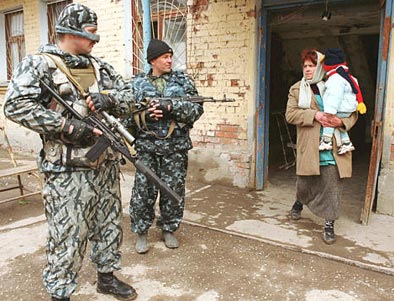
Image by LOreBoNoSi/Flickr.

Russia’s National Counterterrorism Committee (NAK) says that a large operation in the North Caucasus involving forces from the Federal Security Service and Interior Ministry has resulted in 49 militants and bandits being killed, including nine whom the committee called “odious” leaders of militant and outlaw groups.

The NAK reported on October 21 that the operations were carried out in Kabardino-Balkaria and Daghestan.

According to the NAK, four militant leaders were among those killed in Kabardino-Balkaria. It identified them by the names Batyrbekov, Ulbashev, Karkayev, and Tutov.

At least two separate operations were conducted in Daghestan, also leading to the deaths of several men who have been described as militant commanders.

Categories
Uncategorized

Afganistán post-2014: ¿Regresarán los días oscuros?

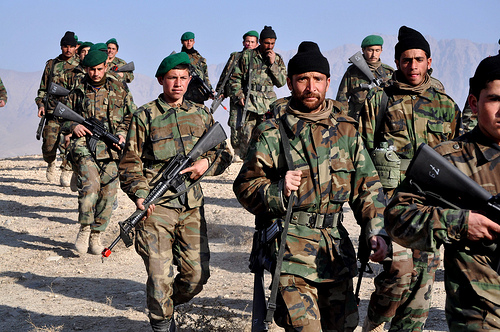
Ejército nacional afgano (ANA). Fotografía de Lt Sally Armstrong, RN / MOD via Helmand Blog en Flickr (CC BY-NC-ND 2.0)

El 07 de octubre del 2012 marcó el 11 aniversario [en] de la guerra de Afganistán liderada por Estados Unidos. Las fuerzas internacionales de combate deben abandonar el país a finales de 2014 [en], pero la guerra sigue siendo una “misión incumplida” [en]. Después de años de conflicto, las fuerzas de la OTAN están abocadas a la responsabilidad de asegurar la entrega del país a las fuerzas armadas afganas. Sin embargo, queda por ver si Afganistán será capaz de mantener el orden y la estabilidad luego de la retirada de las tropas extranjeras.

A raíz del 9/11, los Estados Unidos y sus aliados de la OTAN invadieron Afganistán para desmantelar el régimen talibán y el liderazgo central de Al Qaeda. Tras varias semanas de conflicto, las tropas de la OTAN derrocaron con éxito a los talibanes [en] en varias ciudades y ayudaron a establecer un nuevo país democrático – la República Islámica de Afganistán.

Como resultado, el régimen de los talibanes sigue siendo un recuerdo amargo para la mayoría de los afganos, que no quieren verlos llegar de nuevo al poder.

Afghanistan Post-2014: Will the Dark Days Return?

Will they be able to fight the Taliban after the Americans leave? Photo: Sally Armstrong, , RN/MOD via Helmandblog/flickr

October 7th marked the 11th anniversary of the United States-led war in Afghanistan. International combat forces are due to leave the country at the end of 2014, yet the war has remained “mission unaccomplished“. After years of conflict, NATO forces are set to handover responsibility for securing the country to the Afghan armed forces. However, it remains to be seen whether the Afghan’s will be able maintain order and stability after the withdrawal of foreign troops?

In the aftermath of 9/11, the United States and its NATO allies invaded Afghanistan in order to dismantle the Taliban regime and the core leadership of al Qaeda. After several weeks of conflict, NATO troops successfully ousted the Taliban from various cities and helped to establish a new democratic country — the Islamic Republic of Afghanistan.

L’Afghanistan après 2014: les jours sombres reviendront-ils?

Armée Nationale Afghane (ANA). Photo du Lt Sally Armstrong, RN / MOD via Helmand Blog sur Flickr (CC BY-NC-ND 2.0)

[Liens en anglais sauf mention contraire] Le 7 octobre 2012 a marqué le 11ème anniversaire de la guerre menée par les États-Unis en Afghanistan. Les forces militaires internationales sont censées quitter le pays fin 2014, même si la guerre reste une “mission non accomplie“. Après des années de conflit, les forces de l’OTAN doivent laisser la responsabilité de sécuriser le pays aux forces armées afghanes. Néanmoins, il reste à voir si les Afghans seront capables de maintenir l’ordre et la stabilité après le retrait des troupes étrangères.

Au lendemain du 11 septembre, les États-Unis et ses alliés de l’OTAN ont envahir l’Afghanistan afin de démanteler le régime taliban et le commandement central d’Al-Qaïda. Après plusieurs semaines de combats, les troupes de l’OTAN réussirent à chasser les Talibans de plusieurs villes et aidèrent à établir un nouveau pays démocratique : la République Islamique d’Afghanistan.