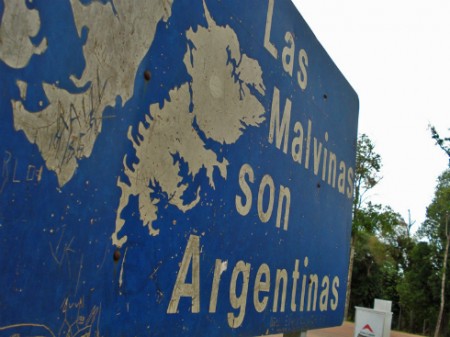
A sign in Argentina reads: ‘The Falklands are Argentinian.’ Photo: Gilmar Mattos/flickr
Next month will determine the eventual fate of the Falkland Islands—and the 1.4 billion barrels of oil so far discovered there—when a referendum on self-determination is held.
In the run-up to that referendum, Argentina has stepped up the rhetoric, most recently with the Argentine Foreign Minister claiming that within 20 years, the Falkland Islands will be entirely under Argentina’s control.
UK Foreign Secretary William Hague has responded by calling this a counterproductive “fantasy”. Hague says the government of Argentine President Cristina Fernandez de Kirchner has refused diplomatic dialogue and chosen instead a path of “bullying”.
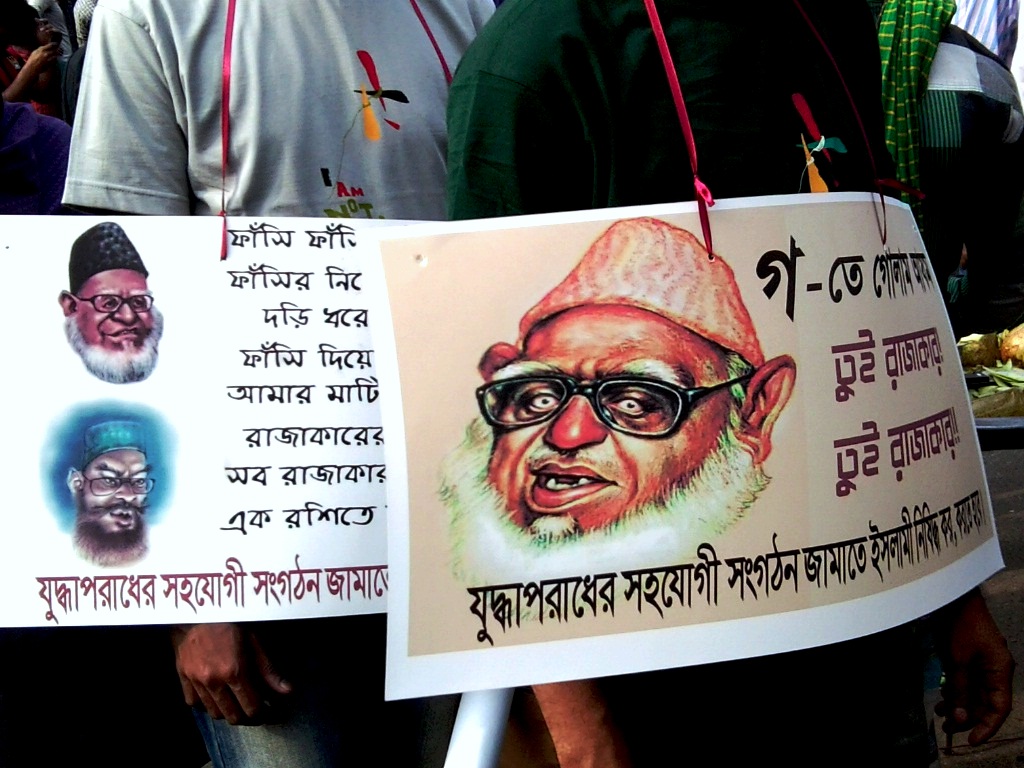
The protesting crowd’s demand “We want capital punishment”. Photo by Arif Hossain Sayeed, used with permission.
Since the beginning of February, hundreds of thousands of Bangladeshis have been occupying a major intersection called Shahbag in the heart of Dhaka, calling for capital punishment for war crimes committed during the country’s liberation from Pakistan in 1971. But what began as a peaceful civic uprising may be taking a turn in the public’s perception as one that contradicts Islam.
While this moment has been in the making for decades, the current explosion of civic activity has a new and youthful character born out of optimism. The vitality and size of the crowd has surprised and delighted. As Shimul Bashar, a reporter for a private TV channel wrote of the #Shahbag protests on Facebook:
President Sata as a victim of the Public Order Act when he was an opposition leader himself. Picture courtesy of Zambian watchdog.
Zambia’s opposition parties have called upon the Commonwealth to suspend the country amid claims of a deteriorating political environment. They accuse Michael Sata’s Patriotic Front (PF) government of using the Public Order Act to severely curtail opposition party activities. Ironically, the Public Order Act was a piece of legislation that the Zambian President had to contend with as an opposition leader. However, since coming to power, he has stated that he has now “fallen in love” with the Act.
Two opposition leaders – the Movement for Multiparty Democracy (MMD)’s Nevers Mumba and United Party for National Development (UPND)’s Hakainde Hichilema – are currently on trial for various political offences covered by Public Order Act. Mumba and Hichilema also attended the recent gathering of opposition leaders in South Africa – known collectively as the Coalition for the Defence of Democratic Rights (CDDR) – that made the demand for Zambia’s suspension from the Commonwealth.
President Sata as a victim of the Public Order Act when he was an opposition leader himself. Picture courtesy of Zambian watchdog.
Les partis d’opposition zambiens ont demandé que la Zambie sorte du Commonwealth, du fait d’une détérioration du climat politique dans leur pays. Ils accusent le parti au pouvoir Front Patriotique, du gouvernement de Michael Sata de recourir à la Loi de sécurité publique (Public Order Act) pour restreindre gravement l’activité des partis d’opposition. Ceci ne manque pas de sel, car Michael Sata, le président actuel, a été victime de cette loi alors qu’il était leader de l’opposition. Depuis son arrivée au pouvoir, celui-ci a déclaré qu’il était maintenant tombé amoureux de cette loi.
Deux leaders de l’opposition, Nevers Mumba du mouvement pour un multipartisme démocratique (MMD) et Hakainde Hichilema du Parti Unifié pour le Développement National (UPDN) sont actuellement devant la justice pour plusieurs délits politiques visés par ladite Loi de Sécurité Publique. Mumba et Hichilema ont assisté au récent congrès des leaders de l’opposition zambienne en Afrique du Sud : Hichilema a déclaré lors d’une conférence de presse que la Coalition pour la défense des droits démocratiques (CDDR) qu’ils ont constituée a fait une demande d’exclusion de la Zambie du Commonwealth.
President Sata as a victim of the Public Order Act when he was an opposition leader himself. Picture courtesy of Zambian watchdog.
دعت أحزاب المعارضة الزامبية الكومنوِلث [بالعربية] لوقف مزاعم الدولة بإفساد المناخ السياسي. اتهموا حكومة جبهة مايكل ساتا الوطنية باستغلال قانون النظام العام لتحجيم دور المعارضة. بطريقة تدعو للسخرية، يعتبر قانون النظام العام جزء من تشريع ناضل ضدة الرئيس الزامبي جمباً إلى جمب مع قادة المعارضة. مع ذلك، منذ توليه السلطة، بدأ “يقع في حب” هذا القانون. [جميع الروابط بالإنجليزية ما لم يُذكر غير ذلك]
يُعرض الآن إثنان من رموز المعارضة – نيفيرز مومبا من الحركة الديمقراطية للتعددة الحزبية وهاكايندي هيشيليما من الحزب المتحد من أجل التنمية الوطنية – أمام المحكمة لعدة إهانات سياسية بسبب قانون النظام العام. حضر أيضاً مومبا وهيشيليما اللقاء الأخير بين رموز المعارضة في جنوب أفريقيا – يعرفون باسم اتحاد الدفاع عن الحقوق الديمقراطية – الذي طالب بتعليق عضوية زامبيا من الكومنولث.
قال هيشيليما في البيان الصحفي: