Lithuanian President Dalia Grybauskaitė participating in a military ceremony. Image: Kapeksas/Wikimedia
Commentators have used Moscow’s tacit support for separatists in eastern Ukraine as an opportunity to speculate whether the Baltic states possess the capability to deter a similar Russian intervention. While this ‘scenario’ is unlikely to happen any time soon, it nevertheless warrants serious consideration given that NATO’s north-eastern flank is home to a sizeable ethnic Russian community. As a starting point, strategic planners in Estonia, Latvia and Lithuania might want to factor Russia’s 2008 military campaign against Georgia into their calculations. Doing so might help them to determine the most effective response for the ultimate ‘worst case scenario’ – an all-out invasion by Russian forces.
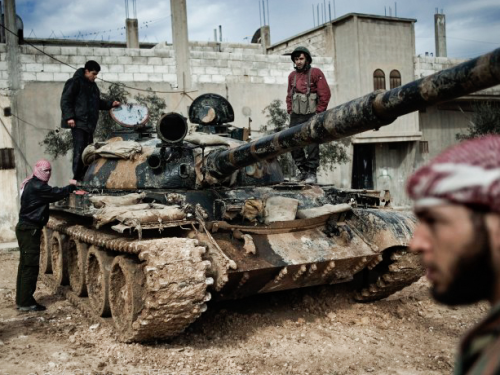
Free Syrian Army rebels preparing for battle. Image: Freedom House/Flickr
Since the start of the Iraq war, the Middle East has been descending into deeper levels of violence. Currently, most of the countries in the region are either suffering from internal conflicts or being affected by other conflicts. And much of the violence in the region is centred in the two least peaceful countries in this year’s Global Peace Index: Syria and Iraq.
The Global Peace Index, produced by the Institute for Economics and Peace, measures peace in 162 countries according to 23 indicators of the absence of violence or the fear of violence. This year’s GPI discusses the ongoing conflicts in the six Middle Eastern and North African countries most affected by conflict. Syria, Iraq, Yemen, Libya, Israel and Lebanon had the highest number of conflict-related civilian and battle fatalities in the region in 2014, and in many cases, that number has been sharply on the rise.
These conflicts have global significance for a variety of reasons, not least because of their fluid nature and increasing intensity. While there is a lot of uncertainty about how events may unfold, what is clear is that the dynamics underlying these conflicts are complex. The fact that each conflict includes numerous state and non-state participants with different tactical and strategic interests only makes the path to peace less clear. The report highlights some of the more important drivers of violence and sets out some of the opportunities for building peace. It includes a detailed discussion of conflict in each country and addresses the following key themes:
The spotlight must be an uncomfortable position for intelligence organisations that would far prefer to remain in the shadows. But since Edward Snowden fled the United States in the summer of 2013, there has been an almost constant drip-feed of stories concerning the operations of the US National Security Agency (NSA) and the UK Government Communications Headquarters (GCHQ). Yet the most recent scoop – originating from Wikileaks – has shown that we would do well to consider these kinds of “revelations” with a little greater care.
At its heart, the claim that the NSA spied on French presidents Jacques Chirac, Nicolas Sarkozy and Francois Holland, effectively boils down to: “country A spied on country B”. As a piece of news, this surely sits alongside the Pope’s status as a Catholic. What else would we expect a national intelligence gathering agency to do? The fundamental purpose of such organisations is to seek out national advantage, in whatever field – whether it is political, economic, military, or otherwise.
Federica Mogherini meeting with John Kerry at the headquarters of the E.U. External Action Service in Brussels, Belgium. Image: US Department of State/Wikimedia
At the start of her term as the EU’s High Representative for foreign affairs, Federica Mogherini moved her office to the Berlaymont building, home of the European Commission. This move was part of her proposed strategy of working more closely with the European Parliament and the Commission and as such was an indication that the new EU foreign policy chief was not going to be catering simply to the Member States.
Since the start of her term she has been faced with growing instability both inside and outside Europe, which demand both short-term crisis responses and long-term strategic revisions. To what extent has Mogherini’s strategy of working more closely with the EU institutions in formulating EU foreign policy been prevalent in what she has done so far as the EU’s High Representative?
The wall of the former US embassy covered in anti-US-murals. Image: Phillip Maiwald/Wikimedia
Those opposed to the nuclear deal currently being negotiated by Iran and the P5+1 typically make a number of criticisms: Iran may still be able to build a bomb at some point in the future; the United States should not ‘allow’ Iran to maintain uranium capabilities; the deal goes against traditional U.S. nonproliferation policy; and so on. Though these critics rarely offer clear alternatives—after all, negotiating a better deal than the current one appears all but impossible—many still favor one option in particular: military strikes against Iranian nuclear facilities. This course of action, however, would be counter-productive. Not only does the current deal with Iran draw on the successful track record of U.S. nonproliferation policy, it was developed in concert with other major powers and international nuclear norms. On balance, it remains the best possible means of affecting the calculus of the Iranian leadership regarding its potential nuclear weapons program. By contrast, military strikes would only increase Tehran’s desire for nuclear weapons and could dramatically shorten the timeframe in which it would be likely to acquire them.