The number of new U.S. asylum applications by Russians has reached its highest level in more than two decades, a surge that immigration lawyers link to the Kremlin’s tightening grip on politics, pervasive corruption, and discrimination and violence against sexual minorities.
Russian nationals filed 1,454 new asylum applications in the 2015 fiscal year ending September 30, up 50 percent from the previous year and more than double the number filed in 2012, when President Vladimir Putin returned to the Kremlin after a four-year stint as prime minister, according to U.S. Department of Homeland Security data obtained by RFE/RL under the Freedom Of Information Act.
It has been argued that the twenty-first century will be ‘God’s Century’.[i] By this it is meant that religion—not God, but religion—will remain a central feature of both international and domestic politics for the next several decades. The basis for this claim can be found in the recent past. Over the last twenty-five years, the world has witnessed an increased level of political activism by religious individuals and organisations. This resurgence of religious politics is evident in the violent sectarianism and exclusive religious identities of the contemporary Middle East, the persistent communalism in South Asia and the continued salience of an illiberal religious politics in the United States and elsewhere. Conceptually, the trend is interesting given the assumptions of secularisation theory, which predicted that the influence of traditional belief systems would diminish with the onset of economic and political development. The persistence of religious politics has also given rise to the view that diplomats, politicians and political scientists all need to better understand religion if they are going to understand contemporary international politics.[ii]
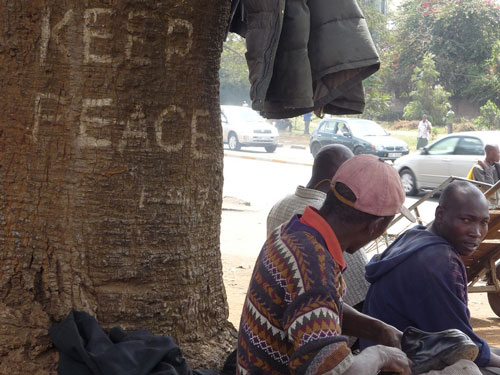
The need for a national framework to guide efforts to prevent conflict and build peace in Kenya cannot be overstated. For a long time Northern Kenya was seen as the most problematic region of the country, with frequent incidents of cattle rustling fuelled by the proliferation of small arms and light weapons. The rest of Kenya remained ‘peaceful’, except for the cycles of political violence that have erupted during every election since the introduction of a multi-party democracy in 1992. The worst political violence was experienced in 2007–08, raising concern about the country’s capacity to deal with such high levels of violence and the effectiveness of its early warning and response, mediation, and security deployment.
North Korea is probably the most corrupt country in Asia. Measuring corruption levels is difficult, and existing ratings (like the well-known index published annually by Transparency International) should be taken with a pinch of salt. Nevertheless, anecdotal evidence appears persuasive enough: Official corruption in North Korea has been exceptional over the last 20 years.
In my frequent discussions with North Koreans, I have discovered the fact that most of them take a high level of corruption for granted. They assume that any official who is in a position to ask for bribes will. In fact, they are surprised if officials refuse bribes. Simply put, corruption is part of the fabric of daily life in North Korea today.
Despite all of the other major foreign policy issues on its agenda, Russia has not forgotten Cuba. Indeed, it appears that Moscow’s strategic interest in this Caribbean island country has grown steadily, despite reported stagnation in their bilateral economic ties (House.gov, October 22). Recently, Russian Deputy Prime Minister Dmitry Rogozin announced plans to establish a signals calibration center in Cuba for Russia’s Global Navigation Satellite System, more commonly known as GLONASS—the Russian equivalent of the United States’ Global Positioning System (GPS). He also announced that Russia may set up an aviation engineering center in Cuba (TASS, October 22). These initiatives are not coincidences or wholly new gambits. Russia has sought to reestablish military bases in Cuba for some time. For instance, in February 2014, Defense Minister Sergei Shoigu announced that Moscow was seeking a network of global naval bases that included Cuba and Nicaragua; and Russia could be discussing similar arrangements with Argentina as well (RIA Novosti, February 26, 2014). Although Moscow’s top diplomat, Sergei Lavrov, denied that Russia was seeking or needs foreign bases, he did admit that his country wants “repair and maintenance stations” for its ocean-going fleet. Yet, at the same time, Shoigu observed that Moscow not only wanted the use of ports for its ships but also installations for the refueling of its long-range bombers (TASS, March 17, 2014).