President Trump and International Relations

The Stinker
Courtesy Maureen Barlin/Flickr. CC BY-NC-ND 2.0.

This article was originally published by the German Institute for International and Security Affairs (SWP) on 18 November 2016.

The election of Donald Trump raises justifiable concerns over how he will handle the crises and conflicts he inherits: war in Syria, conflict in Ukraine, tensions in the South China Sea, North Korean provocations and the fight against terrorism. Yet Germany and Europe – and policy-relevant research – must also examine the broader repercussions for international relations. The following five initial theses require deeper analysis.

A Defeat for Liberalism

Donald Trump’s victory represents a hard knock for the West’s normative bedrock of liberalism. Liberal values of the kind Chancellor Angela Merkel emphasised in her congratulatory message to the president-elect are on the defensive – first and foremost within the United States. Autocrats and supporters of various strands of illiberal democracy, like Putin, Erdogan or Orban, may feel vindicated and energised, while the EU will have to work harder to champion liberal democratic values. European states will inevitably see impacts on their external relations. Although Europe has shown little enthusiasm for talk of the “end of history”, both Europe and the United States have tacitly or explicitly assumed that the liberal democratic models will gradually win the day. Internationally, the EU member states must expect to hear increasing arguments that their form of liberal democracy is only one of several acceptable governance models. This could also have effects on international efforts to stabilise and rebuild fragile and failed states.

Categories
Humanitarian Issues

Beyond Blood Diamonds: The Violence behind the Gold Route

Gold Teeth
Courtesy Jason Taellious/Flickr. CC BY-SA 2.0

This article was originally published by openDemocracy on 25 November 2016.

Illegal gold exchanges between the global North and South are fuelling violence and exploitation, but most consumers are oblivious.

While the violence and exploitation associated with the illegal diamond trade is now widely known, there is far less global awareness of the violence associated with gold extraction. In 2014, an investigative journalism piece documented the illegal gold exchanges between some South American countries and those in the global North—on the one side Colombia, Bolivia, Peru and Brazil, and on the other Canada, the United States, Switzerland, Falkland Islands, Panama, and several European countries. This report found that not only does illegal gold mining adversely affect a country’s tax revenues, it is also directly related to human trafficking—particularly of children—and the perpetuation of conflict by funding armed groups.

While mining in general creates various problems (e.g., contamination of water sources, displacement of local populations), these problems are magnified when mineral extraction is done outside the legal regulatory framework. At this point it is necessary to make a distinction between illegal and informal mining because these tend to be confused.  The first cannot be formalized due to certain characteristics (for instance, it violates environmental laws or has unsafe labour conditions) that lead to criminal mining. Informal mining, however, is defined by the lack of legal mining titles and often can be formalized eventually. The problem with illegal mining is that the lack of mining titles facilitates gold trafficking.

8 Foreign Policy Questions Trump Needs to Ask

Question mark
Courtesy Bilal Kamoon/Flickr. CC BY 2.0

This article was originally published by the Foreign Policy Research institute (FPRI) on 21 November 2016.

President-elect Donald Trump is in the midst of selecting his national security team. He not only needs to decide the “who,” but also the “how” of national security decision-making. It is unclear whether he will adopt Ronald Reagan’s model of entrusting empowered Cabinet secretaries to handle such matters; follow in Richard Nixon’s footsteps of retaining close control over foreign policy within the White House through the National Security Advisor; or emulate George H.W. Bush’s hybrid “gang” blending both White House staff and senior officials.

Beyond his staffing choices, the president-elect and his counselors must also be prepared to tackle a series of questions about U.S. foreign policy and defense strategy, both to inform his continuing selection of personnel to serve in his administration and to shape his conversations with foreign leaders who are anxious to take the temperature of the new Chief Executive. In addition, his answers will be critical if he wants to link his campaign promises with actual policies.

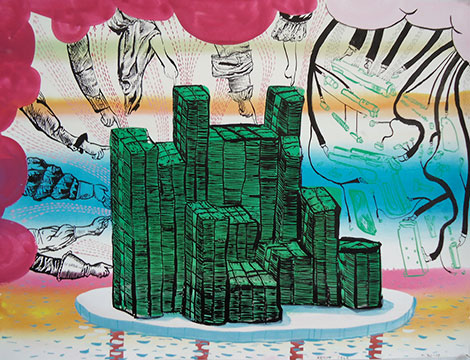
65 Years of Military Spending: Trends in SIPRI’s New Data

Money Pile
Courtesy Kenny Cole/Flickr. CC BY 2.0

This article was originally published by the Stockholm International Peace Research Institute (SIPRI) on 21 November 2016.

Today, SIPRI is launching its new extended military expenditure data—free to download from our website—with consistent data going back as far as 1949.

It may seem curious that, although SIPRI has published military expenditure data almost since its creation, starting with data from 1950 in the very first SIPRI Yearbook of 1969/70, for the past 20 years or so we have only been able to provide data going back to 1988. Varying methodologies meant that we could not guarantee consistency between data collected before 1988 and data collected after 1988, and so no meaningful comparisons between these data sets could be made. Until now.

It´s going to be a Bumpy Ride: The US-led World Order is Tipping Further into Decline

Post Apocalyptic Vision
Courtesy Mary Anne Enriquez/Flickr. CC BY-NC-ND 2.0

This article was originally published by the Lowy Institute on 21 November 2016.

As the Trump juggernaut rolled across the US on election day, turning the political map red, anxious foreign leaders began to contemplate a new world order of a kind few had envisaged.

Could it be that Donald Trump, the quintessential change agent, would administer the last rites to Pax Americana, the US-led rules-based Western order that had prevailed since 1945, thereby achiev­ing what China, Russia and legions of anti-American jihadists had failed to bring about?

German Defence Minister Ursula von der Leyen believes Donald Trump’s shock win signals the end of Pax Americana. Many others agree, among them former Australian foreign minister Bob Carr, who sees the failure of Barack Obama’s signature Trans-Pacific Partnership as ‘symbolic of the dismantling of the post-World War II order in which the US had sought a global leadership role’.