Book Review: The Central African Republic’s Vanishing State

Courtesy of caratello/Flickr. (CC BY-NC 2.0)

This article was originally published by the IPI Global Observatory on 4 May 2017.

The Central African Republic was most recently in the news when armed helicopters assigned to the United Nations mission in the country (MINUSCA) fired at a group of rebels near the town of Bambari. This was deemed necessary to protect civilians from attacks, which has been a central part of MINUSCA’s mandate since 2014, the year in which an armed rebellion ousted then-President Francois Bozize. Bambari marks a frontier between two groups that were part of the Séléka—the rebels that deposed Bozize but have since faced off against each other.

Notably missing from descriptions of this recent incident is the role of the government of CAR itself. Reporters and government officials alike attribute that absence to a “lack of capacity“—the state can scarcely project any presence beyond the capital city of Bangui. A stated goal of international engagement in CAR is to restore and extend state authority and legitimacy, ultimately producing a government able to resolve such insecurity without external assistance. While all involved acknowledge that this is an ambitious undertaking, to fully appreciate its magnitude one must read Yale University anthropologist Louisa Lombard’s account of state-making and rebellion in CAR, State of Rebellion: Violence and Intervention in the Central African Republic.
The Six Day War and the Nuclear Coup that Never Was

Image courtesy of Martin Playing With Pixels & Words/Flickr. (CC BY-NC 2.0)

This article was originally published by War on the Rocks on 29 June 2017.

On the eve of the June 1967 war in the Middle East, a small group of men in the Israeli elite considered a doomsday scenario. They all supported Israel having an overt nuclear strategy, but the dovish prime minister, Levi Eshkol, had resisted. Now, with war looming, they felt that their hour had come. Behind the scenes, these bureaucrats, scientists and officers prepared the ground for using Israel’s ultimate weapon: the nuclear bomb.

Three weeks ago, The New York Times revealed part of that story which the newspaper described as the “last secret” of the Six Day War. The truth is, evidence of these events has been out in the open for several years now. Yitzchak Yaacov, a top scientist who served as a senior officer in the Israeli army, had published his memoirs detailing the deliberations for the secret operation already in 2011. Based on this book as well as several interviews, Amir Oren, military correspondent for Haaretz, wrote in the same year a long analysis of the decision-making process surrounding this chapter in Israel’s history. And in 2014, Oxford University Press published a monograph by Or Rabinowitz that distilled all these Hebrew-language sources into an English-language text.

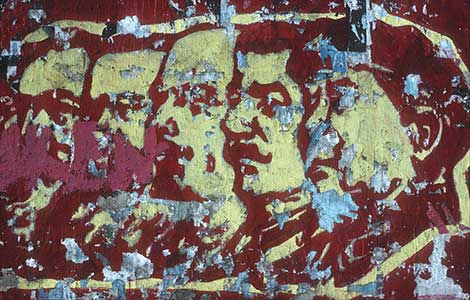
Why Stalin’s Popularity Doesn’t Have to be as Terrifying as it Seems

Image courtesy of Julian Stallabrass/Flickr. (CC BY 2.0)

This article was originally published by the European Council on Foreign Relations on 29 June 2017.

Stalin’s increasing popularity in Russia is worrying, but its importance should not be exaggerated.

This week, yet another poll confirmed Joseph Stalin’s unwavering hold on the popular imagination of Russians. Surveys have documented steadily rising admiration for the Soviet leader in the last several years, but Monday’s open-ended study published by the Levada Center established him as “the most outstanding person” in history, for 38 percent of respondents. Vladimir Putin came in joint second position at 34 percent, alongside the poet Alexander Pushkin.

The poll sounds particularly alarming because instead of answering multiple choice questions, respondents were asked to name the first person to pop into their head – not just Russian, but anyone, anywhere. The fact that for 38 percent of people that was Stalin – without the respondent first being prompted – seems to confirm what many have been fearing for some time: that Russians are steadily forgiving and embracing a tyrant who oversaw a system that slaughtered tens of millions of its own people.

Why Panama Matters

Image courtesy of Nicolas Raymond/Flickr. (CC BY 2.0)

This article was originally published by Pacific Forum CSIS on 27 June 2017.

On June 13, Panama switched diplomatic recognition from the Republic of China on Taiwan (ROC or Taiwan) to the People’s Republic of China (PRC or China). Panama City and Beijing jointly announced that “the Government of the Republic of Panama recognizes that there is but one China in the world, that the Government of the PRC is the sole legal government representing the whole of China, and that Taiwan is an inalienable part of China’s territory.” Panama’s defection should serve as a “wakeup call” for the present administration in Taipei. To be sure, something needs to change.

After learning of the loss of one of Taiwan’s oldest friends, officials in Taipei – including President Tsai Ing-wen – lashed out at Panama for its shocking “betrayal.” Authorities also blasted the PRC for “oppressing” Taiwan. Senior officials even went so far as to threaten that the Tsai administration would consider all of its options while rethinking relations with the Chinese mainland. Paradoxically, anti-China pundits based in Taiwan (and elsewhere) put a different spin on the diplomatic defection. Some argued that the loss of Panama didn’t matter, while others claimed that Beijing had returned to the practice of “checkbook diplomacy” (bribing small countries to switch diplomatic relations). But these interpretations fall short.

Categories
Uncategorized

Understanding the Root Causes of Natural Disasters

Image courtesy of schmid91/Flickr. (CC BY-NC 2.0)

This article was originally published on The Conversation on 27 June 2017.

Every year disasters take lives, cause significant damage, inhibit development and contribute to conflict and forced migration. Unfortunately, the trend is an upward one.

In May 2017, policy-makers and disaster management experts from over 180 countries gathered in Cancun, Mexico, to discuss ways to counter this trend.

In the middle of the Cancun summit, news arrived that large parts of Sri Lanka were devastated by floods and landslides, killing at least 150 and displacing almost half a million people.