The Center for Preventive Action’s annual Preventive Priorities Survey (PPS) evaluates ongoing and potential conflicts based on their likelihood of occurring in the coming year and their impact on U.S. interests. The PPS aims to help the U.S. policymaking community prioritize competing conflict prevention and crisis mitigation demands.
What can one say about the academic study of violent conflict and its implications for the practice of peacebuilding? There is no reason to assume a necessary relationship between these two spheres of activity; the study of armed conflict may or may not have any practical significance for peacebuilding. Of course many scholars in this field are motivated in part by the hope and expectation that their findings will make a contribution, however slight, to the building and maintenance of peace. The editors of Journal of Peace Research articulated this same expectation when, in the inaugural issue of the journal some 50 years ago, they expressed the view that ‘[p]eace research should … concern itself with [the] reduction of violence and [the] promotion of integration.…and should, preferably, have relevance for peace policy’ (Editorial 1964, 2,4).
“[Gen. Martin Dempsey] told American troops based in Japan on Thursday that ‘the best way to avoid war is to prepare for it.’” Associated Press, April 25, 2013.
The idea of “peace through strength” can be traced back to at least Roman times and almost certainly goes back even further, but in U.S. history, it is associated with Ronald Reagan. In his essay, “The Ancient Foreign Policy,” historian Victor Davis Hanson salutes its origins and links this “common wisdom” to the concept of deterrence.
Realism’s theoretical dominance in International Relations (IR) – especially its focus on the power of superpowers and its state-centric view of international society – has been challenged by the collapse of the Soviet Union and the global transformations characterising the post-Cold War era. One of those transformations is the way in which “states neither great nor small” are gaining increased recognition amid the disruptive multi-polarity of the current global disorder. Scholars such as Martin Wight and Carsten Holbraad, whose earlier writings about middle powers were overlooked in mainstream IR, are now acknowledged for their scholarly prescience. Bringing middle powers back into mainstream IR theorising is obviously overdue. There are two problems in the theorising of middle powers in contemporary IR scholarship that obscure their positioning and potential in post-Cold War international politics: (1) its intellectual history has been neglected; (2) “middle power” itself is a vague concept.
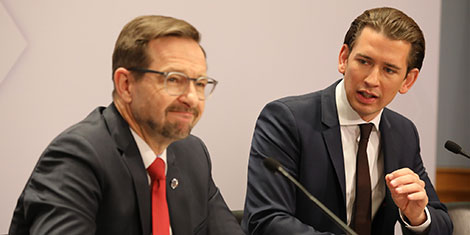
Austria’s 2017 OSCE Chairmanship concentrated on improving the situation of civilians in conflicts, countering the danger of radicalization and rebuilding trust within the OSCE. Yet, deteriorating US-Russian relations prevented substantial successes of an engaged Chairmanship.