North Korean leader Kim Jong-Un’s conciliatory gestures towards South Korea are a welcome move. But they should not belie the high possibility that it will continue ballistic missile and warhead testing in 2018.
China and Russia conducted a six-day military exercise last week. The exercise simulated attacks on both countries from ballistic and cruise missiles. The Chinese Ministry of Defense declined to identify which country was the simulated aggressor in the exercise, but it’s not hard to figure out that it was the United States.
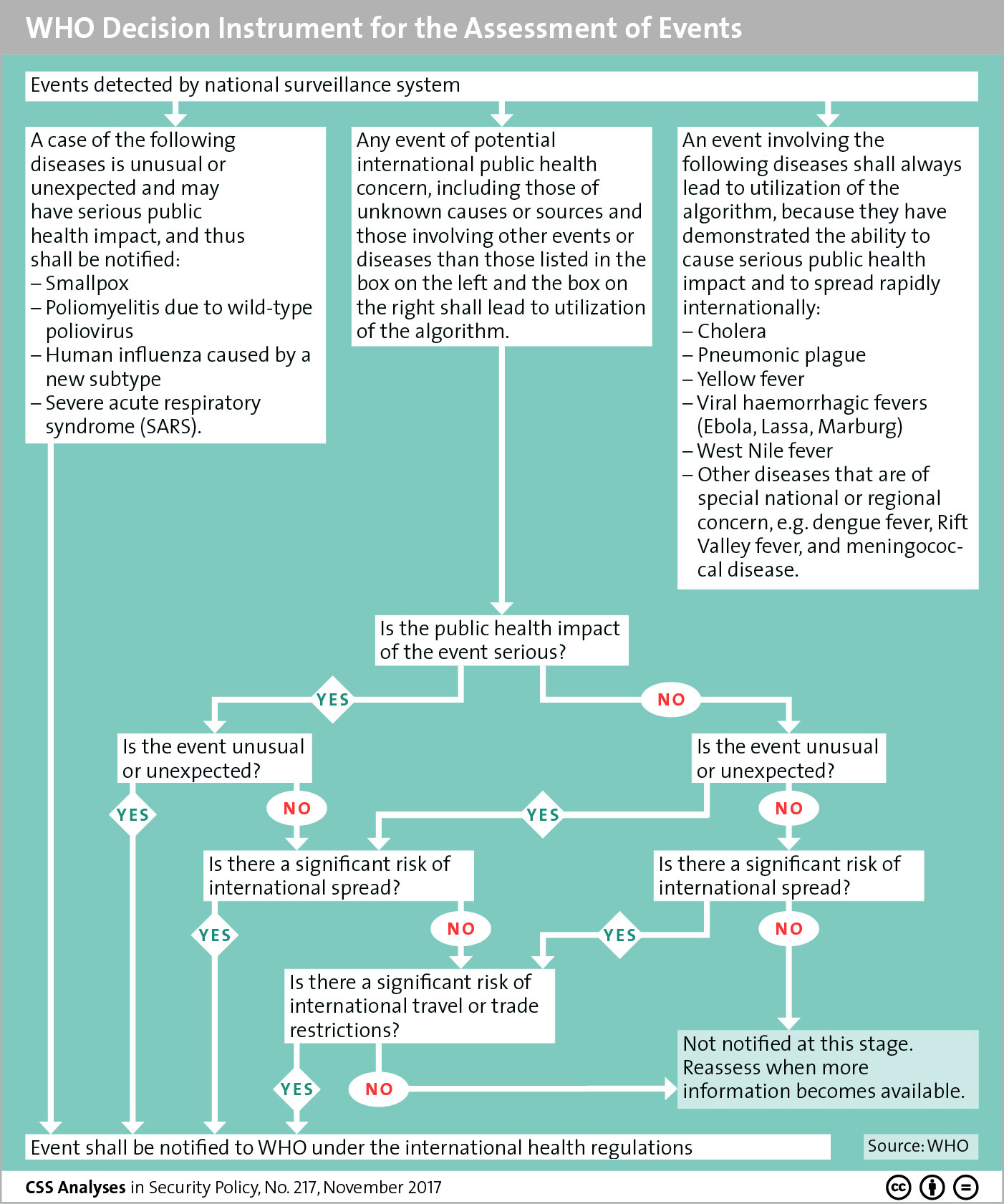
This graphic maps the World Health Organization’s decision instrument for the assessment and notification of events that may constitute a public health emergency of international concern. For more on how the WHO’s international health regulations aim to contain outbreaks in the early stages, see Ursula Jasper’s recent CSS analysis here. For more graphics on international organizations, check out the CSS’ collection of graphs and charts on the subject here.
Mediation Perspectivesis a periodic blog entry that’s provided by the CSS’ Mediation Support Teamand occasional guest authors. Each entry is designed to highlight the utility of mediation approaches in dealing with violent political conflicts. To keep up to date with the Mediation Support Team, you can sign up to their newsletter here.
This is the second blog on temptations of a mediator. The first blog looked at temptations mediators need to resist that pull the mediator in one direction. This second blog looks at temptations that pull you in different directions, thus all the topics have an “or” in the title.
Mediation Perspectivesis a periodic blog entry that’s provided by the CSS’ Mediation Support Teamand occasional guest authors. Each entry is designed to highlight the utility of mediation approaches in dealing with violent political conflicts. To keep up to date with the Mediation Support Team, you can sign up to their newsletter here.
As mediators, we need to be highly flexible and context oriented. It is therefore sometimes easier to focus on what we should not do than what we should do. This focus on the “not” provides more than just parameters in which one can move freely, it also increases an awareness of ‘orange zones’ where we have to be careful as we may end up in a red zone where one can do more harm than good. Lakhdar Bramhimi and Salman Ahmed provide a fantastic write up of this kind of approach in “Seven Deadly Sins of a Mediator.” In particular, the sins Brahimi and Ahmed describe are ignorance, arrogance, partiality, impotence, haste, inflexibility and false promises.