Categories
Uncategorized

Serendipitous Beginnings…

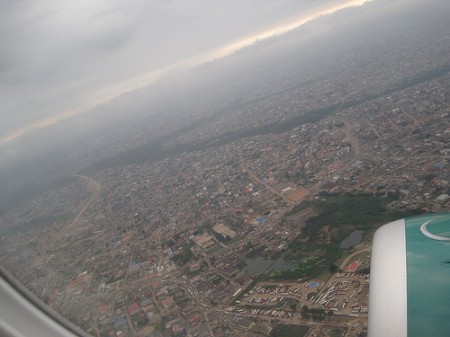
Lagos, Nigeria from the air, photo: Wayan Vota/flickr

This blog post is the first of a series of contributions documenting time spent in southern Nigeria to attend a conference and gather data for the targeting energy infrastructure (TEI) project.

“Was that Wole Soyinka?” I said to myself as I walked passed a man in the Charles de Gaulle airport that looked strikingly similar to renowned Nigerian author, activist, and Nobel laureate. After all, it was barely 2 weeks ago that I was watching a segment on CNN where Christiane Amanpour interviewed Dr. Soyinka on Nigeria’s political stability in light of President Yar A’dua’s deteriorated health and the subsequent stalled peace process in the volatile Niger Delta region where local militants have attacked the energy sector and fought government forces in a campaign for a greater share of oil revenues. In addition to his literary success, Mr. Soyinka is a respected figure in Nigeria where he has been a longtime critic of political corruption and advocate for electoral reform. More recently, he has played a key role in mediating the Niger Delta amnesty process. Needless to say, watching the interview reminded me that this was a person I hoped to meet one day…

Arriving at the gate to catch a flight to Lagos, Nigeria, the same man entered the area and took a seat. After seeing a few people approach and shake his hand, it was clear that this was Dr. Soyinka. Gathering my nerve (yes, I had butterflies), I crossed the room to say hello. As we began to talk (honestly, I don’t think he had a choice since I proceeded to move his bag to the side to make room for me to take a seat), I was thinking to myself how fortuitous it was to meet such an important figure from the very country that I would be spending the next three weeks performing research and attending a conference on security issues in the Niger Delta. Though he may had been wondering to himself “who is this woman and where is the ‘off’ button?”, he was entirely gracious and engaging.

Boarding the plane, energized this chance encountered, I couldn’t help but wonder about the other exchanges that lay ahead. In the coming days I will be interacting with all parts of Nigerian society – ranging from people working in restaurants, students, educators, members from the NGO community and government, to those that have engaged and/or been affected by the militancy and criminality in the Niger Delta. As someone who researches the security issues in this region and the role of the energy sector, I hope to get a flavor of the local perceptions and opinions. In doing so I will document those exchanges and share my observations here.

Next stop, Lagos.
Categories
Uncategorized

The ISN Quiz: The Geopolitics of Turkey

Its pipeline power has made it a country to watch. How well do you know Turkey, the subject of this week’s Special Report? Test your knowledge in this week’s ISN Quiz.

[QUIZZIN 8]

Categories
Uncategorized

ISN Weekly Theme: Turkey at the Crossroads

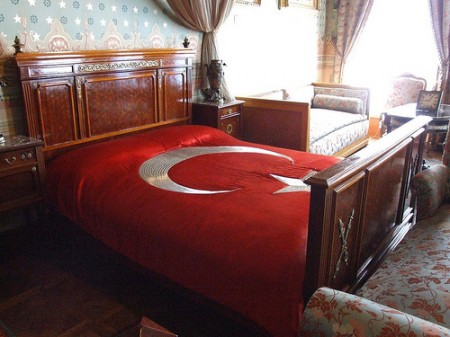
Atatürk's deathbed at Dolmabahçe Palace in Istanbul, courtesy of Serdar Gurbuz/flickr

This week the ISN explores the geopolitical implications of Turkey’s strategic location at the intersection of civilizations. For the first time since its Ottoman glory days, the country appears poised to capitalize on its position at the crossroads of East and West.

In this week’s Special Report:

  • An Analysis by Philip McCrum examines Turkey’s rising geopolitical prowess on the regional and international stage.
  • A Podcast interview with Dr Ali Tekin explores the political gravitas Turkey has gained through its status as a pipeline thoroughfare.
  • Security Watch stories about a brewing military coup scandal, energy pipeline politics, regional relations and much more on Turkish current affairs.
  • Publications housed in our Digital Library, including a recent Atlantic Community paper on how the US and EU are “Seizing Opportunities from Turkey’s Growing Influence”.
  • Primary Resources, like the full text of Ataturk’s speech on the tenth anniversary of the Turkish republic.
  • Links to relevant websites, among them the Central European Journal of International and Security Studies’ analysis of “Turkey’s Strategic Imperatives (2010-2012)”.
  • Our IR Directory with relevant organizations, including the Turkish Statistical Institute.
Categories
Uncategorized

ISN Weekly Theme: At Peace With Rebels

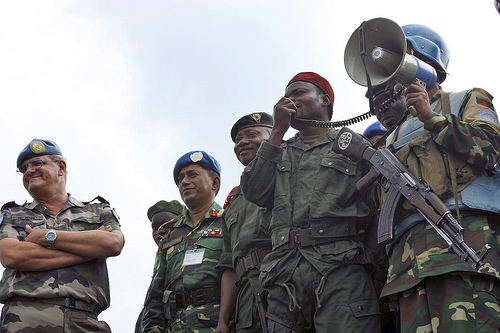
Rebel leader announces the singning of a peace agreement in the DRC
Rebel leader announces the singning of a peace agreement in the DRC, photo: UN Photo/flickr

This week the ISN examines the role of armed non-state actors in conflict environments and peacebuilding processes. From rebel groups to militias, armed non-state actors are key to the course and sustainable resolution of today’s conflicts.

In this week’s Special Report:

  • An Analysis by Dr Véronique Dudouet from the Berghof Center for Conflict Research examines the importance of inclusive peacemaking that addresses the roots of the conflict and facilitates the reintegration of armed non-state groups by offering incentives for political participation.
  • A Podcast with Max Glaser explores the dilemmas facing humanitarian organizations as they try to balance the benefits against the dangers of engaging armed non-state actors.
  • Security Watch articles on India’s Maoist insurgency, US efforts to enlist local militias in the stabilization of Afghanistan and many more.
  • Publications housed in our Digital Library, including a paper analyzing the role of armed non-state actors in peace processes, and a working paper on the importance of foreign military assistance to fragile states facing internal conflict.
  • Primary Resources, including UN Security Council Resolution 1125 on the crisis in the Central African Republic.
  • Links to relevant websites, including an article by the International Committee of the Red Cross detailing instruments and strategies used by non-state actors to respect international humanitarian law during intra-state conflicts in Africa, and a wiki created by Mercyhurst College Institute for Intelligence Studies that provides intelligence analysis on the impact of armed non-state actors in sub-Saharan Africa between 2007 and 2012.
  • And through our IR Directory access to relevant institutions, including the Institute of Peace and Conflict Studies (IPCS).
Categories
Uncategorized

ISN Weekly Theme: Power-sharing

Shaking hands, photo: Aidan Jones/flickr

This week the ISN explores the promises and pitfalls of power-sharing arrangements as they evolve from negotiation to implementation and functional reality.

This week’s Special Report contains the following content:

  • An Analysis by Dr Nicole Töpperwien of Ximpulse examines the delicate progression from armed conflict to power sharing.
  • A Podcast interview with Dr Michael Kerr of King’s College London explores the important negotiating role played by parties external to a conflict.
  • Security Watch stories about power-sharing arrangements from Zimbabwe and Kenya to Tatarstan.
  • Publications housed in our Digital Library, including a recent US Institute of Peace paper on ‘Lebanon’s Unstable Equilibrium,’ following the creation of a power-sharing government led by Prime Minister Saad Hariri.
  • Primary Resources, like the full texts of the Good Friday Agreement and the Zimbabwean power-sharing arrangement between the parties led by Robert Mugabe and Morgan Tsvangirai.
  • Links to relevant websites, among them the BBC-run ‘Search for Peace’, which provides extensive information on the Northern Ireland peace process.