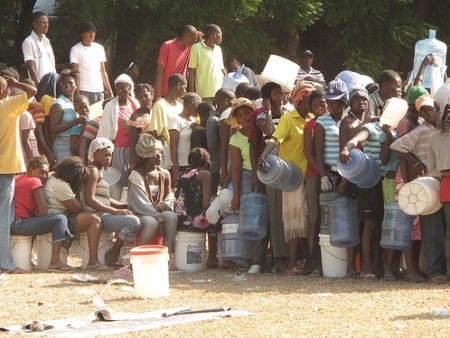
Queuing for water. Photo: Oxfam International/flickr
For many of us, water is such a fixture of everyday life that we take it for granted and even waste it — forgetting that more than 1 billion people in the developing world do not have access to it at all. Today, clean, safe drinking water is scarce. Though a basic human need, so many people around the world spend much of their time searching for it and, too often, failing to find it.
It's week 34 on the ISN's 2011 editorial calendar, Photo: castle79/flickr
This week we’re highlighting the following topics — and so much more:
In ISN Insights on Monday, co-Director of the Center for Economic and Policy Research Dr Dean Baker opines about the failures of European Central Bank policy that have contributed to — and perpetuated — the European debt crisis.
Tuesday’s ISN Special Feature highlights some astonishing facts about water — in the first of a two part series this week on the topic.
In Wednesday’sISN Insights feature, Professor Derek Catsam takes a closer look at South African President Jacob Zuma’s chances for re-election or betrayal — and what his precarious position says more generally about the state of South African politics.
Wrapping up our two part series on water, Thursday’s ISN Special Feature offers up an interactive map on environmental security, with water being a case in point.
And Friday’s ISN Podcast tackles the heady topic of energy security and the exploration of fusion energy as an alternative.
<a rel=”attachment wp-att-20458″ href=”http://isnblog.ethz.ch/?attachment_id=20458″><img class=”size-medium wp-image-20458″ title=”34″ src=”http://isnblog.ethz.ch/wp-content/uploads/2011/08/34-450×358.jpg” alt=”” width=”450″ height=”358″ /></a>It's week 34 on the ISN's 2011 editorial calendar, Photo: castle79/flickr
<strong>This week we’re highlighting the following topics — and so much more: </strong>
<ul>
<li>In <a href=”http://www.isn.ethz.ch/isn/Current-Affairs/ISN-Insights”><em><span style=”text-decoration: underline;”>ISN Insights</span></em></a> on Monday, co-Director of the <a href=”http://www.cepr.net/”>Center for Economic and Policy Research</a> Dr Dean Baker opines about the failures of European Central Bank policy that have contributed to — and perpetuated — the European debt crisis.</li>
</ul>
<ul>
<li>Tuesday’s<em><span style=”text-decoration: underline;”> ISN Special Feature</span></em> highlights some astonishing facts about water — in the first of a two part series this week on the topic.</li>
</ul>
<ul>
<li>In Wednesday’s<a href=”http://www.isn.ethz.ch/isn/Current-Affairs/ISN-Insights”><span style=”text-decoration: underline;”><em> </em></span></a><a href=”http://www.isn.ethz.ch/isn/Current-Affairs/ISN-Insights”><span style=”text-decoration: underline;”><em>ISN Insight</em></span>s</a> feature, Professor Derek Catsam takes a closer look at South African President Jacob Zuma’s chances for re-election or betrayal — and what his precarious position says more generally about the state of South African politics.</li>
</ul>
<ul>
<li>Wrapping up our two part series on water, Thursday’s <span style=”text-decoration: underline;”><em>ISN Special Feature</em></span> offers up an interactive map on water security along the cooperation-conflict spectrum.</li>
</ul>
<ul>
<li>And Friday’s <a href=”http://www.isn.ethz.ch/isn/Current-Affairs/Podcasts”><span style=”text-decoration: underline;”><em>ISN Podcast</em></span></a> tackles the heady topic of fusion energy.</li>
</ul>
<em><strong>And you can catch up on last week’s features here on:</strong> <a href=”http://www.isn.ethz.ch/isn/Current-Affairs/ISN-Insights/Detail?lng=en&ots627=fce62fe0-528d-4884-9cdf-283c282cf0b2&id=131925&contextid734=131925&contextid735=131924&tabid=131924&dynrel=4888caa0-b3db-1461-98b9-e20e7b9c13d4,0c54e3b3-1e9c-be1e-2c24-a6a8c7060233″>Macedonian nation building</a>; <a href=”http://isnblog.ethz.ch/security/international-law-and-the-use-of-drones”>drones and international law</a>; South America’s <a href=”http://www.isn.ethz.ch/isn/Current-Affairs/ISN-Insights/Detail?lng=en&ots627=fce62fe0-528d-4884-9cdf-283c282cf0b2&id=132085&contextid734=132085&contextid735=132070&tabid=132070&dynrel=0c54e3b3-1e9c-be1e-2c24-a6a8c7060233,4888caa0-b3db-1461-98b9-e20e7b9c13d4,40db1b50-7439-887d-706e-8ec00590bdb9″>security dilemma</a>; <a href=”http://isnblog.ethz.ch/calendar/water-conflict-and-female-vulnerability”>water, conflict and gender</a>; and one year after the <a href=”http://www.isn.ethz.ch/isn/Current-Affairs/Podcasts/Detail/?ots591=40db1b50-7439-887d-706e-8ec00590bdb9&lng=en&id=132164″>Pakistani floods</a>.</em>
Woman with water vessel. Source: waterdotorg/flickr
On Monday, August 29th, the Environmental Change and Security Progam (ECSP), part of the Woodrow Wilson International Center for Scholars in Washington, DC, will host a free afternoon event exploring the linkages between water access, gender, and conflict. “Digging Deeper: Water, Women, and Conflict” will be a panel discussion under the auspices of a fledgling ECSP research project examining how these dynamics interact and contribute to human insecurity. If you are unable to attend the event in person, it will also be transmitted live via webcast.
“The meek shall inherit the earth, but not its mineral rights” Photo: theKerb/flickr
If it is true that Marxists “are people whose insides are torn up day after day because they want to rule the world and no one will even publish their letter to the editor,” and also that “few modern ideologies are … as likely to start a third world war as the theory of ‘geopolitics,'” then we may one day look back on the February 2011 forum of the journal Geopolitics — “Towards a Marxist Geopolitics” — as the publisher of those dead letters that would ultimately set the world ablaze.
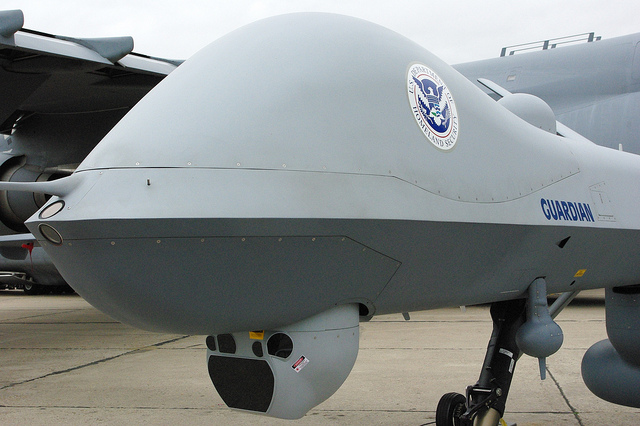
First being used for surveillance, unmanned aerial vehicles (drones) were initially conceived in the early 1990s for reconnaissance and forward observation roles. However, by 2001, the United States started arming drones with missiles and using them in combat operations. Since then, more than 40 other states and entities are estimated to have acquired the drone technology, including Russia, China, Iran, and Israel.
The first known use of a drone to kill a particular individual occurred against Al- Qaeda’s Mohammed Atef in Afghanistan in November 2001. Later in November 2002, a suspected ‘lieutenant’ in Al-Qaeda was killed along with five other persons in a drone attack in Yemen, carried out by CIA personnel. In 2003, the UN special rapporteur concluded that the Yemen strike constituted a “clear case of extrajudicial killing”.
Within states, international human rights law prohibits governments from using excessive force against individual groups; governments may only resort to military force if an armed opposition involves significant force. The normal standards can be found in the UN Basic Principles on the Use of Force and Firearms by Law Enforcement Officials. Despite this clear law, US officials argue that because the 9/11 attacks involved significant force, the US can target and kill Al-Qaeda members and other suspected terrorists and militants without warning, wherever they are found.



 On Monday, August 29th, the