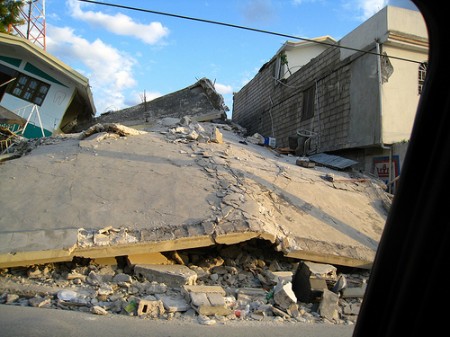
Delmas, Haiti, January 16, 2010 / Photo: AIDG, flickr
In the critical 72 hours following the devastating earthquake in Haiti, the country lacked almost everything: drinking water, food, basic medical supplies, doctors, lifting equipment, power generators, you name it.
But what it did not lack were journalists. A who’s who of reporters from the great cable networks like CNN and MSNBC were on the ground within hours.
This is not a problem in and of itself, had it not been for the fact that the airport outside of Port-au-Prince was partly damaged and over capacity. This caused long delays for rescue teams trying to land there. Some planes providing aid had to be turned away.
Journalists were in many cases the first people from outside the island to venture into the devastated alleyways of the capital city. Many of them took on an active role helping locals to pull earthquake victims out of the rubble. One CNN journalist reported that he gave his granola bar to a starving earthquake victim.
What these journalists-turned-emergency-rescuers did during those critical hours following the earthquake is nothing but human. If you see suffering and are in the position to help, lending a hand is not only the natural but also the ethical thing to do.
Still, it is my guess that the residents of Port-au-Prince would have preferred to see rescue workers with chain saws instead of journalists with camera equipment coming their way.
Before the internet comes the mobile phone / Photo: Esthr, flickr
They are among the most underdeveloped countries in the world. Only a minority of their people has access to electricity. Clean drinking water remains a distant dream. Many of their children continue to die of diseases that have long become extinct here in the West or are easily preventable.
But in one area, developing countries are clearly ahead of the industrialized world: the use of mobile phone applications.
Three-quarters of the world’s mobile phones are believed to be owned by people in developing countries.
In Africa, more people own mobile phones (37 percent) than have access to electricity (25 percent). (Note: Phones are often charged using rather ingenious methods, such as old car batteries). According to one estimate, about a billion people, most of them in the developing world, don’t have a bank account but – guess what? – own a cell phone.
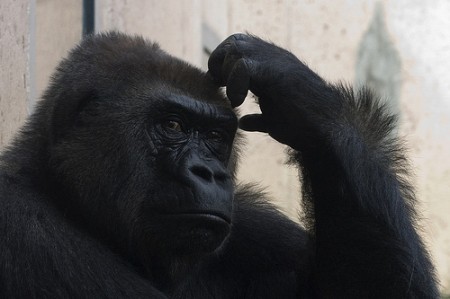
Head scratching gorilla / photo: amuderick, flickr
Forget the complexity of global warming and the diffuse threat posed by global terrorism. Back in the day, problems faced by the international community seemed so much more manageable. During the Cold War, we knew who the bad guys were and where the threats came from. Environmental degradation became an important issue in the 1980s, but the problems we faced still seemed pretty straightforward: to halt de-forestation and soil erosion, we have to stop cutting trees without replacing them; to prevent the whole-sale extinction of endangered species, we have to stop hunting them.
Relatively straightforward also was the first man-made atmospheric problem humankind faced back in the ’80s: the ozone hole.
The culprit, as scientists were able to convincingly show, was a single chemical substance: the ozone-depleting hydrochlorofluorocarbons (HCFCs), widely used as coolants in refrigerators, air conditioners and aerosol cans.
The international community got together in Montreal and agreed to phase out the use of this ozone-depleting substance. The result was the Montreal Protocol, which entered into force in 1987 and was touted by former UN Secretary-General Kofi Annan as ” perhaps the single most successful international agreement to date.”
Since January 1 of this year, developed states are bound by the treaty to cut HCFC consumption and production by 75 percent. The ozone hole is now slowly on the mend and scientists expect the hole to close within 50 to 100 years.
But as all our problems seem to be getting more and more complex in the 21st century, so does the good old ozone hole saga.
According to a recent piece in the New Scientist, the ozone hole over Antarctica is slowing down the warming of Antarctica (and thus the rising of sea levels). This is so because the thinning of the ozone layer is strengthening circumpolar winds that have a cooling effect on Antarctica. Once the ozone hole is closed up, the theory goes, it will trap more hot air and accelerate the melting of Antarctic glaciers.
It almost sounds as if global warming has turned the environmental success story of the 1980s into a no-win.
Or perhaps not? A scientist at Canada’s University of Waterloo, Professor Qin-Bin-Lu, now argues that the straightforward ban of HCFC in fact was more of a silver bullet to man-made atmospheric changes than we could have possibly imagined back in the ’80s.
Indeed, he argues that HCFC, and not CO2, is to blame for global warming all along. His satellite and balloon measurements show that HCFC is tens of thousands of times more potent as a greenhouse gas than CO2 on a molecule per molecule basis. Hence, Lu expects the global phase-out of HCFCs to eventually allow global temperatures to revert back to pre-HCFC levels.
It is an interesting theory, but to me it simply sounds too good to be true. As a member of generation X, I’m used to problems being more complex than that, and I have been taught that there simply is no silver bullet or straightforward solution to the complex global threats out there.
Besides, cutting our CO2 emissions and not burning down our forests still seem like pretty good ideas to me.
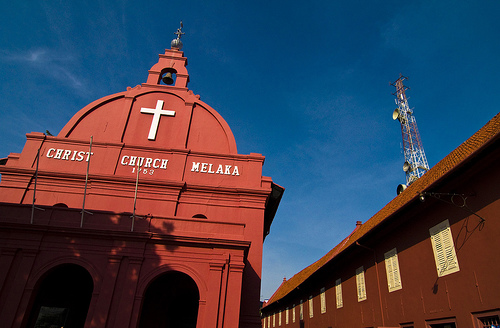
Church in Malacca, Malaysia, photo: HKmPUA /flickr
After a tense weekend, the Malaysian online news media is teeming with commentaries on the controversy regarding the use of the word ‘Allah’ by Christians in Malaysia and the subsequent arson attacks against Christian churches in and around the capital.
The camps, quite predictably, are divided along the pro-Malay, pro-government camp, made up primarily of pious Malay Muslims, devoted to the concept of a Malay-dominated Malaysia and opposed to the use of ‘Allah’ in non-Muslim contexts, and Malaysians (Muslims, Christians and Hindus) who wish to see historically divisive Malay-dominance dismantled and genuine pluralism embraced in its place.
Although Prime Minister Najib Razak was quick to condemn the attacks, even twittering “It’s been a difficult weekend for all. I share your outrage. We must stand united & not allow these incidents to break us,” outrage and dismay over the government’s pro-ban stance is boiling over. So far venting from the pluralist camp has been confined to cyberspace, although it is not so clear how long non-Malay calm will last if ethnic rifts continue to deepen.
In his article for the ISN weekly theme, Dr Markus Schultze-Kraft explains that the “political-ideological rift that divides the region, deep mutual distrust, opposed geopolitical projects and international alliances, and not least the enormously challenging nature of the transnational security threats, such as Colombia’s armed conflict and drug-trafficking, all conspire against regional security improvements.”
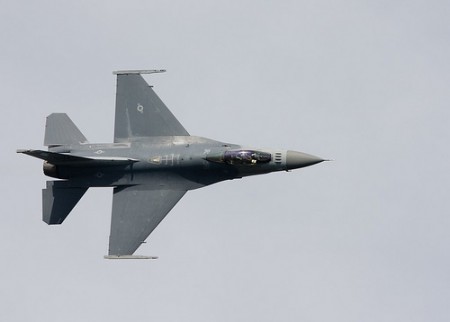
I will not argue against this statement that summarizes perfectly the issues that South America is facing today. I will elaborate on something that has not been mentioned and that is, to me, crucial to the (non-)establishment of confidence and regional security in the continent: the militarization of South American countries.

%26hl%3Den "cellphone")